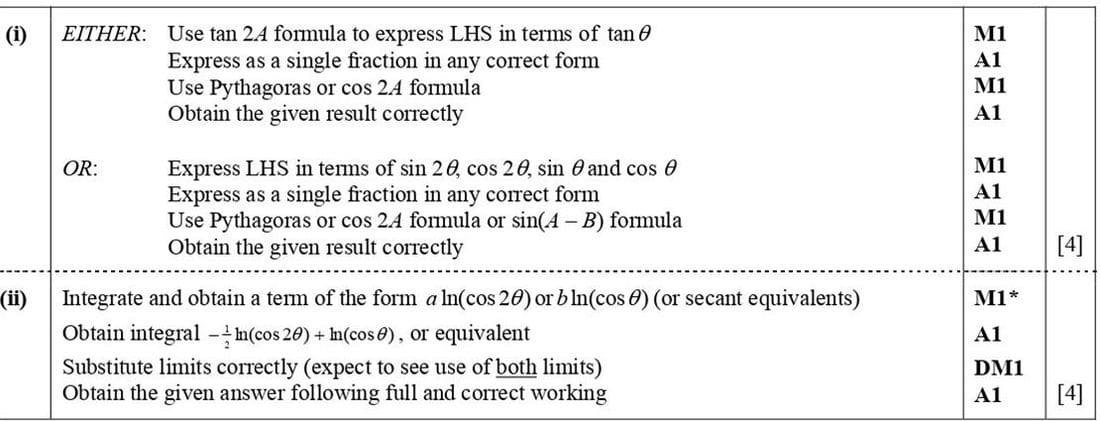
(i) Start with the left-hand side: \(\tan 2\theta - \tan \theta\).
Using the identity \(\tan 2\theta = \frac{2\tan \theta}{1 - \tan^2 \theta}\), substitute:
\(\frac{2\tan \theta}{1 - \tan^2 \theta} - \tan \theta\).
Combine into a single fraction:
\(\frac{2\tan \theta - \tan \theta (1 - \tan^2 \theta)}{1 - \tan^2 \theta} = \frac{2\tan \theta - \tan \theta + \tan^3 \theta}{1 - \tan^2 \theta}\).
Simplify the numerator:
\(\frac{\tan \theta (1 + \tan^2 \theta)}{1 - \tan^2 \theta}\).
Recognize that \(\sec 2\theta = \frac{1}{\cos 2\theta} = \frac{1}{1 - \tan^2 \theta}\).
Thus, \(\tan \theta \sec 2\theta = \frac{\tan \theta}{1 - \tan^2 \theta}\).
Therefore, \(\tan 2\theta - \tan \theta = \tan \theta \sec 2\theta\).
(ii) Consider the integral \(\int_{0}^{\frac{1}{6}\pi} \tan \theta \sec 2\theta \, d\theta\).
Substitute \(\sec 2\theta = \frac{1}{\cos 2\theta}\), so the integral becomes:
\(\int_{0}^{\frac{1}{6}\pi} \frac{\tan \theta}{\cos 2\theta} \, d\theta\).
Use the identity \(\tan \theta = \frac{\sin \theta}{\cos \theta}\) and \(\cos 2\theta = 1 - 2\sin^2 \theta\).
Integrate to obtain:
\(-\frac{1}{2} \ln(\cos 2\theta) + \ln(\cos \theta)\).
Evaluate from \(0\) to \(\frac{1}{6}\pi\):
\(-\frac{1}{2} \ln(\cos(\frac{1}{3}\pi)) + \ln(\cos(\frac{1}{6}\pi))\).
Substitute the values: \(\cos(\frac{1}{3}\pi) = \frac{1}{2}\) and \(\cos(\frac{1}{6}\pi) = \frac{\sqrt{3}}{2}\).
Resulting in:
\(-\frac{1}{2} \ln(\frac{1}{2}) + \ln(\frac{\sqrt{3}}{2}) = \frac{1}{2} \ln \frac{3}{2}\).