9709 P32 - Mar 2018 - Q3
1711
(i) Using the expansions of \(\cos(3x + x)\) and \(\cos(3x - x)\), show that \(\frac{1}{2}(\cos 4x + \cos 2x) = \cos 3x \cos x\).
(ii) Hence show that \(\int_{-\frac{1}{6}\pi}^{\frac{1}{6}\pi} \cos 3x \cos x \, dx = \frac{3}{8}\sqrt{3}\).
Solution
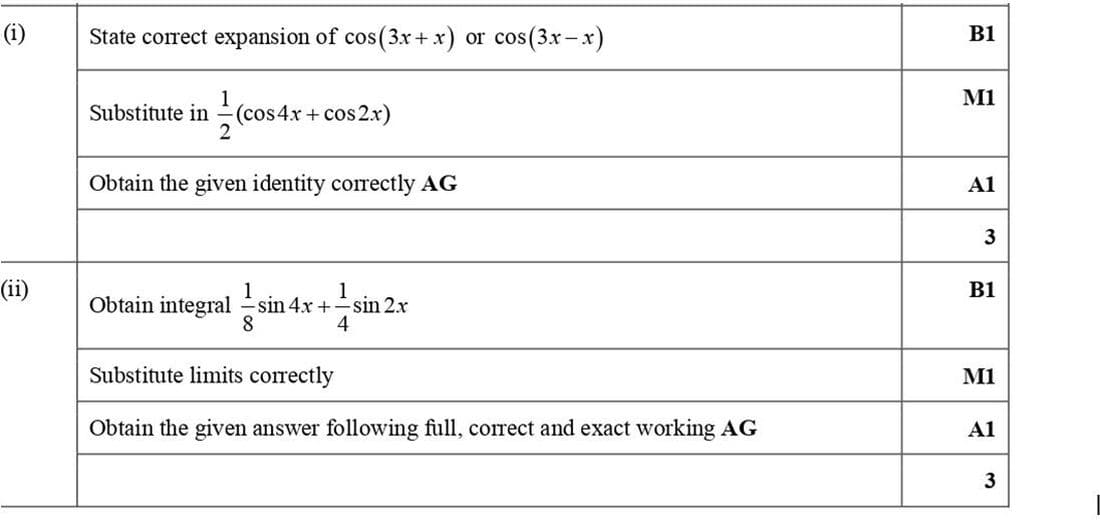
(i) The expansion of \(\cos(3x + x)\) is \(\cos 3x \cos x - \sin 3x \sin x\).
The expansion of \(\cos(3x - x)\) is \(\cos 3x \cos x + \sin 3x \sin x\).
Adding these, we get:
\(\cos(3x + x) + \cos(3x - x) = 2 \cos 3x \cos x\).
Thus, \(\frac{1}{2}(\cos 4x + \cos 2x) = \cos 3x \cos x\).
(ii) We have \(\int \cos 3x \cos x \, dx = \frac{1}{2} \int (\cos 4x + \cos 2x) \, dx\).
Integrating, we get:
\(\frac{1}{2} \left( \frac{1}{4} \sin 4x + \frac{1}{2} \sin 2x \right) = \frac{1}{8} \sin 4x + \frac{1}{4} \sin 2x\).
Substituting the limits \(-\frac{1}{6}\pi\) to \(\frac{1}{6}\pi\), we find:
\(\left[ \frac{1}{8} \sin 4x + \frac{1}{4} \sin 2x \right]_{-\frac{1}{6}\pi}^{\frac{1}{6}\pi} = \frac{3}{8}\sqrt{3}\).