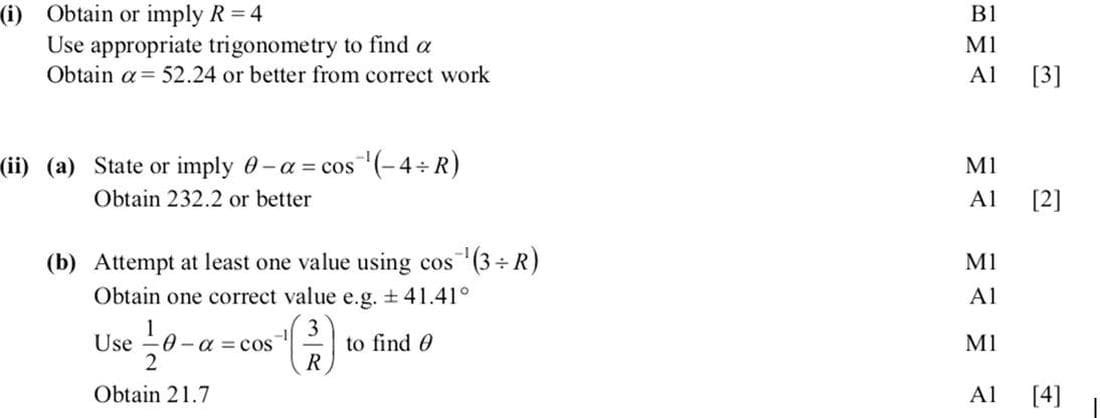
(i) To express \(\sqrt{6} \cos \theta + \sqrt{10} \sin \theta\) in the form \(R \cos(\theta - \alpha)\), we use the identities:
\(\begin{aligned} a \sin \theta + b \cos \theta &\equiv R \sin(\theta + \alpha), \\ a \cos \theta + b \sin \theta &\equiv R \cos(\theta - \alpha), \\ R &= \sqrt{a^2 + b^2}, \quad \tan \alpha = \frac{b}{a}, \quad 0^\circ < \alpha < 90^\circ. \end{aligned}\)
Here, \(a = \sqrt{6}\) and \(b = \sqrt{10}\).
Calculate \(R\):
\(R = \sqrt{(\sqrt{6})^2 + (\sqrt{10})^2} = \sqrt{6 + 10} = \sqrt{16} = 4.\)
Calculate \(\alpha\):
\(\tan \alpha = \frac{\sqrt{10}}{\sqrt{6}} = \sqrt{\frac{10}{6}} = \sqrt{\frac{5}{3}}.\)
\(\alpha = \tan^{-1}(\sqrt{\frac{5}{3}}) \approx 52.24^\circ\).
(ii) (a) Solve \(\sqrt{6} \cos \theta + \sqrt{10} \sin \theta = -4\):
Using \(R \cos(\theta - \alpha) = -4\), we have:
\(\cos(\theta - 52.24^\circ) = \frac{-4}{4} = -1.\)
\(\theta - 52.24^\circ = 180^\circ\), so \(\theta = 180^\circ + 52.24^\circ = 232.24^\circ\).
(b) Solve \(\sqrt{6} \cos \frac{1}{2} \theta + \sqrt{10} \sin \frac{1}{2} \theta = 3\):
Using \(R \cos(\frac{1}{2} \theta - \alpha) = 3\), we have:
\(\cos(\frac{1}{2} \theta - 52.24^\circ) = \frac{3}{4}.\)
\(\frac{1}{2} \theta - 52.24^\circ = \cos^{-1}(0.75) \approx 41.41^\circ\).
\(\frac{1}{2} \theta = 41.41^\circ + 52.24^\circ = 93.65^\circ\).
\(\theta = 2 \times 93.65^\circ = 187.3^\circ\).
Smallest positive \(\theta = 21.7^\circ\).