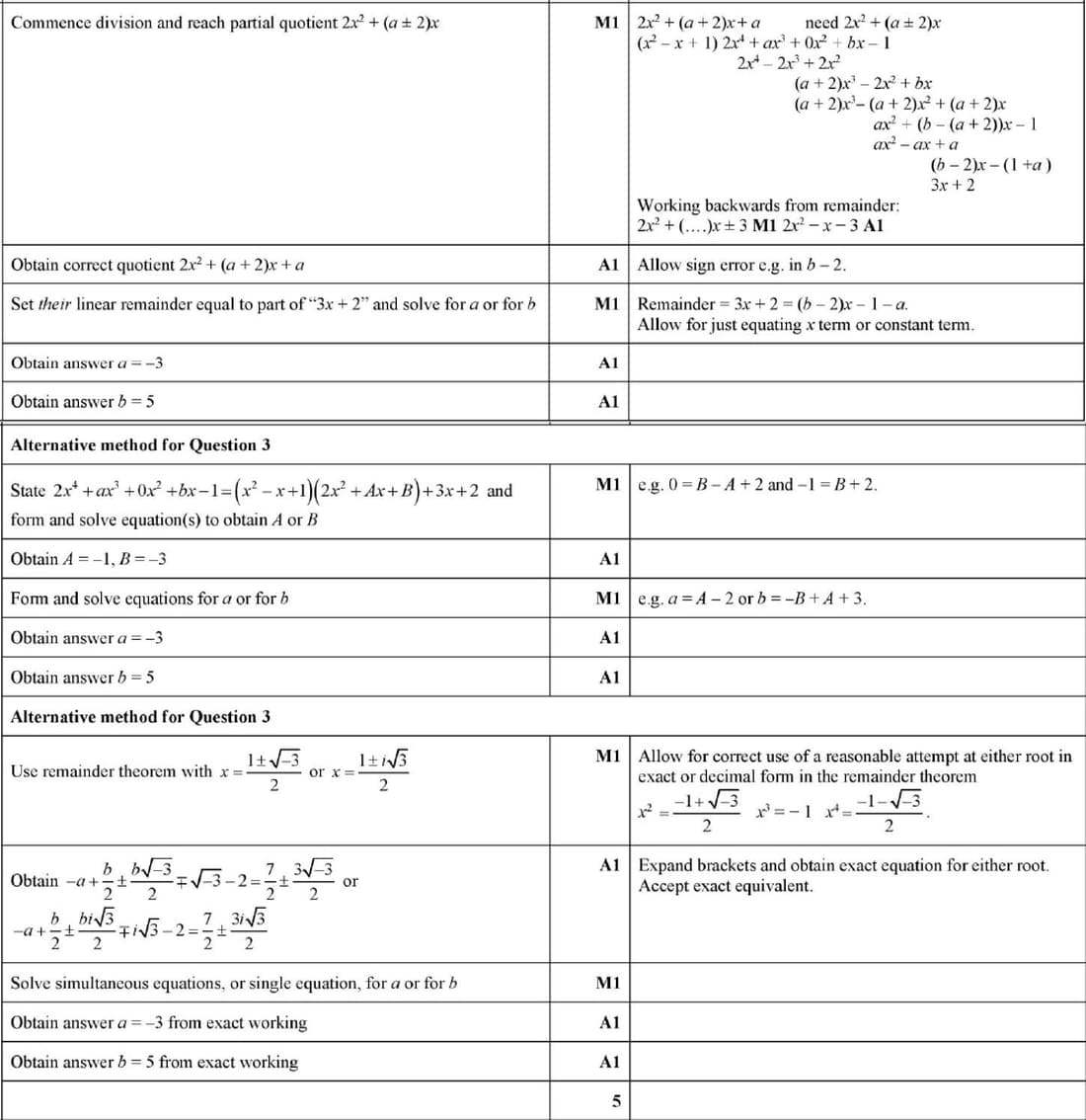
To find the values of \(a\) and \(b\), we perform polynomial division of \(2x^4 + ax^3 + bx - 1\) by \(x^2 - x + 1\) and set the remainder equal to \(3x + 2\).
1. Start the division: The first term of the quotient is \(2x^2\) because \(2x^2 \cdot (x^2 - x + 1) = 2x^4 - 2x^3 + 2x^2\).
2. Subtract \(2x^4 - 2x^3 + 2x^2\) from \(2x^4 + ax^3 + bx - 1\) to get \((a + 2)x^3 - 2x^2 + bx - 1\).
3. The next term of the quotient is \((a + 2)x\) because \((a + 2)x \cdot (x^2 - x + 1) = (a + 2)x^3 - (a + 2)x^2 + (a + 2)x\).
4. Subtract \((a + 2)x^3 - (a + 2)x^2 + (a + 2)x\) from \((a + 2)x^3 - 2x^2 + bx - 1\) to get \((b - (a + 2))x - 1\).
5. The remainder is \((b - (a + 2))x - 1\), which must equal \(3x + 2\).
6. Equate coefficients: \(b - (a + 2) = 3\) and \(-1 = 2\).
7. Solve the equations: From \(-1 = 2\), we find \(a = -3\). From \(b - (a + 2) = 3\), substitute \(a = -3\) to get \(b - (-3 + 2) = 3\), which simplifies to \(b + 1 = 3\), so \(b = 5\).
Thus, \(a = -3\) and \(b = 5\).