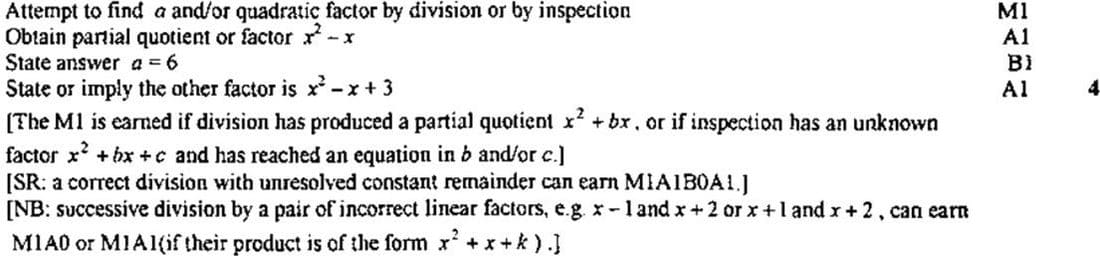
Given that \((x^2 + x + 2)\) is a factor of \(p(x) = x^4 + 4x^2 + x + a\), we can express \(p(x)\) as:
\(p(x) = (x^2 + x + 2)(x^2 + bx + c)\)
Expanding the right-hand side, we have:
\((x^2 + x + 2)(x^2 + bx + c) = x^4 + bx^3 + cx^2 + x^3 + bx^2 + cx + 2x^2 + 2bx + 2c\)
Combining like terms, we get:
\(x^4 + (b+1)x^3 + (c+b+2)x^2 + (c+2b)x + 2c\)
Equating coefficients with \(x^4 + 4x^2 + x + a\), we have:
1. \(b+1 = 0\) implies \(b = -1\)
2. \(c+b+2 = 4\) implies \(c - 1 + 2 = 4\) so \(c = 3\)
3. \(c+2b = 1\) implies \(3 - 2 = 1\), which is consistent
4. \(2c = a\) implies \(2 \times 3 = a\) so \(a = 6\)
Thus, the other quadratic factor is \(x^2 - x + 3\).