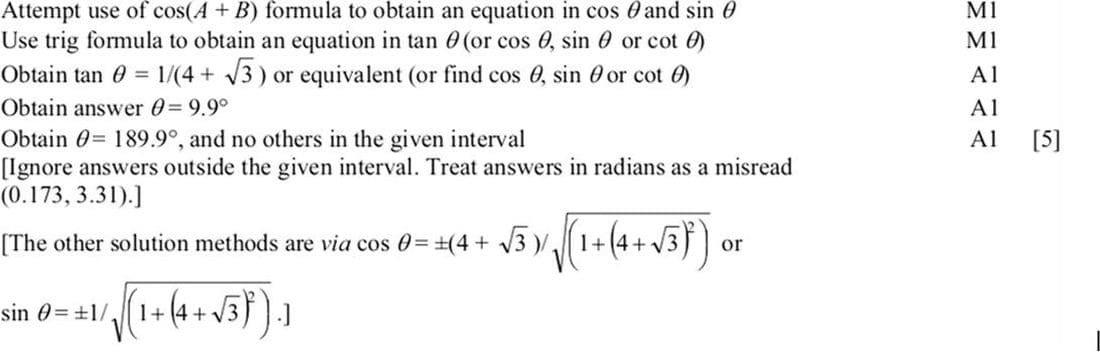
To solve \(\cos(\theta + 60^\circ) = 2 \sin \theta\), we start by using the angle addition formula for cosine:
\(\cos(\theta + 60^\circ) = \cos \theta \cos 60^\circ - \sin \theta \sin 60^\circ.\)
Substituting the values \(\cos 60^\circ = \frac{1}{2}\) and \(\sin 60^\circ = \frac{\sqrt{3}}{2}\), we get:
\(\frac{1}{2} \cos \theta - \frac{\sqrt{3}}{2} \sin \theta = 2 \sin \theta.\)
Rearranging gives:
\(\frac{1}{2} \cos \theta = 2 \sin \theta + \frac{\sqrt{3}}{2} \sin \theta.\)
Combine the terms on the right:
\(\frac{1}{2} \cos \theta = \left(2 + \frac{\sqrt{3}}{2}\right) \sin \theta.\)
Divide both sides by \(\sin \theta\) (assuming \(\sin \theta \neq 0\)):
\(\frac{1}{2} \cot \theta = 2 + \frac{\sqrt{3}}{2}.\)
Solving for \(\cot \theta\), we find:
\(\cot \theta = 4 + \sqrt{3}.\)
Thus, \(\tan \theta = \frac{1}{4 + \sqrt{3}}.\)
Calculating \(\theta\) gives:
\(\theta = \tan^{-1}\left(\frac{1}{4 + \sqrt{3}}\right).\)
This results in \(\theta \approx 9.9^\circ\) and \(\theta \approx 189.9^\circ\) within the interval \(0^\circ \leq \theta \leq 360^\circ\).