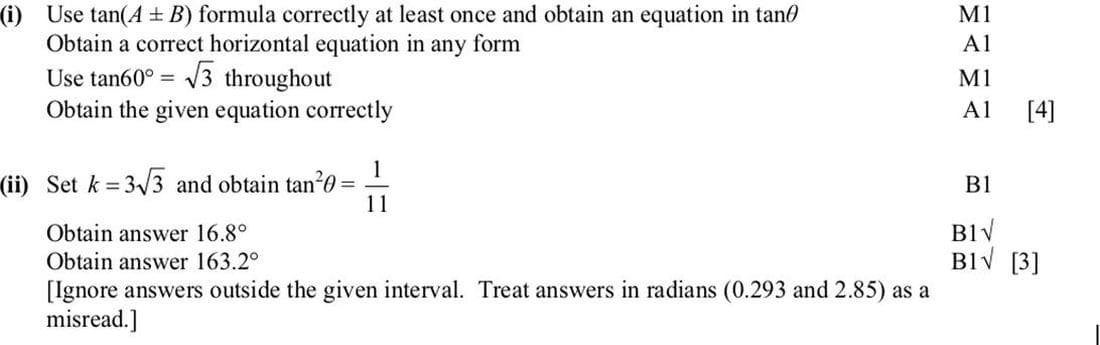
(i) Use the tangent addition and subtraction formulas:
\(\tan(60^\circ + \theta) = \frac{\tan 60^\circ + \tan \theta}{1 - \tan 60^\circ \tan \theta}\)
\(\tan(60^\circ - \theta) = \frac{\tan 60^\circ - \tan \theta}{1 + \tan 60^\circ \tan \theta}\)
Given \(\tan 60^\circ = \sqrt{3}\), substitute:
\(\tan(60^\circ + \theta) = \frac{\sqrt{3} + \tan \theta}{1 - \sqrt{3} \tan \theta}\)
\(\tan(60^\circ - \theta) = \frac{\sqrt{3} - \tan \theta}{1 + \sqrt{3} \tan \theta}\)
Add the two equations:
\(\tan(60^\circ + \theta) + \tan(60^\circ - \theta) = \frac{(\sqrt{3} + \tan \theta)(1 + \sqrt{3} \tan \theta) + (\sqrt{3} - \tan \theta)(1 - \sqrt{3} \tan \theta)}{(1 - \sqrt{3} \tan \theta)(1 + \sqrt{3} \tan \theta)}\)
Simplify the numerator:
\(= 2\sqrt{3}(1 + \tan^2 \theta)\)
Simplify the denominator:
\(= 1 - 3\tan^2 \theta\)
Thus, the equation becomes:
\(\frac{2\sqrt{3}(1 + \tan^2 \theta)}{1 - 3\tan^2 \theta} = k\)
Therefore, \((2\sqrt{3})(1 + \tan^2 \theta) = k(1 - 3\tan^2 \theta)\).
(ii) Set \(k = 3\sqrt{3}\) and solve:
\(2\sqrt{3}(1 + \tan^2 \theta) = 3\sqrt{3}(1 - 3\tan^2 \theta)\)
Divide by \(\sqrt{3}\):
\(2(1 + \tan^2 \theta) = 3(1 - 3\tan^2 \theta)\)
Expand and simplify:
\(2 + 2\tan^2 \theta = 3 - 9\tan^2 \theta\)
\(11\tan^2 \theta = 1\)
\(\tan^2 \theta = \frac{1}{11}\)
\(\tan \theta = \pm \frac{1}{\sqrt{11}}\)
Find \(\theta\) in the interval \(0^\circ \leq \theta \leq 180^\circ\):
\(\theta = 16.8^\circ, 163.2^\circ\)