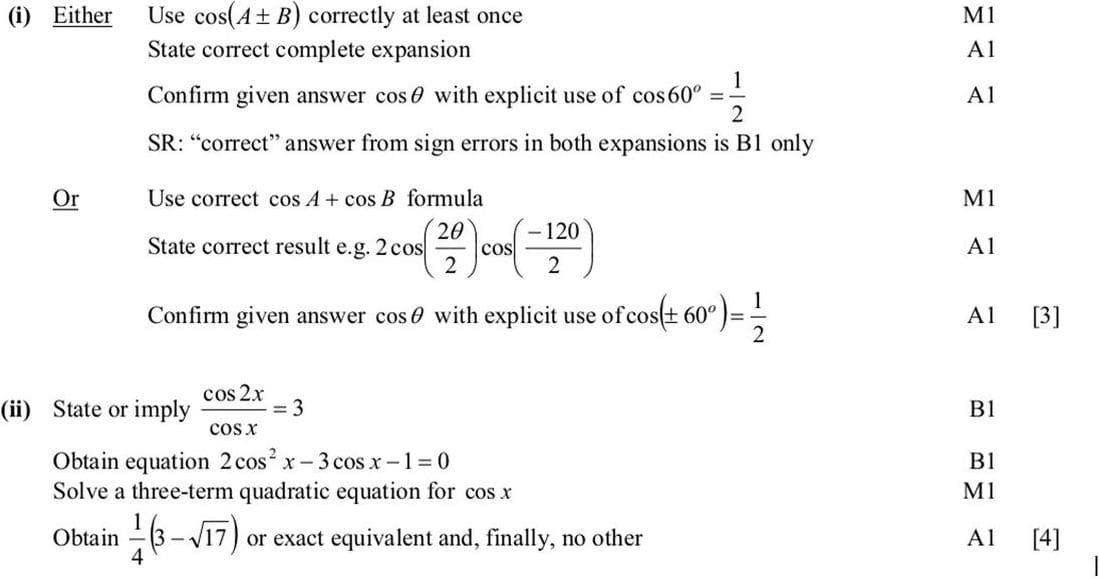
(i) Use the sum-to-product identities:
\(\cos(\theta - 60^\circ) + \cos(\theta + 60^\circ) = 2 \cos \left( \frac{2\theta}{2} \right) \cos \left( \frac{-120^\circ}{2} \right)\)
\(= 2 \cos \theta \cos(-60^\circ)\)
Since \(\cos(-60^\circ) = \cos(60^\circ) = \frac{1}{2}\), we have:
\(2 \cos \theta \cdot \frac{1}{2} = \cos \theta\)
Thus, \(\cos(\theta - 60^\circ) + \cos(\theta + 60^\circ) = \cos \theta\).
(ii) Start with:
\(\frac{\cos(2x - 60^\circ) + \cos(2x + 60^\circ)}{\cos(x - 60^\circ) + \cos(x + 60^\circ)} = 3\)
Using the identity \(\cos A + \cos B = 2 \cos \left( \frac{A+B}{2} \right) \cos \left( \frac{A-B}{2} \right)\), we have:
\(\cos(2x - 60^\circ) + \cos(2x + 60^\circ) = 2 \cos(2x) \cos(60^\circ) = \cos(2x)\)
\(\cos(x - 60^\circ) + \cos(x + 60^\circ) = 2 \cos(x) \cos(60^\circ) = \cos(x)\)
Thus, \(\frac{\cos(2x)}{\cos(x)} = 3\), implying \(\cos(2x) = 3 \cos(x)\).
Using the double angle identity \(\cos(2x) = 2 \cos^2(x) - 1\), we get:
\(2 \cos^2(x) - 1 = 3 \cos(x)\)
\(2 \cos^2(x) - 3 \cos(x) - 1 = 0\)
Solving this quadratic equation for \(\cos(x)\):
Let \(y = \cos(x)\), then:
\(2y^2 - 3y - 1 = 0\)
Using the quadratic formula \(y = \frac{-b \pm \sqrt{b^2 - 4ac}}{2a}\), where \(a = 2\), \(b = -3\), \(c = -1\):
\(y = \frac{3 \pm \sqrt{(-3)^2 - 4 \cdot 2 \cdot (-1)}}{4}\)
\(y = \frac{3 \pm \sqrt{9 + 8}}{4}\)
\(y = \frac{3 \pm \sqrt{17}}{4}\)
Since \(\cos(x)\) must be between -1 and 1, the valid solution is:
\(\cos(x) = \frac{1}{4}(3 - \sqrt{17})\)