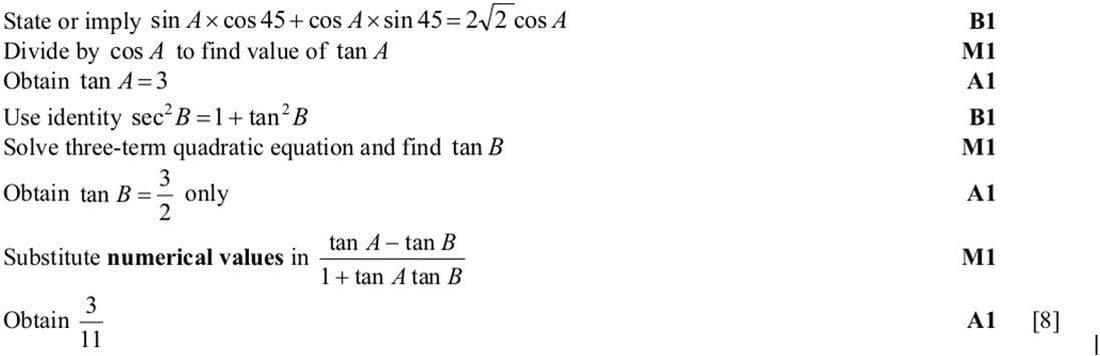
1. Use the identity for \(\sin(A + 45^\circ)\):
\(\sin A \cos 45^\circ + \cos A \sin 45^\circ = 2\sqrt{2} \cos A\)
2. Simplify using \(\cos 45^\circ = \sin 45^\circ = \frac{\sqrt{2}}{2}\):
\(\sin A \cdot \frac{\sqrt{2}}{2} + \cos A \cdot \frac{\sqrt{2}}{2} = 2\sqrt{2} \cos A\)
3. Divide through by \(\cos A\):
\(\tan A \cdot \frac{\sqrt{2}}{2} + \frac{\sqrt{2}}{2} = 2\sqrt{2}\)
4. Solve for \(\tan A\):
\(\tan A = 3\)
5. Use the identity \(\sec^2 B = 1 + \tan^2 B\) in the second equation:
\(4(1 + \tan^2 B) + 5 = 12 \tan B\)
6. Simplify and solve the quadratic equation:
\(4\tan^2 B - 12\tan B + 9 = 0\)
7. Factor or use the quadratic formula to find:
\(\tan B = \frac{3}{2}\)
8. Use the identity for \(\tan(A - B)\):
\(\tan(A - B) = \frac{\tan A - \tan B}{1 + \tan A \tan B}\)
9. Substitute \(\tan A = 3\) and \(\tan B = \frac{3}{2}\):
\(\tan(A - B) = \frac{3 - \frac{3}{2}}{1 + 3 \cdot \frac{3}{2}}\)
10. Simplify:
\(\tan(A - B) = \frac{\frac{3}{2}}{1 + \frac{9}{2}} = \frac{\frac{3}{2}}{\frac{11}{2}} = \frac{3}{11}\)