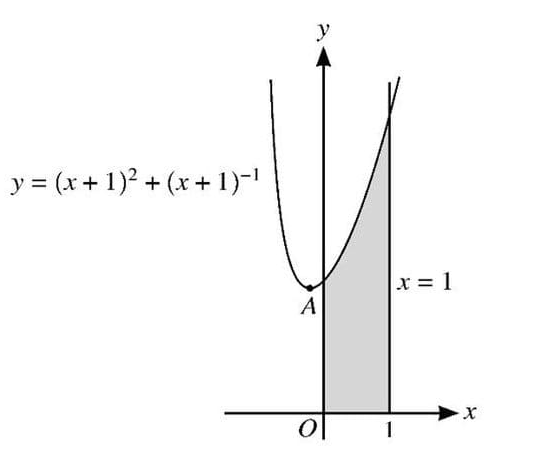
The diagram shows part of the curve \(y = (x+1)^2 + (x+1)^{-1}\) and the line \(x = 1\). The point \(A\) is the minimum point on the curve.
(i) Show that the \(x\)-coordinate of \(A\) satisfies the equation \(2(x+1)^3 = 1\) and find the exact value of \(\frac{d^2y}{dx^2}\) at \(A\).
(ii) Find, showing all necessary working, the volume obtained when the shaded region is rotated through 360° about the \(x\)-axis.
Solution
(i) Differentiate \(y = (x+1)^2 + (x+1)^{-1}\) to find \(\frac{dy}{dx} = 2(x+1) - (x+1)^{-2}\).
Set \(\frac{dy}{dx} = 0\) to find the minimum point: \(2(x+1)^3 = 1\).
Differentiate again to find \(\frac{d^2y}{dx^2} = 2 + 2(x+1)^{-3}\).
Substitute \((x+1)^{-3} = 2\) to find \(\frac{d^2y}{dx^2} = 6\).
(ii) The volume of the solid of revolution is given by \(\pi \int y^2 \, dx\).
Calculate \(y^2 = (x+1)^4 + (x+1)^{-2} + 2(x+1)^2\).
Integrate \(y^2\) from 0 to 1: \(\pi \left[ \frac{(x+1)^5}{5} + (x+1)^{-1} + \frac{2(x+1)^2}{2} \right]_0^1\).
Evaluate the definite integral: \(\pi \left[ \frac{32}{5} - \frac{1}{2} + 4 - \left( \frac{1}{5} + 1 \right) \right]\).
The volume is \(9.7\pi\) or \(30.5\).
Log in to record attempts.