9709 P13 - Nov 2018 - Q10
1325
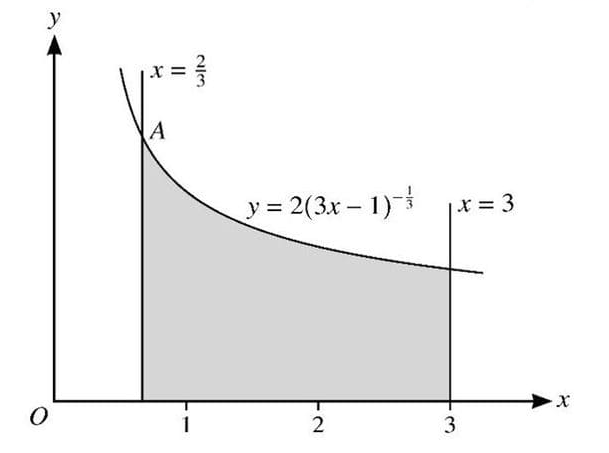
The diagram shows part of the curve \(y = 2(3x - 1)^{-\frac{1}{3}}\) and the lines \(x = \frac{2}{3}\) and \(x = 3\). The curve and the line \(x = \frac{2}{3}\) intersect at the point \(A\).
(i) Find, showing all necessary working, the volume obtained when the shaded region is rotated through \(360^\circ\) about the \(x\)-axis.
(ii) Find the equation of the normal to the curve at \(A\), giving your answer in the form \(y = mx + c\).
Solutions locked. Please sign in with access to view them.