9709 P11 - Jun 2023 - Q10
1321
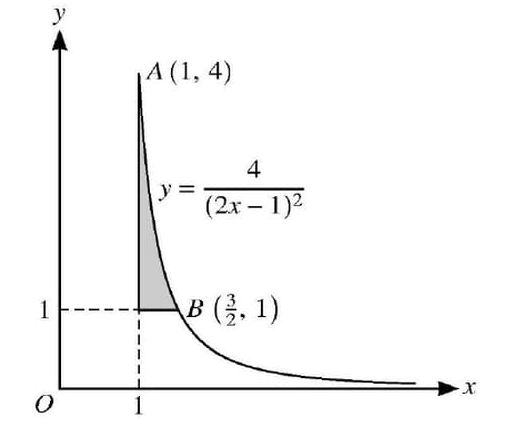
The diagram shows part of the curve with equation \(y = \frac{4}{(2x-1)^2}\) and parts of the lines \(x = 1\) and \(y = 1\). The curve passes through the points \(A(1, 4)\) and \(B\left( \frac{3}{2}, 1 \right)\).
(a) Find the exact volume generated when the shaded region is rotated through 360° about the x-axis.
(b) A triangle is formed from the tangent to the curve at \(B\), the normal to the curve at \(B\) and the x-axis. Find the area of this triangle.
Solutions locked. Please sign in with access to view them.