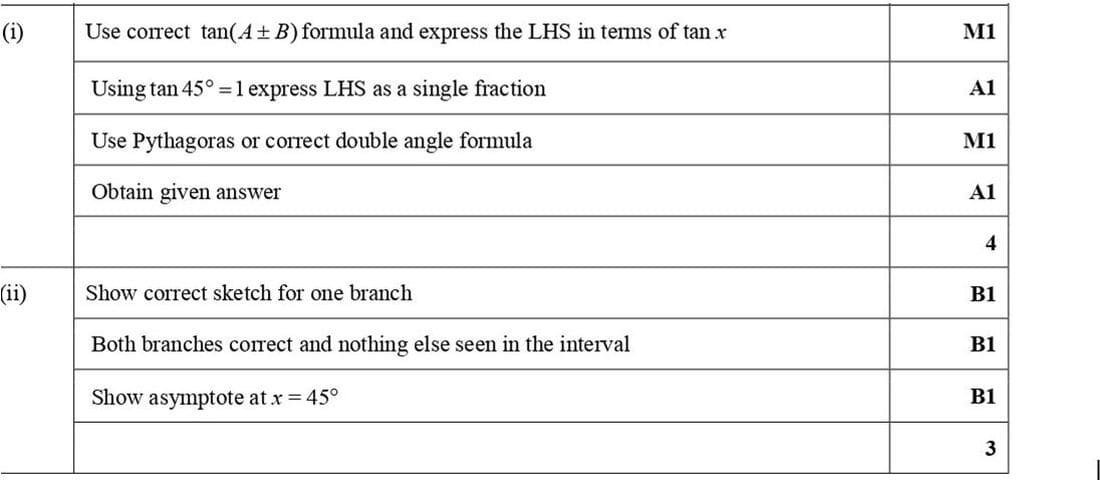
(i) To prove the identity \(\tan(45^\circ + x) + \tan(45^\circ - x) \equiv 2 \sec 2x\):
Use the tangent addition and subtraction formulas:
\(\tan(45^\circ + x) = \frac{\tan 45^\circ + \tan x}{1 - \tan 45^\circ \tan x} = \frac{1 + \tan x}{1 - \tan x}\)
\(\tan(45^\circ - x) = \frac{\tan 45^\circ - \tan x}{1 + \tan 45^\circ \tan x} = \frac{1 - \tan x}{1 + \tan x}\)
Add the two expressions:
\(\tan(45^\circ + x) + \tan(45^\circ - x) = \frac{1 + \tan x}{1 - \tan x} + \frac{1 - \tan x}{1 + \tan x}\)
Combine into a single fraction:
\(= \frac{(1 + \tan x)^2 + (1 - \tan x)^2}{(1 - \tan x)(1 + \tan x)}\)
Simplify the numerator:
\(= \frac{1 + 2\tan^2 x + 1}{1 - \tan^2 x} = \frac{2(1 + \tan^2 x)}{1 - \tan^2 x}\)
Using the identity \(1 + \tan^2 x = \sec^2 x\), we have:
\(= \frac{2 \sec^2 x}{1 - \tan^2 x} = 2 \sec 2x\)
Thus, the identity is proven.
(ii) To sketch the graph of \(y = \tan(45^\circ + x) + \tan(45^\circ - x)\) for \(0^\circ \leq x \leq 90^\circ\):
The function has an asymptote at \(x = 45^\circ\) because \(\tan(45^\circ + x)\) and \(\tan(45^\circ - x)\) become undefined.
The graph consists of two branches approaching the asymptote at \(x = 45^\circ\).