9709 P11 - Nov 2022 - Q10
1318
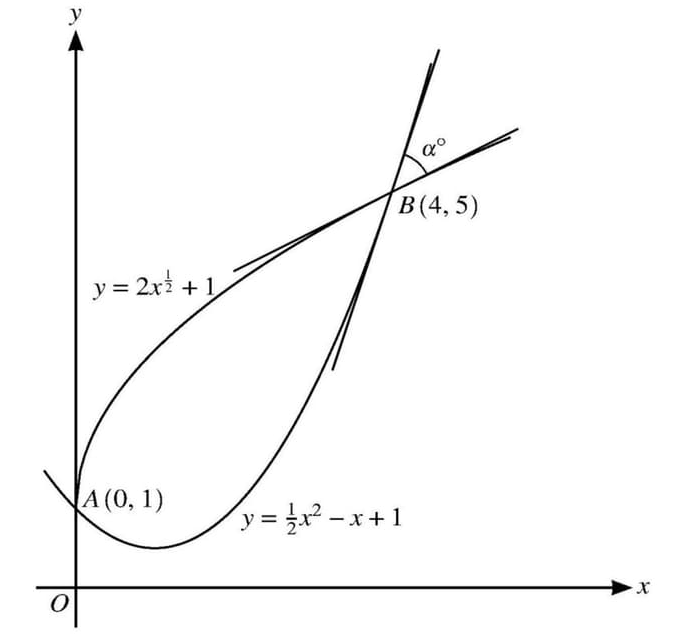
Curves with equations \(y = 2x^{\frac{1}{2}} + 1\) and \(y = \frac{1}{2}x^2 - x + 1\) intersect at \(A(0, 1)\) and \(B(4, 5)\), as shown in the diagram.
(a) Find the area of the region between the two curves.
The acute angle between the two tangents at \(B\) is denoted by \(\alpha^\circ\), and the scales on the axes are the same.
(b) Find \(\alpha\).
Solutions locked. Please sign in with access to view them.