Browsing as Guest. Progress, bookmarks and attempts are disabled.
Log in to track your work.
Nov 2002 p1 q10
1316
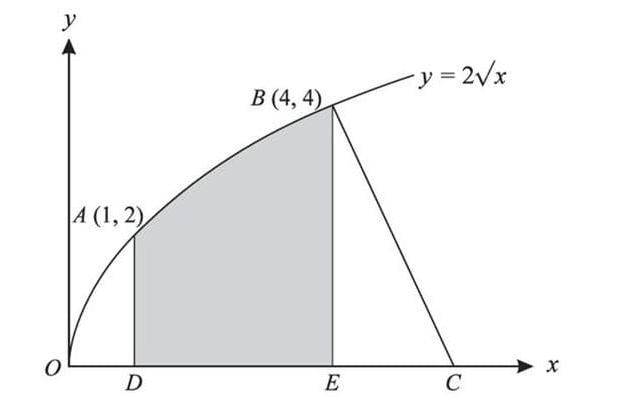
The diagram shows the points A (1, 2) and B (4, 4) on the curve \(y = 2\sqrt{x}\). The line BC is the normal to the curve at B, and C lies on the x-axis. Lines AD and BE are perpendicular to the x-axis.
(i) Find the equation of the normal BC.
(ii) Find the area of the shaded region.
Solution
(i) The curve is given by \(y = 2\sqrt{x}\). To find the equation of the normal, we first find the derivative \(\frac{dy}{dx}\). For \(y = 2\sqrt{x}\), \(\frac{dy}{dx} = x^{-\frac{1}{2}}\).
At \(x = 4\), \(\frac{dy}{dx} = \frac{1}{2}\). The slope of the normal is the negative reciprocal, so \(m = -2\).
The equation of the normal line at point B (4, 4) is \(y - 4 = -2(x - 4)\), which simplifies to \(y = -2x + 12\).
(ii) To find the area of the shaded region, we integrate the curve from \(x = 1\) to \(x = 4\). The integral is \(\int 2\sqrt{x} \, dx = \int 2x^{0.5} \, dx = \frac{2}{1.5}x^{1.5}\).