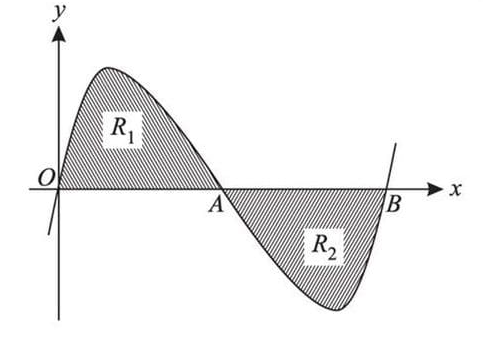
The diagram shows the curve \(y = x(x-1)(x-2)\), which crosses the x-axis at the points \(O(0, 0)\), \(A(1, 0)\), and \(B(2, 0)\).
(i) The tangents to the curve at the points \(A\) and \(B\) meet at the point \(C\). Find the x-coordinate of \(C\).
(ii) Show by integration that the area of the shaded region \(R_1\) is the same as the area of the shaded region \(R_2\).
Solution
(i) The curve is given by \(y = x(x-1)(x-2) = x^3 - 3x^2 + 2x\).
Differentiate to find the gradient: \(\frac{dy}{dx} = 3x^2 - 6x + 2\).
At \(A(1, 0)\), the gradient \(m = -1\), so the tangent is \(y = -1(x-1)\).
At \(B(2, 0)\), the gradient \(m = 2\), so the tangent is \(y = 2(x-2)\).
Solving the equations \(y = -x + 1\) and \(y = 2x - 4\) gives \(x = \frac{5}{3}\).
(ii) The area \(R_1\) is given by \(\int_0^1 (x^3 - 3x^2 + 2x) \, dx\).
Integrate: \(\left[ \frac{x^4}{4} - \frac{3x^3}{3} + \frac{2x^2}{2} \right]_0^1 = \frac{1}{4}\).
The area \(R_2\) is given by \(\int_1^2 (x^3 - 3x^2 + 2x) \, dx\).
Integrate: \(\left[ \frac{x^4}{4} - \frac{3x^3}{3} + \frac{2x^2}{2} \right]_1^2 = -\frac{1}{4}\).
Thus, \(R_1 = R_2 = \frac{1}{4}\).
Log in to record attempts.