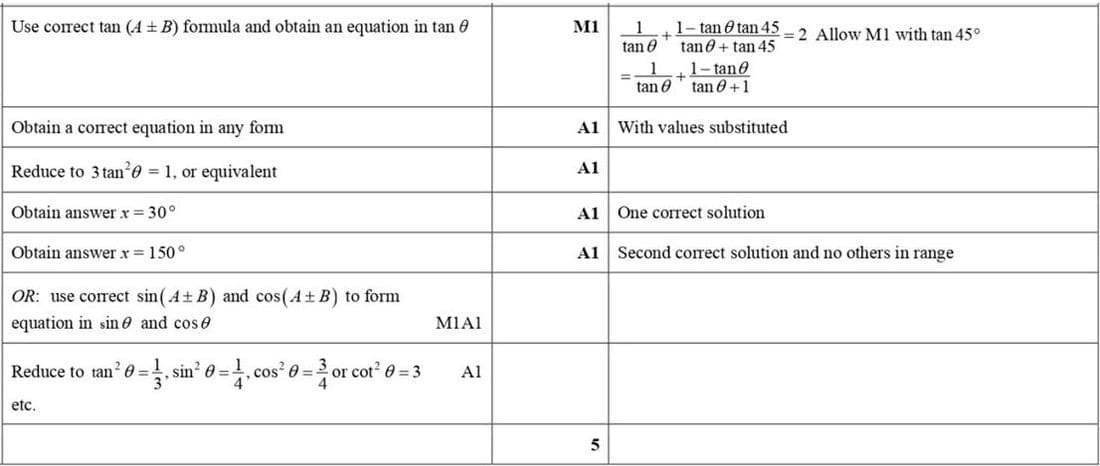
We solve the equation \(\cot \theta + \cot(\theta + 45^\circ) = 2\) using the addition formula for tangent.
Let \(t = \tan \theta\). Using the identity
\[
\tan(\theta + 45^\circ) = \frac{\tan \theta + \tan 45^\circ}{1 - \tan \theta \tan 45^\circ}
= \frac{t + 1}{1 - t},
\]
so
\[
\cot(\theta + 45^\circ)
= \frac{1}{\tan(\theta + 45^\circ)}
= \frac{1 - t}{t + 1}.
\]
Also, \(\cot \theta = \frac{1}{t}\). Substituting these into the original equation gives
\[
\frac{1}{t} + \frac{1 - t}{t + 1} = 2.
\]
Multiply through by \(t(t+1)\):
\[
(t+1) + t(1 - t) = 2t(t+1).
\]
Expanding and simplifying:
\[
t + 1 + t - t^2 = 2t^2 + 2t \quad \Rightarrow \quad 2t - t^2 + 1 = 2t^2 + 2t.
\]
Bring all terms to one side:
\[
0 = 3t^2 - 1 \quad \Rightarrow \quad t^2 = \frac{1}{3}.
\]
So
\[
t = \pm \frac{1}{\sqrt{3}}.
\]
This gives \(\tan \theta = \frac{1}{\sqrt{3}}\) or \(\tan \theta = -\frac{1}{\sqrt{3}}\).
In degrees:
- \(\tan \theta = \frac{1}{\sqrt{3}}\) gives \(\theta = 30^\circ + 180^\circ k\).
- \(\tan \theta = -\frac{1}{\sqrt{3}}\) gives \(\theta = 150^\circ + 180^\circ k\).
For \(0^\circ < \theta < 180^\circ\), the solutions are \(\boxed{\theta = 30^\circ \text{ and } \theta = 150^\circ}\).