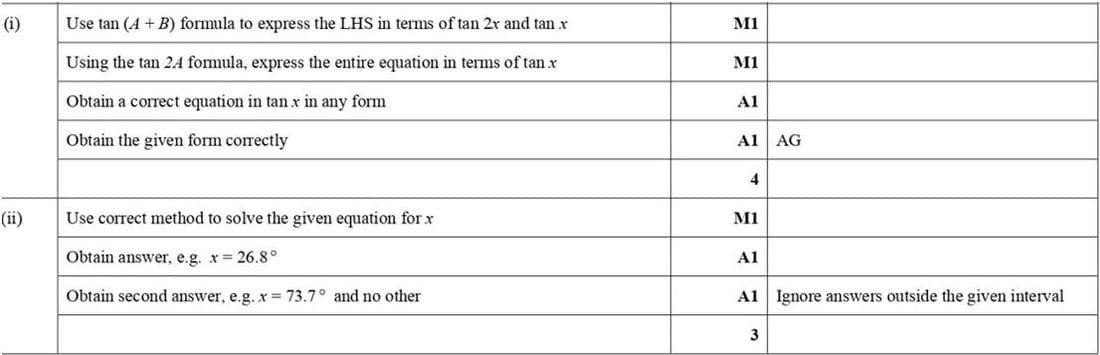
(i) Start by expanding \(\tan(2x + x)\) using the angle addition formula:
\(\tan(2x + x) = \frac{\tan 2x + \tan x}{1 - \tan 2x \tan x}\)
Using \(\tan 2x = \frac{2 \tan x}{1 - \tan^2 x}\), substitute into the equation:
\(\tan 3x = \frac{\frac{2 \tan x}{1 - \tan^2 x} + \tan x}{1 - \frac{2 \tan x}{1 - \tan^2 x} \tan x}\)
Simplify the expression:
\(\tan 3x = \frac{2 \tan x + \tan x (1 - \tan^2 x)}{1 - 2 \tan^2 x}\)
\(\tan 3x = \frac{3 \tan x - \tan^3 x}{1 - 2 \tan^2 x}\)
Given \(\tan 3x = 3 \cot x = \frac{3}{\tan x}\), equate and simplify:
\(\frac{3 \tan x - \tan^3 x}{1 - 2 \tan^2 x} = \frac{3}{\tan x}\)
Cross-multiply and simplify:
\(3 \tan^2 x - \tan^4 x = 3 - 6 \tan^2 x\)
Rearrange to obtain:
\(\tan^4 x - 12 \tan^2 x + 3 = 0\)
(ii) Solve \(\tan^4 x - 12 \tan^2 x + 3 = 0\) by substituting \(y = \tan^2 x\):
\(y^2 - 12y + 3 = 0\)
Use the quadratic formula:
\(y = \frac{12 \pm \sqrt{144 - 12}}{2}\)
\(y = \frac{12 \pm \sqrt{132}}{2}\)
\(y = 6 \pm \sqrt{33}\)
Since \(y = \tan^2 x\), solve for \(x\):
\(\tan x = \sqrt{6 + \sqrt{33}}\) or \(\tan x = \sqrt{6 - \sqrt{33}}\)
Calculate \(x\) for \(0^\circ < x < 90^\circ\):
\(x = 26.8^\circ\) and \(x = 73.7^\circ\)