9709 P12 - Nov 2013 - Q6
1205
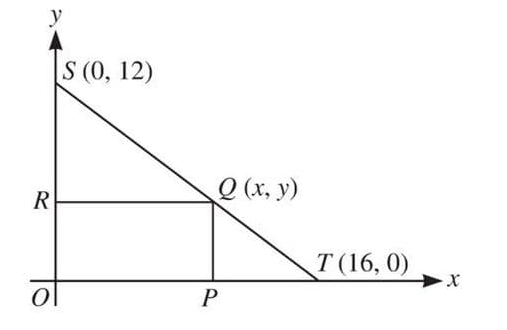
In the diagram, S is the point (0, 12) and T is the point (16, 0). The point Q lies on ST, between S and T, and has coordinates (x, y). The points P and R lie on the x-axis and y-axis respectively and OPQR is a rectangle.
- Show that the area, A, of the rectangle OPQR is given by \(A = 12x - \frac{3}{4}x^2\).
- Given that x can vary, find the stationary value of A and determine its nature.
Solutions locked. Please sign in with access to view them.