9709 P1 - Jun 2004 - Q8
1197
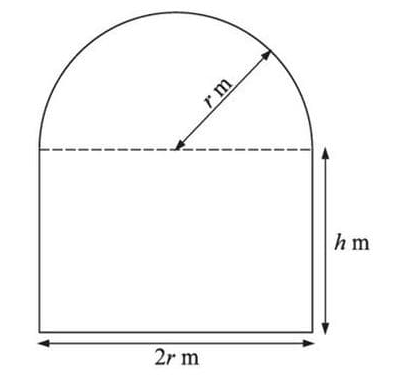
The diagram shows a glass window consisting of a rectangle of height \(h\) m and width \(2r\) m and a semicircle of radius \(r\) m. The perimeter of the window is 8 m.
(i) Express \(h\) in terms of \(r\).
(ii) Show that the area of the window, \(A\) m\(^2\), is given by \(A = 8r - 2r^2 - \frac{1}{2} \pi r^2\).
Given that \(r\) can vary,
(iii) find the value of \(r\) for which \(A\) has a stationary value,
(iv) determine whether this stationary value is a maximum or a minimum.
Solutions locked. Please sign in with access to view them.