9709 P1 - Nov 2005 - Q5
1195
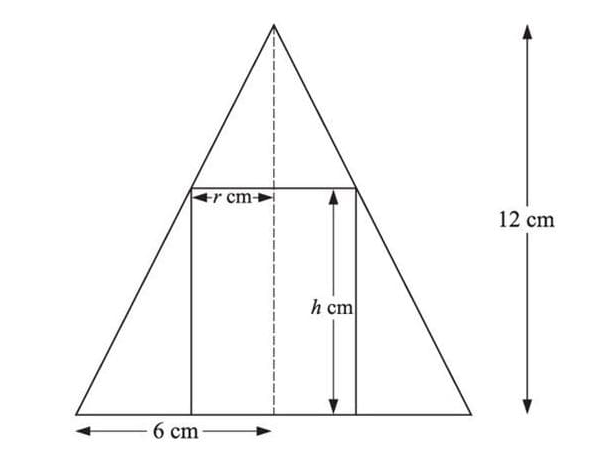
The diagram shows the cross-section of a hollow cone and a circular cylinder. The cone has radius 6 cm and height 12 cm, and the cylinder has radius \(r\) cm and height \(h\) cm. The cylinder just fits inside the cone with all of its upper edge touching the surface of the cone.
(i) Express \(h\) in terms of \(r\) and hence show that the volume, \(V \text{ cm}^3\), of the cylinder is given by \(V = 12\pi r^2 - 2\pi r^3\).
(ii) Given that \(r\) varies, find the stationary value of \(V\).
Solutions locked. Please sign in with access to view them.