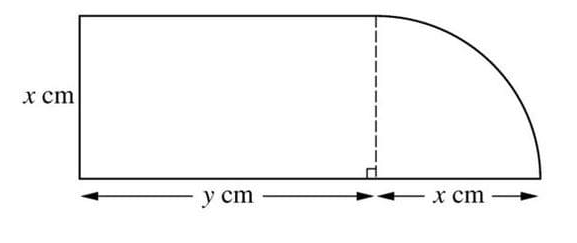
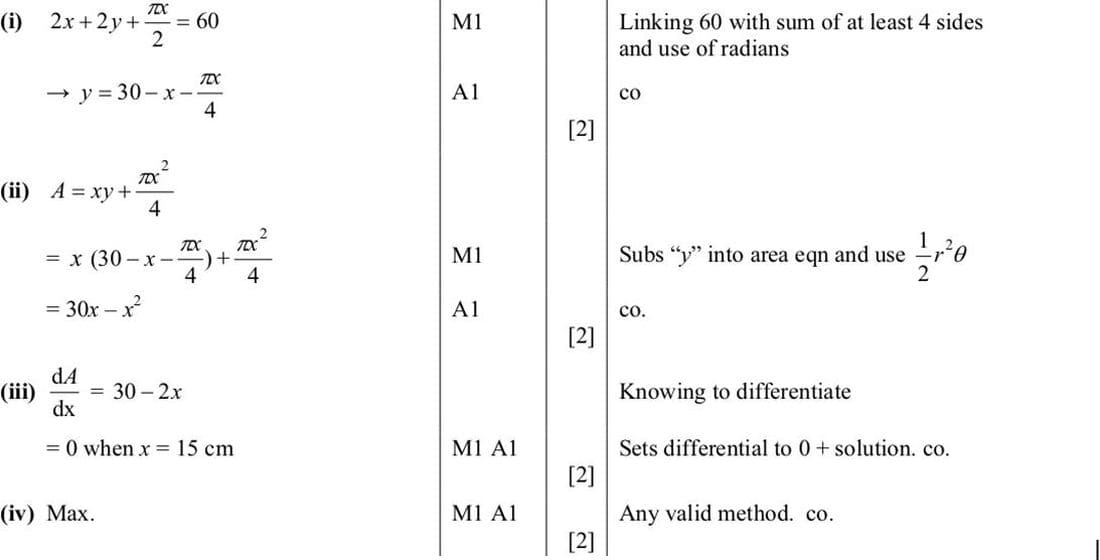
(i) The perimeter of the plate is given by the sum of the sides of the rectangle and the arc of the quarter-circle: \(2x + 2y + \frac{\pi x}{2} = 60\). Solving for \(y\), we have:
\(2y = 60 - 2x - \frac{\pi x}{2}\)
\(y = 30 - x - \frac{\pi x}{4}\)
(ii) The area of the plate consists of the area of the rectangle and the area of the quarter-circle. The area of the rectangle is \(xy\) and the area of the quarter-circle is \(\frac{1}{4} \pi x^2\). Thus,
\(A = xy + \frac{\pi x^2}{4}\)
Substituting \(y = 30 - x - \frac{\pi x}{4}\) into the equation, we get:
\(A = x(30 - x - \frac{\pi x}{4}) + \frac{\pi x^2}{4}\)
\(A = 30x - x^2 - \frac{\pi x^2}{4} + \frac{\pi x^2}{4}\)
\(A = 30x - x^2\)
(iii) To find the stationary value, differentiate \(A\) with respect to \(x\):
\(\frac{dA}{dx} = 30 - 2x\)
Setting \(\frac{dA}{dx} = 0\), we find:
\(30 - 2x = 0\)
\(x = 15 \text{ cm}\)
(iv) To determine if this is a maximum or minimum, consider the second derivative:
\(\frac{d^2A}{dx^2} = -2\)
Since \(\frac{d^2A}{dx^2} < 0\), the stationary point is a maximum.