Browsing as Guest. Progress, bookmarks and attempts are disabled.
Log in to track your work.
Nov 2011 p11 q7
1188
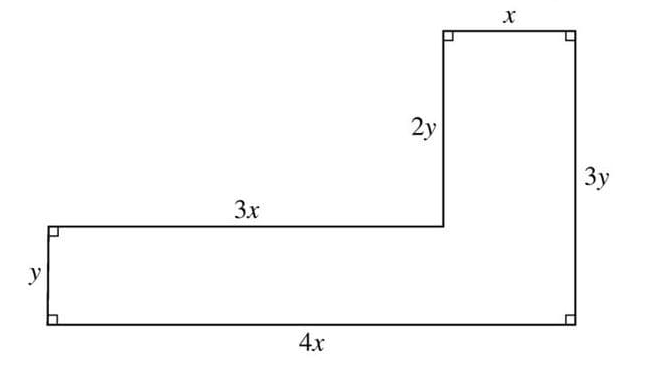
The diagram shows the dimensions in metres of an L-shaped garden. The perimeter of the garden is 48 m.
Find an expression for y in terms of x.
Given that the area of the garden is A m2, show that A = 48x - 8x2.
Given that x can vary, find the maximum area of the garden, showing that this is a maximum value rather than a minimum value.
Solution
(i) The perimeter of the L-shaped garden is given by the sum of all its sides: \(y + 3x + 2y + x + 3y + 4x = 48\). Simplifying, we get \(6y + 8x = 48\). Solving for \(y\), we have \(y = \frac{1}{6}(48 - 8x)\).
(ii) The area \(A\) of the L-shaped garden can be expressed as the sum of the areas of the two rectangles: \(A = 4xy + 2xy = 6xy\). Substituting \(y = \frac{1}{6}(48 - 8x)\) into the area equation, we get \(A = x(48 - 8x) = 48x - 8x^2\).
(iii) To find the maximum area, we differentiate \(A\) with respect to \(x\): \(\frac{dA}{dx} = 48 - 16x\). Setting \(\frac{dA}{dx} = 0\) gives \(48 - 16x = 0\), so \(x = 3\). Substituting \(x = 3\) into the area equation, \(A = 48(3) - 8(3)^2 = 144 - 72 = 72\). To confirm it's a maximum, we check the second derivative: \(\frac{d^2A}{dx^2} = -16\), which is less than zero, indicating a maximum.