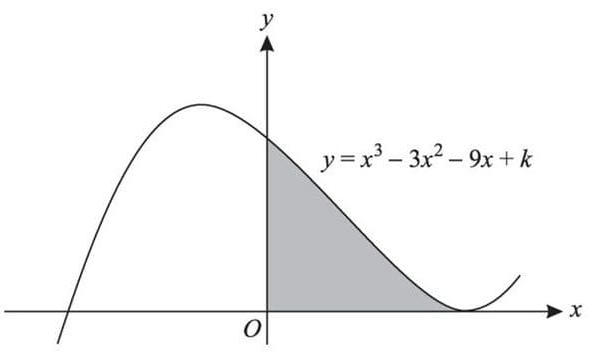
(i) Differentiate the function: \(\frac{dy}{dx} = 3x^2 - 6x - 9\).
Set \(\frac{dy}{dx} = 0\) to find critical points: \(3x^2 - 6x - 9 = 0\).
Factorize: \(3(x^2 - 2x - 3) = 0\).
Solve: \(x^2 - 2x - 3 = 0\) gives \((x - 3)(x + 1) = 0\).
Thus, \(x = 3\) or \(x = -1\).
Since the minimum point is on the \(x\)-axis, \(y = 0\) at \(x = 3\).
Substitute \(x = 3\) into the original equation: \(3^3 - 3(3)^2 - 9(3) + k = 0\).
Simplify: \(27 - 27 - 27 + k = 0\).
Thus, \(k = 27\).
(ii) Substitute \(x = -1\) into the original equation to find the maximum point:
\(y = (-1)^3 - 3(-1)^2 - 9(-1) + 27\).
Simplify: \(y = -1 - 3 + 9 + 27 = 32\).
Thus, the maximum point is \((-1, 32)\).
(iii) The function is decreasing where \(\frac{dy}{dx} < 0\).
From \(3x^2 - 6x - 9 = 0\), the roots are \(x = 3\) and \(x = -1\).
Test intervals: \(-1 < x < 3\) is where \(\frac{dy}{dx} < 0\).
Thus, the function is decreasing for \(-1 < x < 3\).