June 2007 p1 q11
1151
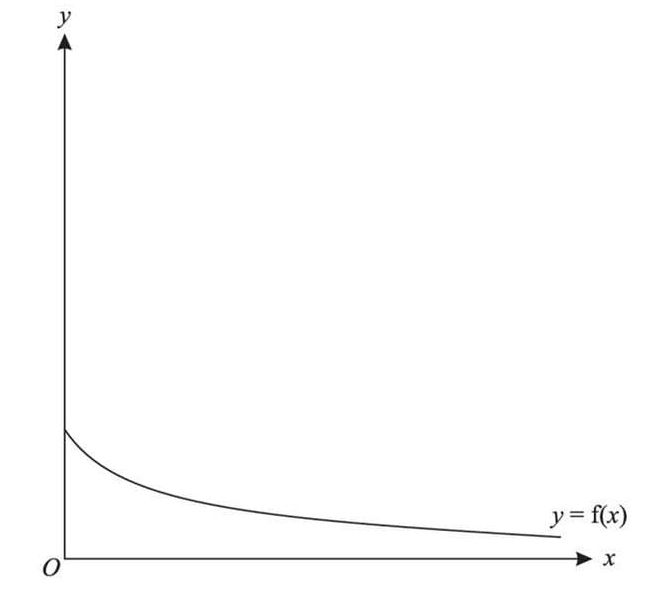
The diagram shows the graph of \(y = f(x)\), where \(f : x \mapsto \frac{6}{2x+3}\) for \(x \geq 0\).
Find an expression, in terms of \(x\), for \(f'(x)\) and explain how your answer shows that \(f\) is a decreasing function.
Solution
To find \(f'(x)\), we start with the function \(f(x) = \frac{6}{2x+3}\).
Using the quotient rule or by rewriting as \(f(x) = 6(2x+3)^{-1}\), differentiate:
\(f'(x) = 6 \times (-1)(2x+3)^{-2} \times 2\).
This simplifies to \(f'(x) = -6(2x+3)^{-2} \times 2\).
The expression \(f'(x)\) is always negative because \((2x+3)^{-2}\) is positive for \(x \geq 0\), and the negative sign makes \(f'(x)\) negative.
Since \(f'(x) < 0\) for all \(x \geq 0\), the function \(f\) is decreasing.
Log in to record attempts.