9709 P13 - Jun 2022 - Q10
1133
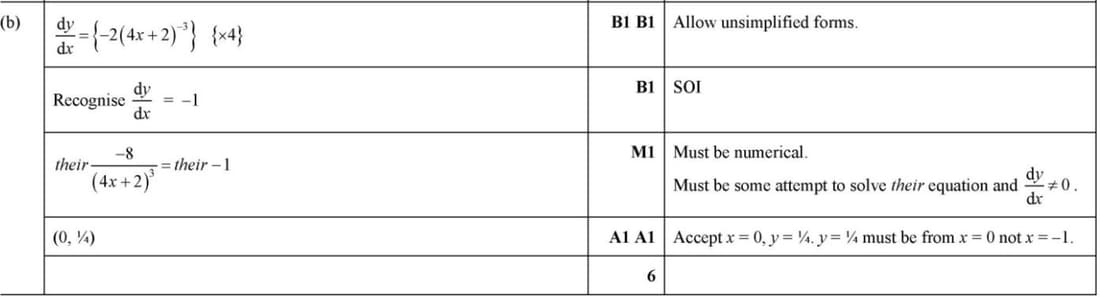
The function f is defined by \(f(x) = (4x + 2)^{-2}\) for \(x > -\frac{1}{2}\).
A point is moving along the curve \(y = f(x)\) in such a way that, as it passes through the point A, its y-coordinate is decreasing at the rate of k units per second and its x-coordinate is increasing at the rate of k units per second.
Find the coordinates of A.