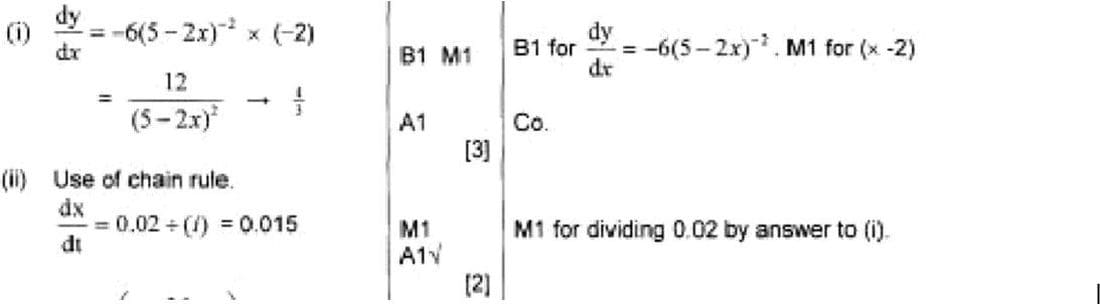
(i) To find the gradient of the curve, we need to differentiate \(y = \frac{6}{5 - 2x}\) with respect to \(x\).
Using the chain rule, \(\frac{dy}{dx} = -6(5 - 2x)^{-2} \times (-2)\).
This simplifies to \(\frac{dy}{dx} = \frac{12}{(5 - 2x)^2}\).
Substitute \(x = 1\) into the derivative: \(\frac{dy}{dx} = \frac{12}{(5 - 2 \times 1)^2} = \frac{12}{9} = \frac{4}{3}\).
Therefore, the gradient at \(x = 1\) is \(\frac{1}{3}\).
(ii) We are given that \(\frac{dy}{dt} = 0.02\). We need to find \(\frac{dx}{dt}\) when \(x = 1\).
Using the chain rule, \(\frac{dy}{dt} = \frac{dy}{dx} \times \frac{dx}{dt}\).
Rearrange to find \(\frac{dx}{dt} = \frac{dy}{dt} \div \frac{dy}{dx}\).
Substitute \(\frac{dy}{dt} = 0.02\) and \(\frac{dy}{dx} = \frac{1}{3}\) from part (i):
\(\frac{dx}{dt} = \frac{0.02}{\frac{1}{3}} = 0.02 \times 3 = 0.06\).
Therefore, the rate of increase of \(x\) when \(x = 1\) is \(0.015\).