9709 P11 - Jun 2015 - Q2
1117
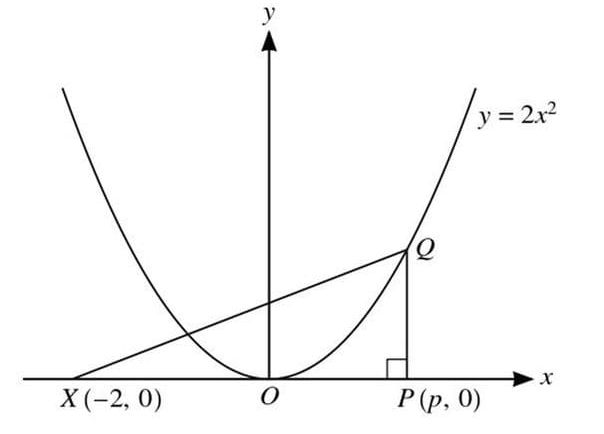
The diagram shows the curve \(y = 2x^2\) and the points \(X(-2, 0)\) and \(P(p, 0)\). The point \(Q\) lies on the curve and \(PQ\) is parallel to the \(y\)-axis.
(i) Express the area, \(A\), of triangle \(XPQ\) in terms of \(p\).
(ii) The point \(P\) moves along the \(x\)-axis at a constant rate of 0.02 units per second and \(Q\) moves along the curve so that \(PQ\) remains parallel to the \(y\)-axis. Find the rate at which \(A\) is increasing when \(p = 2\).
Solutions locked. Please sign in with access to view them.