9709 P12 - Mar 2017 - Q3
1112
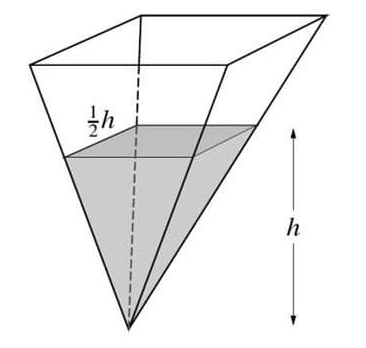
The diagram shows a water container in the form of an inverted pyramid, which is such that when the height of the water level is h cm the surface of the water is a square of side \(\frac{1}{2}h\) cm.
(i) Express the volume of water in the container in terms of h.
[The volume of a pyramid having a base area A and vertical height h is \(\frac{1}{3}Ah\).]
Water is steadily dripping into the container at a constant rate of 20 cm3 per minute.
(ii) Find the rate, in cm per minute, at which the water level is rising when the height of the water level is 10 cm.
Solutions locked. Please sign in with access to view them.