9709 P13 - Jun 2017 - Q10
1109
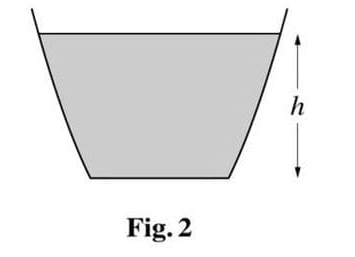
Fig. 2 shows a cross-section of a bowl containing water. When the height of the water level is \(h\) cm, the volume, \(V\) cm\(^3\), of water is given by \(V = \pi \left( \frac{1}{2}h^2 + h \right)\). Water is poured into the bowl at a constant rate of 2 cm\(^3\) s\(^{-1}\). Find the rate, in cm s\(^{-1}\), at which the height of the water level is increasing when the height of the water level is 3 cm.
Solutions locked. Please sign in with access to view them.