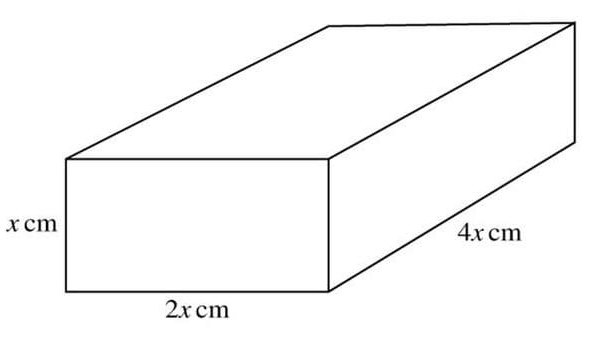
(i) The surface area \(S\) of the cuboid is given by:
\(S = 2(x \cdot 2x + 2x \cdot 4x + 4x \cdot x) = 2(2x^2 + 8x^2 + 4x^2) = 28x^2\).
The volume \(V\) of the cuboid is:
\(V = x \cdot 2x \cdot 4x = 8x^3\).
To show \(S = 7V^{\frac{2}{3}}\), substitute \(V = 8x^3\):
\(V^{\frac{2}{3}} = (8x^3)^{\frac{2}{3}} = 4x^2\).
Thus, \(S = 7 \cdot 4x^2 = 28x^2\), which confirms the relation.
(ii) Given \(V = 1000\), find \(x\):
\(8x^3 = 1000 \Rightarrow x^3 = 125 \Rightarrow x = 5\).
\(S = 28x^2 = 28 \cdot 25 = 700\).
\(\frac{dS}{dt} = 2\), \(\frac{dS}{dx} = 56x\), \(\frac{dV}{dx} = 24x^2\).
\(\frac{dV}{dt} = \frac{dV}{dx} \cdot \frac{dx}{dt}\).
\(\frac{dS}{dt} = \frac{dS}{dx} \cdot \frac{dx}{dt} \Rightarrow 2 = 56x \cdot \frac{dx}{dt} \Rightarrow \frac{dx}{dt} = \frac{1}{140}\).
\(\frac{dV}{dt} = 24x^2 \cdot \frac{1}{140} = \frac{24 \cdot 25}{140} = \frac{30}{7}\).
Thus, the rate of increase of the volume is \(\frac{30}{7}\) or 4.29 cm3 sโ1.