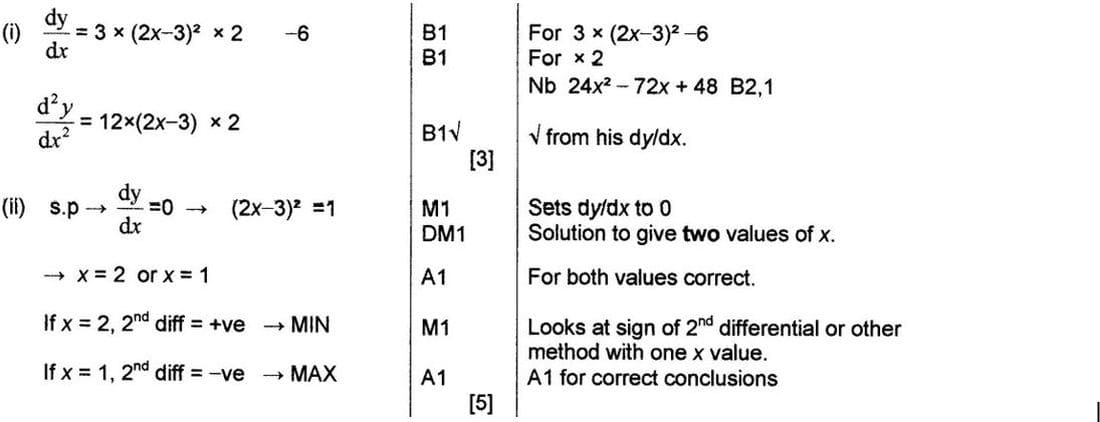
(i) To find \(\frac{dy}{dx}\), use the chain rule on \(y = (2x - 3)^3 - 6x\):
\(\frac{dy}{dx} = 3(2x-3)^2 \cdot \frac{d}{dx}(2x-3) - 6\)
\(\frac{dy}{dx} = 3(2x-3)^2 \cdot 2 - 6\)
\(\frac{dy}{dx} = 6(2x-3)^2 - 6\)
For \(\frac{d^2y}{dx^2}\), differentiate \(\frac{dy}{dx}\):
\(\frac{d^2y}{dx^2} = \frac{d}{dx}(6(2x-3)^2)\)
\(\frac{d^2y}{dx^2} = 12(2x-3) \cdot \frac{d}{dx}(2x-3)\)
\(\frac{d^2y}{dx^2} = 12(2x-3) \cdot 2\)
\(\frac{d^2y}{dx^2} = 24(2x-3)\)
(ii) Stationary points occur where \(\frac{dy}{dx} = 0\):
\(6(2x-3)^2 - 6 = 0\)
\(6(2x-3)^2 = 6\)
\((2x-3)^2 = 1\)
\(2x-3 = \pm 1\)
\(2x = 4\) or \(2x = 2\)
\(x = 2\) or \(x = 1\)
To determine the nature, use \(\frac{d^2y}{dx^2}\):
For \(x = 2\), \(\frac{d^2y}{dx^2} = 24(2 \cdot 2 - 3) = 24 \cdot 1 = 24\) (positive, minimum)
For \(x = 1\), \(\frac{d^2y}{dx^2} = 24(2 \cdot 1 - 3) = 24 \cdot (-1) = -24\) (negative, maximum)