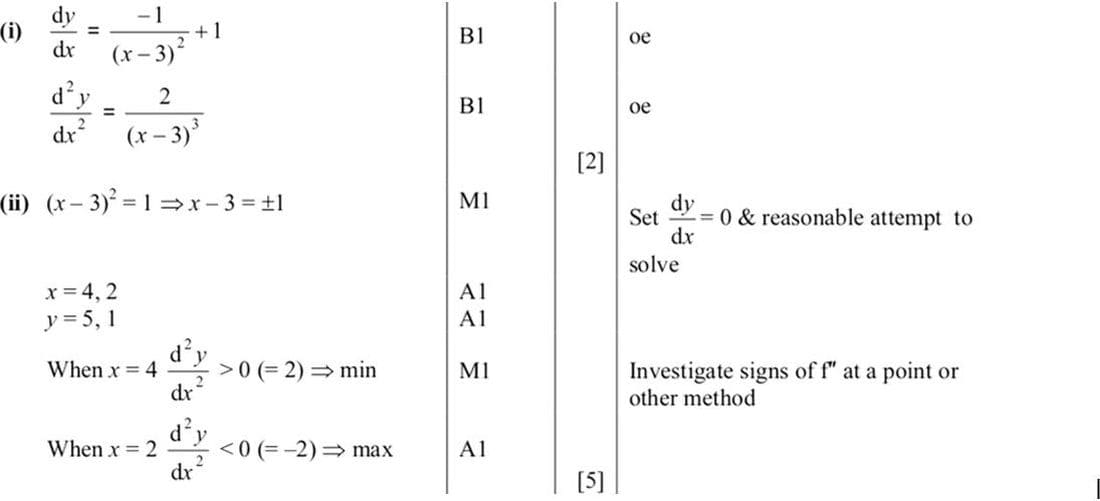
(i) To find \(\frac{dy}{dx}\), differentiate \(y = \frac{1}{x-3} + x\).
The derivative of \(\frac{1}{x-3}\) is \(\frac{-1}{(x-3)^2}\) and the derivative of \(x\) is 1.
Thus, \(\frac{dy}{dx} = \frac{-1}{(x-3)^2} + 1\).
To find \(\frac{d^2y}{dx^2}\), differentiate \(\frac{dy}{dx} = \frac{-1}{(x-3)^2} + 1\).
The derivative of \(\frac{-1}{(x-3)^2}\) is \(\frac{2}{(x-3)^3}\) and the derivative of 1 is 0.
Thus, \(\frac{d^2y}{dx^2} = \frac{2}{(x-3)^3}\).
(ii) To find the critical points, set \(\frac{dy}{dx} = 0\):
\(\frac{-1}{(x-3)^2} + 1 = 0 \Rightarrow (x-3)^2 = 1 \Rightarrow x-3 = \pm 1\).
Solving gives \(x = 4\) and \(x = 2\).
For \(x = 4\), substitute into \(y = \frac{1}{x-3} + x\):
\(y = \frac{1}{4-3} + 4 = 1 + 4 = 5\).
For \(x = 2\), substitute into \(y = \frac{1}{x-3} + x\):
\(y = \frac{1}{2-3} + 2 = -1 + 2 = 1\).
Check the second derivative \(\frac{d^2y}{dx^2}\) to determine concavity:
When \(x = 4\), \(\frac{d^2y}{dx^2} = \frac{2}{(4-3)^3} = 2 > 0\), indicating a minimum.
When \(x = 2\), \(\frac{d^2y}{dx^2} = \frac{2}{(2-3)^3} = -2 < 0\), indicating a maximum.
Thus, the maximum point is \(A(2, 5)\) and the minimum point is \(B(4, 1)\).