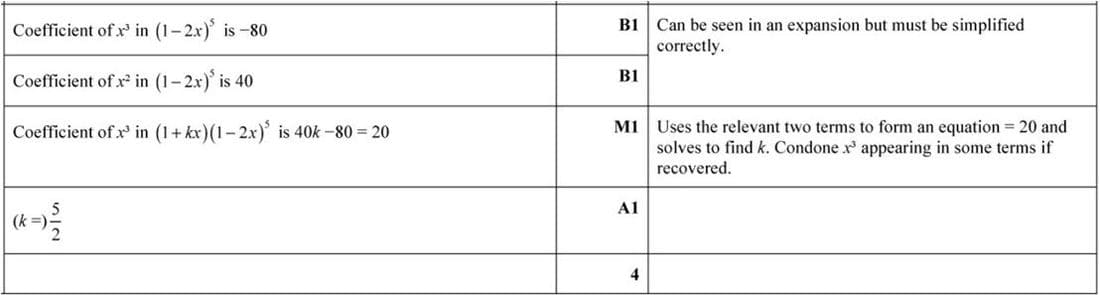
First, find the coefficient of \(x^3\) in \((1 - 2x)^5\). The general term in the binomial expansion of \((1 - 2x)^5\) is given by:
\(\binom{5}{r} (1)^{5-r} (-2x)^r = \binom{5}{r} (-2)^r x^r\).
For \(x^3\), set \(r = 3\):
\(\binom{5}{3} (-2)^3 x^3 = 10(-8)x^3 = -80x^3\).
Thus, the coefficient of \(x^3\) in \((1 - 2x)^5\) is \(-80\).
Next, find the coefficient of \(x^2\) in \((1 - 2x)^5\) to combine with \(kx\) from \((1 + kx)\):
For \(x^2\), set \(r = 2\):
\(\binom{5}{2} (-2)^2 x^2 = 10(4)x^2 = 40x^2\).
Thus, the coefficient of \(x^2\) in \((1 - 2x)^5\) is \(40\).
The coefficient of \(x^3\) in \((1 + kx)(1 - 2x)^5\) is given by:
\(40k - 80 = 20\).
Solving for \(k\):
\(40k - 80 = 20\)
\(40k = 100\)
\(k = \frac{100}{40} = \frac{5}{2}\).