Linearising an exponential model
Difficulty: ★☆☆The constants \(a\) and \(b\) are fixed. Using logarithms, rewrite \(y=e^{ax+b}\) in the form \(Y=mX+c\).
Which choice correctly identifies \(X\), \(Y\), \(m\) and \(c\)?
Linearising a power of ten model
Difficulty: ★☆☆The constants \(a\) and \(b\) are fixed. Using logarithms, rewrite \(y=10^{ax-b}\) in the form \(Y=mX+c\).
Which choice correctly identifies \(X\), \(Y\), \(m\) and \(c\)?
Linearising an inverse power model
Difficulty: ★★☆The constants \(a\) and \(b\) are fixed. Using logarithms, rewrite \(y=ax^{-b}\) in the form \(Y=mX+c\).
Which choice correctly identifies \(X\), \(Y\), \(m\) and \(c\)?
Linearising an exponential base b model
Difficulty: ★★☆The constants \(a\) and \(b\) are fixed. Using logarithms, rewrite \(y=ab^x\) in the form \(Y=mX+c\).
Which choice correctly identifies \(X\), \(Y\), \(m\) and \(c\)?
Rearranging before linearising
Difficulty: ★★★The constants \(a\) and \(b\) are fixed. Using logarithms, rewrite \(a=e^{x^2+by}\) in the form \(Y=mX+c\).
Which choice correctly identifies \(X\), \(Y\), \(m\) and \(c\)?
Linearising a product of powers
Difficulty: ★★★The constants \(a\) and \(b\) are fixed. Using logarithms, rewrite \(x^a y^b=8\) in the form \(Y=mX+c\).
Which choice correctly identifies \(X\), \(Y\), \(m\) and \(c\)?
Linearising with y in the exponent
Difficulty: ★★★The constants \(a\) and \(b\) are fixed. Using logarithms, rewrite \(x a^y=b\) in the form \(Y=mX+c\).
Which choice correctly identifies \(X\), \(Y\), \(m\) and \(c\)?
Linearising an exponential decay model
Difficulty: ★★☆The constants \(a\) and \(b\) are fixed. Using logarithms, rewrite \(y=a e^{-bx}\) in the form \(Y=mX+c\).
Which choice correctly identifies \(X\), \(Y\), \(m\) and \(c\)?
Equation of a straight line from a log plot
Difficulty: ★★☆The variables \(x\) and \(y\) are related so that, when \(\log_{10} y\) is plotted on the vertical axis and \(x\) is plotted on the horizontal axis, the graph is a straight line through the points \((2,5)\) and \((6,11)\).
Which equation expresses \(\log_{10} y\) in terms of \(x\)?
Recovering y from a base-10 logarithmic equation
Difficulty: ★★☆The variables \(x\) and \(y\) satisfy \(\log_{10} y=\dfrac32x+2\).
Which expression gives \(y\) in the form \(a\times10^{bx}\)?
Equation of a straight line from a ln-ln plot
Difficulty: ★★☆The variables \(x\) and \(y\) are related so that, when \(\ln y\) is plotted on the vertical axis and \(\ln x\) is plotted on the horizontal axis, the graph is a straight line through the points \((2,4)\) and \((5,13)\).
Which equation expresses \(\ln y\) in terms of \(\ln x\)?
Recovering y from a natural logarithm equation
Difficulty: ★★☆The variables \(x\) and \(y\) satisfy \(\ln y=3\ln x-2\).
Which expression gives \(y\) in terms of \(x\)?
Linearising an equation involving powers
Difficulty: ★★★The variables \(x\) and \(y\) satisfy \(5^{2y}=3^{2x+1}\).
By taking natural logarithms, which equation shows that the graph of \(y\) against \(x\) is a straight line?
Gradient and intercept from a linearised equation
Difficulty: ★★★The variables \(x\) and \(y\) satisfy \(5^{2y}=3^{2x+1}\).
After linearising, the graph of \(y\) against \(x\) is a straight line. Which statement correctly gives the gradient and the point where the line cuts the \(y\)-axis?
Finding a and n from a ln-ln graph
Difficulty: ★★★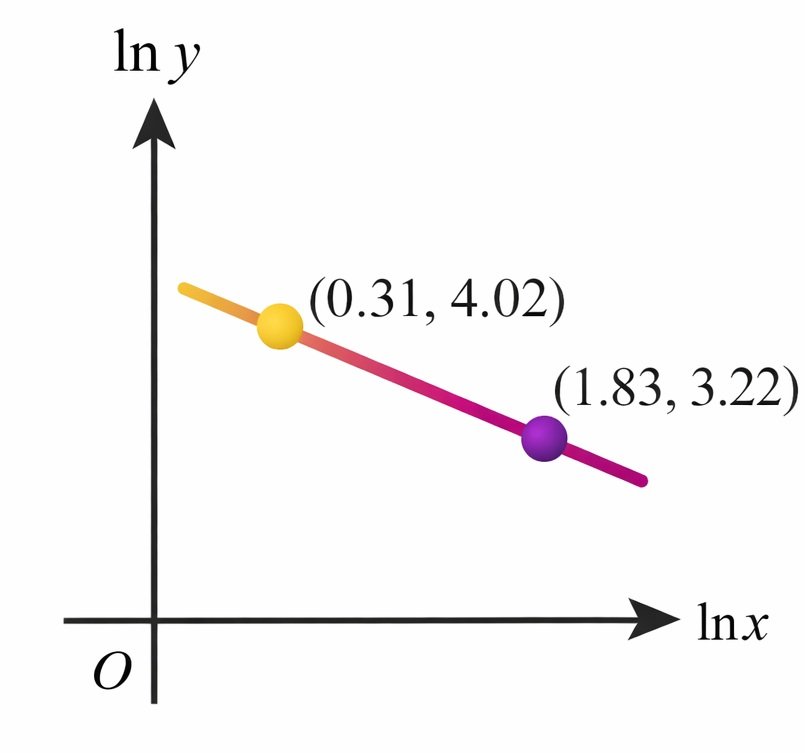
The variables \(x\) and \(y\) satisfy the equation \(y=ax^n\), where \(a\) and \(n\) are constants.
When \(\ln y\) is plotted against \(\ln x\), the graph is a straight line passing through the points \((0.31,4.02)\) and \((1.83,3.22)\).
Find the value of \(a\) and the value of \(n\), correct to 2 significant figures.
Finding k and n from a semi-log graph
Difficulty: ★★★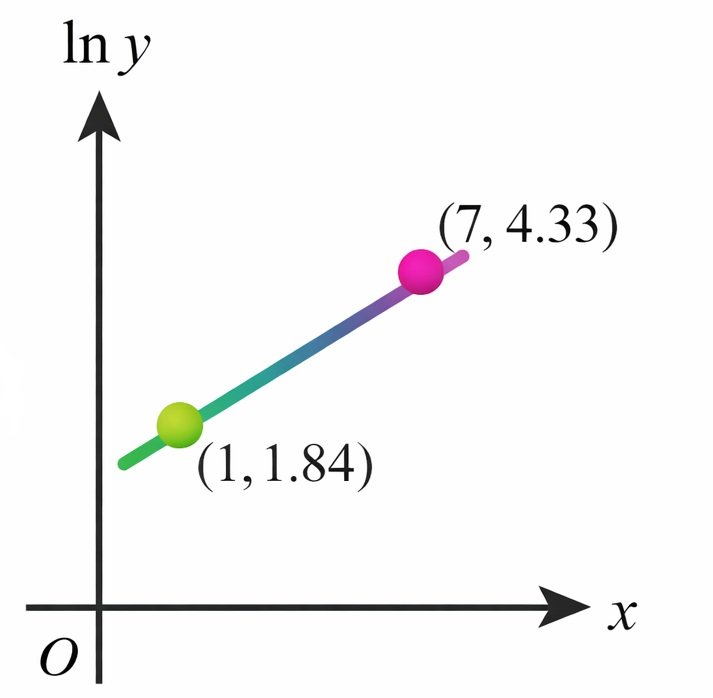
The variables \(x\) and \(y\) satisfy the equation \(y=k e^{n(x-2)}\), where \(k\) and \(n\) are constants.
When \(\ln y\) is plotted against \(x\), the graph is a straight line passing through the points \((1,1.84)\) and \((7,4.33)\).
Find the value of \(k\) and the value of \(n\), correct to 2 significant figures.
Estimating fund growth parameters from data
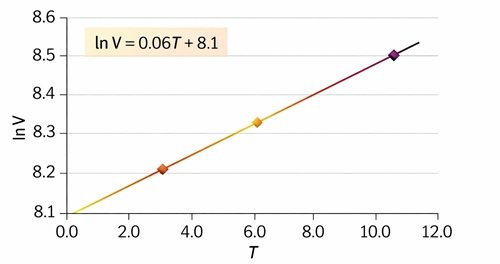
Difficulty: ★★★Warren invests \(\$A\) in a fund. After \(T\) years, its value \(V\) is modelled by \(V=Ar^T\).
The table shows four recorded values.
| \(T\) | 2 | 4 | 6 | 9 |
|---|---|---|---|---|
| \(V\) | 3572 | 4000 | 4440 | 5106 |
Using a straight-line logarithmic model, which estimate is most reasonable for \(A\), \(r\), and the average annual return?
Estimating parameters in a bacterial growth model
Difficulty: ★★★The population \(P\) of a colony of bacteria is modelled by \(P=kr^t\), where \(P\) is in thousands of bacteria and \(t\) is the number of hours since the experiment started.
The data are shown below.
| \(t\) | 1.2 | 2.5 | 4.2 | 6.2 |
|---|---|---|---|---|
| \(P\) | 12.3 | 17.2 | 26.9 | 45.9 |
Using a straight-line logarithmic model, which estimate is most reasonable for \(k\) and \(r\)?
Linear form, gradient and intercept from a logarithmic equation
Difficulty: ★★☆The variables \(x\) and \(y\) satisfy \(5^y=6^{2x-5}\).
By taking logarithms, which statement correctly shows that the graph of \(y\) against \(x\) is a straight line and gives its exact gradient and intercept?
Estimating A and k from a straight-line plot
Difficulty: ★★☆Two variables are related by \(y=Ak^x\), where \(A\) and \(k\) are constants.
An attached straight-line graph of \(\ln y\) against \(x\) is used to estimate the parameters.
Which estimate is most reasonable for \(A\) and \(k\)?
Solving an exponential equation with logarithms
Difficulty: ★★☆Use logarithms to solve the equation \(3^{x+2}=11^{x-1}\).
Choose the solution correct to 3 significant figures.
Solving e to the 2x equals 5 to the x minus 3
Difficulty: ★★☆Use logarithms to solve the equation \(e^{2x}=5^{x-3}\).
Choose the solution correct to 3 decimal places.
Solving e to the x minus 1 equals 5 to the x plus 3
Difficulty: ★★☆Use logarithms to solve the equation \(e^{x-1}=5^{x+3}\).
Choose the solution correct to 3 significant figures.