Final Round 2022 · ARMO

Total: 19
Reset
ARMO 2022, Final Round, 9.1
ID: 182 ✍️ A.S. Golovanov 🏷 ARMO 📅 2022 🎓 9 ★★★★★★★☆☆☆ Hard
geometry (misc) number theory probability

We will call the two largest natural divisors of a composite number \( n \), other than \( n \) itself, its main divisors. Composite natural numbers \( a \) and \( b \) are such that the main divisors of \( a \) coincide with the main divisors of \( b \). Prove that \( a = b \).

Let \( n > k \) be the main divisors of the number \( a \); then \( a / n \) and \( a / k \) are the two smallest divisors of the number \( a \) greater than one. Let \( p \) be the smallest prime divisor of the number \( a \), and \( q \) be the smallest prime divisor of \( a \) other than \( p \) (if such exists). Then \( a / n = p \). Furthermore, \( a / k \) is either a prime number (then it is \( q \)), or composite. In the second case, the only prime divisor of \( a / k \) is \( p \), and therefore \( a / k = p^{2} \); this case occurs precisely when \( a \) is divisible by \( p^{2} \), with \( p^{2} < q \) or \( q \) does not exist.

Thus, the main divisors of the number \( a \) are either \( a / p \) and \( a / q \), or \( a / p \) and \( a / p^{2} \). We will now show that the composite number \( a \) is uniquely determined by the two main divisors \( n > k \) (from which the required follows). If \( n \) is divisible by \( k \), then the second case is fulfilled, and then \( a = n^{2} / k \). Otherwise, the first case is fulfilled, and then \( a = \operatorname{lcm}(n, k) \).

ARMO 2022, Final Round, 9.2
ID: 183 ✍️ L. Emelyanov, I. Bogdanov 🏷 ARMO 📅 2022 🎓 9 ★★★★★★★☆☆☆ Hard
geometry geometry (misc) planimetry probability

The angle bisectors of triangle \( ABC \) intersect at point \( I \), and the external angle bisectors of its angles \( B \) and \( C \) intersect at point \( J \). The circle \( \omega_{b} \) with center at point \( O_{b} \) passes through point \( B \) and is tangent to line \( CI \) at point \( I \). The circle \( \omega_{c} \) with center at point \( O_{c} \) passes through point \( C \) and is tangent to line \( BI \) at point \( I \). Segments \( O_{b}O_{c} \) and \( IJ \) intersect at point \( K \). Find the ratio \( IK / KJ \).

\( 1 / 3 \).

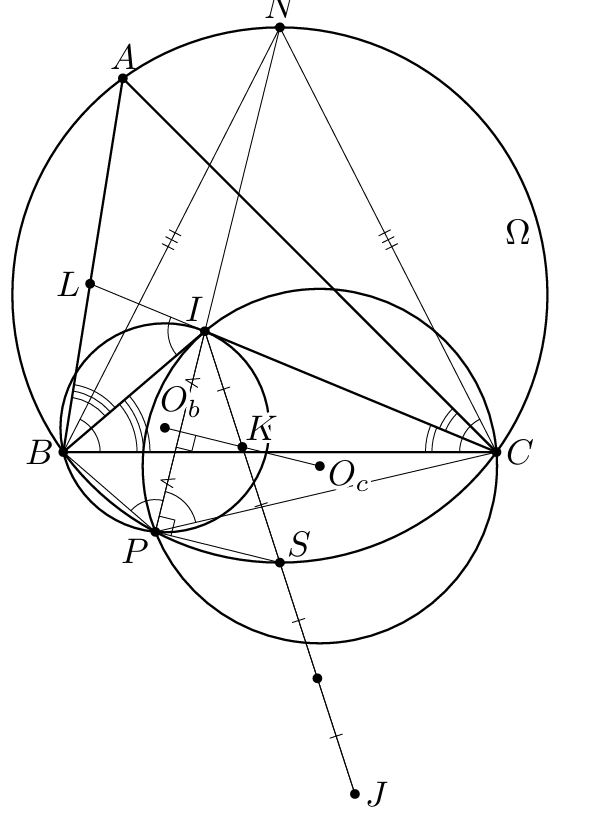
First solution. Draw diameter \( IX \) in circle \( \omega_{b} \), and diameter \( IY \) in circle \( \omega_{c} \). Note that \( \angle IBJ = 90^{\circ} = \angle ICJ \), since the internal and external angle bisectors are perpendicular. Therefore, point \( X \) lies on \( BJ \), and point \( Y \) lies on \( CJ \) (see image 1). Moreover, \( IX \perp IC \), since \( \omega_{b} \) is tangent to \( IC \) at point \( I \), so \( IX \parallel CJ \). Similarly, \( IY \parallel BJ \). Thus, quadrilateral \( IXJY \) is a parallelogram, let its diagonals intersect at point \( M \). Then \( IM = MJ \), and segment \( O_{b}O_{j} \) is the midline of triangle \( IXY \), so point \( K \) is the midpoint of segment \( IM \). Therefore, \( IK = IM / 2 = IJ / 4 \), which implies that \( IK / KJ = 1 / 3 \).

Image 1

Image 2

Second solution. Let \( N \) be the midpoint of arc \( BAC \) of the circumcircle \( \Omega \) of triangle \( ABC \), and let \( S \) be the midpoint of the other arc \( BC \). Let ray \( NI \) intersect \( \Omega \) again at point \( P \) (see image 2). Since \( SN \) is the diameter of circle \( (ABC) \), \( \angle NPS = 90^{\circ} \).

By a known lemma about the trident, we have \( SI = SC = SJ \), in particular, \( S \) is the midpoint of segment \( IJ \). Since \( \angle BAC = \angle BNC \) and \( BN = NC \), \( \angle NBC = \angle NCB = \frac{1}{2} \angle ABC + \frac{1}{2} \angle ACB \).

Extend ray \( CI \) to intersect \( AB \) at point \( L \). Since \( \angle LIB \) is external for triangle \( BIC \), and quadrilateral \( BNCP \) is inscribed, we obtain \( \angle LIB = \angle IBC + \angle ICB = \frac{1}{2} \angle ABC + \frac{1}{2} \angle ACB = \angle NCB = \angle IPB \), so circle \( (IBP) \) is tangent to line \( CI \) at point \( I \). Also, this circle passes through \( B \), hence it is circle \( \omega_{b} \). Similarly, circle \( \omega_{c} \) is circumscribed around triangle \( IPC \).

Thus, \( IP \) is the common chord of circles \( \omega_{b} \) and \( \omega_{c} \), and then \( O_{b}O_{c} \) is the perpendicular bisector of segment \( IP \). Since \( \angle IPS = 90^{\circ} \), we find that \( O_{1}O_{2} \) passes through the midpoint of segment \( IS \), i.e., \( KI = KS \), and then \( IK / KJ = 1 / 3 \).

Note. Point \( S \) in the second solution coincides with point \( M \) from the first solution.

solution media solution media
ARMO 2022, Final Round, 10.2
ID: 190 ✍️ A. Kuznetsov 🏷 ARMO 📅 2022 🎓 10 ★★★★★★★☆☆☆ Hard
averages geometry number theory proof by contradiction

On the side \( BC \) of an acute triangle \( ABC \), points \( D \) and \( E \) are marked such that \( BD = CE \). On the arc \( DE \) of the circumcircle of triangle \( ADE \), not containing point \( A \), there are points \( P \) and \( Q \) such that \( AB = PC \) and \( AC = BQ \). Prove that \( AP = AQ \).

First solution. Without loss of generality, assume that point \( D \) lies on segment \( BE \) and \( AD \leqslant AE \). Let \( O \) be the center of the circle (\( ADE \)). Let point \( A' \) be symmetric to \( A \) with respect to the perpendicular bisector of segment \( DE \) (see fig. 5). By symmetry, \( A'B = AC = BQ \). The circle centered at \( B \) with radius \( BA' \) intersects the circle (\( ADE \)) at points symmetric with respect to line \( BO \), meaning points \( A' \) and \( Q \) are symmetric with respect to \( BO \). Similarly, points \( A' \) and \( P \) are symmetric with respect to line \( CO \).

Lines \( OB \) and \( OC \) are symmetric with respect to the perpendicular bisector of segment \( DE \), so they form equal angles with line \( DE \). Since \( A'P \perp CO, A'Q \perp BO \) and \( AA' \parallel DE \), lines \( A'Q \) and \( A'P \) form equal angles with line \( AA' \). Therefore, the smaller arcs of the circle (\( ADE \)), subtended by chords \( AP \) and \( AQ \), are equal, hence \( AP = AQ \), as required.

Second solution. Without loss of generality, assume that point \( D \) lies on segment \( BE \). Let \( O \) be the center of the circle (\( ADE \)). Note that \( OB = OC \). Since \( \angle DAE < \angle BAC < 90^{\circ} \), points \( A \) and \( O \) lie on the same side of line \( BC \) (see fig. 6). Triangles \( OAB \) and \( OPC \) are congruent by three sides, and triangles \( OAC \) and \( OQB \) are also congruent.

Then \( \angle ABQ = \angle ABO + \angle OBQ = \angle PCO + \angle OCA = \angle PCA \). (If ray \( BO \) does not lie inside angle \( ABQ \), then ray \( BA \) lies inside angle \( QBO \), and hence inside angle \( OBC \). In this case, either \( \angle BOA > \angle BOE = \angle COD > \angle COP \), or \( \angle BOA << \angle BOD = \angle COE < \angle COP \); in both cases, we get a contradiction with the congruence of triangles \( OAB \) and \( OPC \). Similarly, ray \( CO \) lies inside angle \( PCA \).

Therefore, triangles \( ABQ \) and \( PCA \) are congruent by two sides and the angle between them, from which \( AP = AQ \).

solution media solution media
ARMO 2022, Final Round, 11.2
ID: 197 ✍️ A. Kuznetsov 🏷 ARMO 📅 2022 🎓 11 ★★★★★★★☆☆☆ Hard
algebra equations geometry graph theory graphs & loci trigonometry

On the plane, the graphs of the functions \( y = \sin x \) and \( y = \operatorname{tg} x \) are drawn, as well as the coordinate axes. How can one construct, using a compass and straightedge, a line that is tangent to the sine graph both above and below the x-axis (\( O x \)), and possibly has several other points of intersection?

We will look for a tangent line passing through the origin. The tangent to the sine graph at the point \( ( x_{0}, \sin x_{0} ) \) has the equation \( y = (x - x_{0}) \cdot \cos x_{0} + \sin x_{0} \). This line passes through the origin if and only if \( 0 = -x_{0} \cdot \cos x_{0} + \sin x_{0} \), which is equivalent to \( \operatorname{tg} x_{0} = x_{0} \).

It remains to construct the point \( ( x_{0}, \sin x_{0} ) \). For this, using a compass and straightedge, we construct the bisector of the coordinate angle, i.e., the line \( y = x \). We choose its intersection point with the tangent graph: \( (x_{0}, \operatorname{tg} x_{0}), x_{0} \neq 0 \). Then, by dropping a perpendicular from this point to the x-axis and intersecting this perpendicular with the sine graph, we obtain the point \( ( x_{0}, \sin x_{0} ) \). The line passing through the origin and the point \( (x_{0}, \sin x_{0}) \) will be tangent to the sine graph at the point \( (x_{0}, \sin x_{0}) \) by the choice of the point \( x_{0} \), as well as at the point \( (-x_{0},-\sin x_{0}) \) due to symmetry with respect to the origin. These points lie on opposite sides of the x-axis, as required.

ARMO 2022, Final Round, 9.3
ID: 184 ✍️ O. Podlipskiy, I. Bogdanov 🏷 ARMO 📅 2022 🎓 9 ★★★★★★★★☆☆ Hard
calculus (series) classical combinatorics combinatorics digits examples & counterexamples number theory

A sequence of 200 natural numbers is written in a row. For any two adjacent numbers in the sequence, the right one is either 9 times the left one or 2 times less than the left one. Can the sum of all these 200 numbers be equal to \( 24^{2022} \)?

It cannot.

Let the sequence consist of numbers \( a_{1}, a_{2}, \ldots, a_{200} \) in this order. If the number \( a_{i} = 2k \) is even, then the next number can be either \( k \) or \( 18k \); these numbers give the same remainders when divided by 17. If \( a_{i} \) is odd, then \( a_{i + 1} = 9a_{i} \). In any case, we obtain that \( a_{i} \equiv 2a_{i + 1} \pmod{17} \).

Thus, assuming \( a = a_{200} \), we find that in terms of remainders modulo 17, the sequence is arranged like the sequence \( 2^{199}a, 2^{198}a, \ldots, 2a, a \). The sum of all the terms of this new sequence is \( \left(2^{200}-1\right)a \). In particular, it is divisible by \( 2^{8}-1 = 15 \cdot 17 \), i.e., it is divisible by 17. Therefore, the sum of the numbers in the original sequence is also divisible by 17, and it cannot be equal to \( 24^{2022} \).

Note. It is also possible to prove that the sum of all numbers in the sequence is divisible by 17 in another way. For example, one can divide the sequence into groups of eight consecutive numbers and notice that the sum of the numbers in a group ending with the number \( a \) is congruent to \( \left(2^{8}-1\right)a = 17 \cdot 15a \).

Another approach is as follows. Each subsequent number in the sequence is obtained from the previous one by one of the following operations: division by 2 or multiplication by 9. Note that swapping these operations does not change the remainder of the sum of all numbers when divided by 17 (indeed, after such a swap, the fragment \( 2k, 18k, 9k \) is replaced by the fragment \( 2k, k, 9k \)). Then, one can rearrange the operations so that divisions by 2 come first, followed by multiplications by 9.

If there are \( n - 1 \) divisions by 2, followed by \( 200-n \) multiplications by 9, then the sequence consists of numbers \( 2^{n - 1}a, 2^{n - 2}a, \ldots \), \( 2a, a, 9a, 81a, \ldots, 9^{200-n}a \). The sum of all these numbers is

\[ a\left(2^{n}-1\right) + 9a \cdot \frac{9^{200-n}-1}{8} = \frac{a}{8} \cdot\left(2^{n + 3} + 9^{201-n}-17\right) . \]

After this, it is sufficient to check that the number \( 2^{i} + 9^{j} \) is divisible by 17 if \( i + j \) leaves a remainder of 4 when divided by 8. This can be done, for example, by checking the remainders modulo 8, taking into account that \( 2^{8}-1 = 15 \cdot 17 \equiv 0 \pmod{17} \) and \( 9^{8}-1 \equiv(-4)^{4}-1 = 2^{8}-1 \equiv 0 \pmod{17} \).

ARMO 2022, Final Round, 9.4
ID: 185 ✍️ A. Ibragimov, I. Bogdanov 🏷 ARMO 📅 2022 🎓 9 ★★★★★★★★☆☆ Hard
algebra averages geometry geometry (misc) inequalities

In a class, there are 18 children. The parents decided to give the children a cake. To do this, they first asked each child the area of the piece they wanted to receive. Then they ordered a square-shaped cake, the area of which is exactly equal to the sum of the 18 specified numbers. However, upon seeing the cake, the children wanted their pieces to also be square. The parents can cut the cake with cuts parallel to the sides of the cake (the cuts do not have to start or end on the side of the cake). For what maximum \( k \) can the parents guarantee to cut \( k \) square pieces from the ordered cake, which can be given to \( k \) children so that each of them receives what they want?

\( k = 12 \).

We always assume that the area of the cake is 1.

Let's show that for some requests from the children, the parents will not be able to cut more than 12 required pieces. Choose a number \( 1 / 15 > x > 1 / 16 \). Suppose that 15 main children ordered a piece of cake with an area of \( x \) (and the remaining three made arbitrary orders so that the total area of the ordered pieces was equal to 1). Mentally divide the cake into 16 equal squares and mark on the cake all 9 vertices of these squares that do not lie on the border of the cake (see image 3). Then strictly inside any square piece of area \( x \) there will be one of the marked points, that is, no more than nine such pieces can be cut. Therefore, at least six children will not get the desired pieces.

It remains to prove that 12 children can always get what they want. Let \( a_{1} \geqslant a_{2} \geqslant \ldots \geqslant a_{18} \) be the side lengths of the pieces that the children want to receive, that is,

\[ a_{1}^{2} + a_{2}^{2} + \ldots + a_{18}^{2} = 1 . \]

We will show that pieces with sides \( a_{7}, a_{8}, \ldots, a_{18} \) can be cut from the square.

For this, we will need the inequalities

\[ a_{7} + a_{10} + a_{13} + a_{16} \leqslant 1 \quad \text { and } \quad a_{7} + a_{8} + a_{9} \leqslant 1 . \]

To prove the first inequality, note that

\[ \begin{array}{l} 1 \geqslant a_{1}^{2} + a_{2}^{2} + \ldots + a_{16}^{2} \geqslant 4 a_{4}^{2} + 4 a_{8}^{2} + 4 a_{12}^{2} + 4 a_{16}^{2} \geqslant \\ \quad \geqslant 4\left(a_{7}^{2} + a_{10}^{2} + a_{13}^{2} + a_{16}^{2}\right) \geqslant\left(a_{7} + a_{10} + a_{13} + a_{16}\right)^{2} \end{array} \]

in the last step we used the inequality between the quadratic mean and the arithmetic mean. The second inequality is proved similarly:

\[ \begin{aligned} 1 \geqslant a_{1}^{2} + a_{2}^{2} & + \ldots + a_{9}^{2} \geqslant 3 a_{3}^{2} + 3 a_{6}^{2} + 3 a_{9}^{2} \geqslant \\ & \geqslant 3\left(a_{7}^{2} + a_{8}^{2} + a_{9}^{2}\right) \geqslant\left(a_{7} + a_{8} + a_{9}\right)^{2} . \end{aligned} \]

Image 3

Image 4

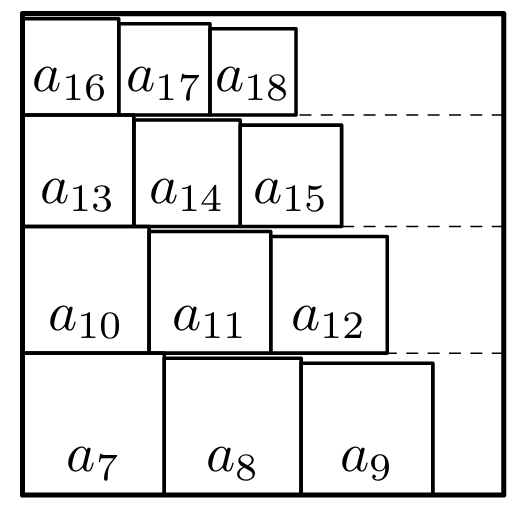
From the inequalities (*) it follows that the cake can be cut into horizontal strips of heights not less than \( a_{7}, a_{10}, a_{13} \) and \( a_{16} \) respectively, and in the \( i \)-th strip, squares with sides \( a_{3 i + 4}, a_{3 i + 5} \) and \( a_{3 i + 6} \) can be placed, as shown in image 4.

solution media solution media
ARMO 2022, Final Round, 10.3
ID: 191 ✍️ M. Antipov 🏷 ARMO 📅 2022 🎓 10 ★★★★★★★★☆☆ Hard
algebra equivalence relations geometry (misc) inequalities number theory

Initially, the pair of numbers \((1,1)\) is written on the board. If for some \(x\) and \(y\) the pair \((x, y - 1)\) or \((x + y, y + 1)\) is written on the board, then the other can be added. Similarly, if the pair \((x, xy)\) or \(\left(\frac{1}{x}, y\right)\) is written on the board, then the other can be added. Prove that in every written pair, the first number will be positive.

First solution. We call the discriminant of the pair of numbers \((a, b)\) the value \(D(a, b) = b^{2}-4a\). We will prove that the discriminant of all pairs of numbers written on the board is always negative. Indeed, the discriminant of the initially written pair is \(D(1,1) = -3 < 0\). Furthermore, the following relations hold:

\[ \frac{D(x, y - 1)}{D(x + y, y + 1)} = \frac{y^{2}-4x - 2y + 1}{y^{2}-4x - 2y + 1} = 1 \]

and

\[ \frac{D(x, xy)}{D(1 / x, y)} = \frac{x^{2}y^{2}-4x}{y^{2}-4/x} = x^{2} \]

therefore, at no point can a number with a positive discriminant appear on the board. Now consider any pair \((a, b)\) written on the board. In it, the first number \(a\) is equal to \(\frac{b^{2}-D}{4}\) and, therefore, is greater than 0, which is what we needed to prove.

Second solution. If the pair \((x, y)\) is written on the board, then using the first operation, one can add either the pair \((x + y + 1, y + 2)\) or the pair \((x - y + 1, y - 2)\). Both of these pairs can be written as \(\left(x + ky + k^{2}, y + 2k\right)\), where in the first case \(k = 1\), and in the second \(-k = -1\). Using the second operation, one can only add the pair \(\left(\frac{1}{x}, \frac{y}{x}\right)\).

We will prove a more general fact: at each step, for any integers \(s, t\), such that \(s^{2} + t^{2} > 0\), for any pair of numbers \((x, y)\) written on the board, the inequality

\[ s^{2}x + sty + t^{2} > 0 \]

holds. In particular, for \(s = 1, t = 0\), we get exactly the statement of the original problem.

For the pair \((1,1)\), the statement of the problem is true. Next, consider two types of operations: - \((x, y) \rightarrow\left(x + ky + k^{2}, y + 2k\right)\). Then for the new pair, it holds \(s^{2}\left(x + ky + k^{2}\right) + st(y + 2k) + t^{2} = s^{2}x + s(sk + t)y + (sk + t)^{2} > 0\).

- \((x, y) \rightarrow(1 / x, y / x)\). Here, we also obtain the required inequality: \[ s^{2} \frac{1}{x} + st \frac{y}{x} + t^{2} = \frac{t^{2}x + tsy + s^{2}}{x} = \frac{t^{2}x + tsy + s^{2}}{1^{2} \cdot x + 1 \cdot 0 \cdot y + 0^{2}} > 0 . \]

ARMO 2022, Final Round, 10.4
ID: 192 🏷 ARMO 📅 2022 🎓 10 ★★★★★★★★☆☆ Hard
averages combinatorics examples & counterexamples geometry graph theory proof by contradiction

Given a natural number \( n > 4 \). On a plane, \( n \) points are marked, no three of which are collinear. Vasily draws all segments connecting pairs of marked points one by one. At each step, when drawing the next segment \( S \), Vasily labels it with the smallest natural number that has not yet been used to label any segment sharing an endpoint with \( S \). What is the largest \( k \) for which Vasily can label some segment with the number \( k \)? (A. Glebov, D. Khramov)

\( k = 2n - 3 \) for odd \( n \), and \( k = 2n - 4 \) for even \( n > 4 \).

Estimate. Consider the step at which Vasily labels a segment \( AB \). Before this step, from each of the points \( A \) and \( B \), at most \( n - 2 \) segments emanate, and they contain at most \( 2n - 4 \) different labels. Therefore, Vasily can certainly label this segment with a number not exceeding \( 2n - 3 \). Thus, \( k \leq 2n - 3 \).

If \( n \) is even, this estimate can be refined as follows. Call a segment labeled with one a small segment. We will prove that at the end of the process, a small segment will emanate from each point; assume the contrary. The points from which small segments emanate are paired with points connected by such a segment. Therefore, there are at least two points \( X \) and \( Y \) from which no small segments emanate. It follows that when Vasily drew the segment \( XY \), he must have labeled it with one—a contradiction.

Thus, if the segment \( AB \) is not small, then at the end of the process, among the segments emanating from \( A \) and \( B \), besides \( AB \), there will be two small segments. Therefore, on these segments, there will be at most \( 2(n - 2) - 1 = 2n - 5 \) different labels. Consequently, when Vasily draws the segment \( AB \), he will be able to label it with a number not exceeding \( 2n - 4 \), and \( k \leq 2n - 4 \).

Example. It remains to prove that Vasily can achieve the indicated values of \( k \).

Lemma. If the number of points is even and equal to \( m \), then Vasily can label all segments between these points using only numbers from 1 to \( m - 1 \). Moreover, from each point, segments labeled with all these numbers will emanate.

Proof. The statement of the lemma does not depend on the specific arrangement of the points, so we can assume that \( m - 1 \) points \( A_{1}, \ldots, A_{m - 1} \) are located at the vertices of a regular \( (m - 1) \)-gon, and the remaining point is at its center \( O \).

Then all segments between these points can be divided into \( m - 1 \) sets \( S_{1}, S_{2}, \ldots, S_{m - 1} \) such that the segments of one set do not have common endpoints. For example, in the set \( S_{i} \), one can include the segment \( OA_{i} \) and all segments connecting pairs of vertices of the \( (m - 1) \)-gon and perpendicular to \( OA_{i} \). From each point, a segment from each of the sets emanates.

Now Vasily can first label all segments of set \( S_{1} \) with the number 1, then all segments of the second set with the number 2, and so on.

Returning to the solution. Let \( n \) be odd, and let \( A \) be a marked point. Let Vasily first label all segments between points other than \( A \) with numbers from 1 to \( n - 2 \) according to the lemma. Then he will draw all \( n - 1 \) segments from \( A \); each segment \( AB \) will have to be labeled with a number greater than \( n - 2 \) because segments labeled with all smaller numbers already emanate from \( B \). Moreover, all these \( n - 1 \) segments will be labeled with different numbers because they have a common endpoint. Consequently, they will be labeled with numbers \( n - 1, n, \ldots, 2n - 3 \), meaning Vasily will achieve a label \( k = 2n - 3 \).

Now let \( n \) be even. Choose two marked points \( A \) and \( B \); let \( C_{1}, C_{2}, \ldots, C_{n - 2} \) be the other marked points. Let Vasily first label all segments between points \( C_{i} \) with numbers from 1 to \( n - 3 \) according to the lemma, and also label the segment \( AB \) with the number 1. Then he sequentially draws the segments \( AC_{1}, AC_{2}, \ldots, AC_{n - 3} \); since segments with labels from 1 to \( n - 3 \) already enter the vertices \( C_{i} \), the new segments will be labeled with numbers \( n - 2, n - 1, \ldots, 2n - 6 \) respectively. Next, Vasily draws the segments \( BC_{n - 3}, BC_{2}, BC_{3}, \ldots, BC_{n - 4} \); similarly, he will label them with numbers \( n - 2, n - 1, \ldots, 2n - 6 \) respectively.

Now segments with all labels from \( n - 2 \) to \( 2n - 6 \) already enter the vertices \( A \) and \( B \), and segments with all labels from 1 to \( n - 3 \) enter the vertex \( C_{n - 2} \). Therefore, when Vasily draws the segments \( AC_{n - 2} \) and \( BC_{n - 2} \), the first will be labeled with the number \( 2n - 5 \), and the second with the number \( 2n - 4 \) (since it shares an endpoint with the previous one). Thus, Vasily achieved the appearance of the number \( k = 2n - 4 \).

ARMO 2022, Final Round, 11.3
ID: 198 ✍️ I. Kukharchuk, M. Didin 🏷 ARMO 📅 2022 🎓 11 ★★★★★★★★☆☆ Hard
geometry geometry (misc) logic planimetry

In the plane, a fixed acute-angled triangle \( ABC \) is given with the largest side \( BC \). Let \( PQ \) be an arbitrary diameter of its circumcircle, where the point \( P \) lies on the minor arc \( AB \), and the point \( Q \) lies on the minor arc \( AC \). The points \( X, Y, \) and \( Z \) are the feet of the perpendiculars dropped from the point \( P \) to the line \( AB \), from the point \( Q \) to the line \( AC \), and from the point \( A \) to the line \( PQ \). Prove that the circumcenter of triangle \( XYZ \) lies on a fixed circle (independent of the choice of points \( P \) and \( Q \)).

Note that \( \angle PAQ = 90^{\circ} \), since \( PQ \) is a diameter of the circumcircle of \( ABC \). Let \( M \) and \( N \) be the midpoints of segments \( AP \) and \( AQ \) respectively. Since \( \angle AZP = 90^{\circ} = \angle AXP \), the quadrilateral \( AZXP \) is inscribed in a circle with center at point \( M \), from which \( \angle PZX = \angle PAB = 90^{\circ} - \angle BAQ = 90^{\circ} - \angle BPZ \). Consequently, \( XZ \perp BP \). Therefore, as stated above, the perpendicular bisector of segment \( XZ \) passes through point \( M \) and is parallel to line \( BP \), and thus it also passes through the midpoint of segment \( AB \), denoted by \( D \). Similarly, if \( E \) is the midpoint of segment \( AC \), then \( NE \) is the perpendicular bisector of segment \( YZ \). Thus, the lines \( MD \) and \( NE \) intersect at the center of the circle \( XYZ \), denoted by \( O \).

Then \( \angle DOE = 180^{\circ} - \angle XZY = \angle PZX + \angle QZY = \angle PAB + \angle QAC = 90^{\circ} - \angle BAC \). Therefore, point \( O \) lies on a fixed circle passing through points \( D \) and \( E \), which is what was required.

ARMO 2022, Final Round, 9.5
ID: 186 ✍️ A.S. Golovanov 🏷 ARMO 📅 2022 🎓 9 ★★★★★★★★★☆ Very hard
contradiction inequalities infinite sequences monotonicity proof by contradiction sequences

Consider an infinite sequence of numbers \( a_{1}, a_{2}, \ldots \), in which no two terms are equal. A segment \( a_{i}, a_{i + 1}, \ldots, a_{i + m - 1} \) of this sequence is called a monotonic segment of length \( m \) if the inequalities \( a_{i} < a_{i + 1} < \ldots < a_{i + m - 1} \) or the inequalities \( a_{i} > a_{i + 1} > \ldots > a_{i + m - 1} \) hold. It turns out that for each natural number \( k \), the term \( a_{k} \) is contained in some monotonic segment of length \( k + 1 \). Prove that there exists a natural number \( N \) such that the sequence \( a_{N}, a_{N + 1}, \ldots \) is monotonic, i.e., \( a_{N} < a_{N + 1} < \ldots \) or \( a_{N} > a_{N + 1} > \ldots \).

First solution. We will call an index \( k \geqslant 2 \) bad if \( a_{k - 1} < a_{k} > a_{k + 1} \) or \( a_{k - 1} > a_{k} < a_{k + 1} \). Note that if there are no bad indices among \( N + 1, N + 2, \ldots \), then the sequence \( a_{N}, a_{N + 1}, a_{N + 2}, \ldots \) is monotonic.

Assume that the statement of the problem is false. Then there are infinitely many bad indices. Choose some bad index \( k \). Take any \( n > k \) and consider the monotonic segment \( I \) of length \( n + 1 \) containing \( a_{n} \). It cannot contain the terms \( a_{k - 1}, a_{k} \) and \( a_{k + 1} \) simultaneously; therefore, since \( k + 1 \leqslant n \), the segment \( I \) definitely does not contain \( a_{k - 1} \), and hence does not contain \( a_{1} \).

Thus, the monotonic segment \( I \) of length \( n + 1 \) contains \( a_{n} \) but does not contain \( a_{1} \); then it must contain \( a_{n}, a_{n + 1} \), and \( a_{n + 2} \), so the index \( n + 1 \) is not bad. Therefore, for any \( n > k \), the index \( n + 1 \) is not bad, so there are finitely many bad indices. Contradiction.

Second solution. Assume the contrary. Without loss of generality, we can assume that \( a_{1} < a_{2} \) (otherwise, we can multiply all terms of the sequence by -1). Since the sequence \( a_{2}, a_{3}, \ldots \) is not increasing, there exists \( k \geqslant 2 \) such that \( a_{k} > a_{k + 1} \). Since the sequence \( a_{k + 1}, a_{k + 2}, \ldots \) is not decreasing, there exists \( \ell > k \) such that \( a_{\ell} < a_{\ell + 1} \). Choose the smallest \( \ell \) satisfying these two inequalities. Then either \( \ell > k + 1 \), and then \( a_{\ell - 1} > a_{\ell} \) according to the choice of \( \ell \), or \( \ell = k + 1 \), and then \( a_{\ell - 1} = a_{k} > a_{k + 1} = a_{\ell} \). Thus, in any case, \( a_{\ell - 1} > a_{\ell} \).

Consider a monotonic segment of length \( \ell \) containing \( a_{\ell - 1} \); it must also contain \( a_{\ell} \). Since \( a_{\ell - 1} > a_{\ell} \), the numbers in this segment decrease monotonically. Therefore, it cannot contain the number \( a_{1} \) (otherwise, it would also contain \( a_{2} > a_{1} \)). But then, since the length of the segment is \( \ell \), it must also contain \( a_{\ell + 1} > a_{\ell} \), which is impossible.

ARMO 2022, Final Round, 9.6
ID: 187 ✍️ A. Khrabrov 🏷 ARMO 📅 2022 🎓 9 ★★★★★★★★★☆ Very hard
algebra exponents & roots geometry (misc) inequalities proof by contradiction quadratic equations

For what smallest natural number \( a \) do there exist integers \( b \) and \( c \) such that the quadratic trinomial \( a x^{2} + b x + c \) has two distinct positive roots not exceeding \( \frac{1}{1000} \)?

\( a = 1001000 \).

First solution. We will prove that \( a \geqslant 1001000 \). Note that if \( y \) is a root of the trinomial \( a x^{2} + b x + c \), then \( 1 / y \) is a root of the trinomial \( c x^{2} + b x + a \). Therefore, the problem requires finding the smallest natural \( a \) for which the roots \( x_{1} \) and \( x_{2} \) of some trinomial \( c x^{2} + b x + a \) (with integer \( b \) and \( c \)) are greater than 1000. Since \( x_{1} \) and \( x_{2} \) are positive and \( x_{1} x_{2} = a / c \) (by Vieta's theorem), we have \( c > 0 \).

If \( c = 1 \), then \( \left|x_{1}-x_{2}\right| = \sqrt{b^{2}-4 a} \geqslant 1 \). Since the smaller root is at least 1000, the larger root is at least 1001, and then \( a = x_{1} x_{2} \geqslant 1001 \cdot 1000 \). If \( c \geqslant 2 \), then \( a = c x_{1} x_{2} \geqslant 2 x_{1} x_{2} > 2000000 \). In both cases, the required estimate is proven.

It remains to note that the trinomial \( x^{2}-(1000 + 1001) x + 1001 \cdot 1000 \) has roots 1000 and 1001, so \( a = 1001000 \) is suitable.

Second solution. Let us denote \( n = 1000 \) for brevity. Let \( x_{1} \) and \( x_{2} \) be two distinct roots of the trinomial \( f(x) = a x^{2} + b x + c \), with \( 0 < x_{1} < x_{2} \leqslant \frac{1}{n} \). Then the number \( b = -a(x_{1} + x_{2}) \) is negative, and the number \( c = a x_{1} x_{2} \) is positive. Moreover, we have \( \frac{-b}{a} = x_{1} + x_{2} < \frac{2}{n} \), hence \( a > -\frac{n b}{2} \).

Since the roots are distinct, the discriminant \( D = b^{2}-4 a c \) is positive. Therefore, \( b^{2} > 4 a c > -2 n b c \) and thus \( -b > 2 n c \). Therefore, \( a > (-b) \cdot \frac{n}{2} > 2 n c \cdot \frac{n}{2} = n^{2} c \). Let \( a = n^{2} c + d \), where \( d \) is a natural number.

Assume \( a < n^{2} + n \). Then \( c = 1 \) and \( d < n \). Therefore, \( 0 \leqslant f\left(\frac{1}{n}\right) = \frac{a}{n^{2}} + \frac{b}{n} + c = \frac{d}{n^{2}} + \frac{b}{n} + 2 < \frac{1}{n} + \frac{b}{n} + 2 \) and thus \( -b < 2 n + 1 \). Consequently, \( -b \leqslant 2 n \) and \( D = b^{2}-4 a c \leqslant 4 n^{2} - 4(n^{2} + d) = -4 d < 0 \). This contradiction shows that \( d \geqslant n \).

If \( a = n^{2} + n \), then for \( b = -2 n - 1 \) and \( c = 1 \), the trinomial has roots \( x_{1} = \frac{1}{n + 1} \) and \( x_{2} = \frac{1}{n} \).

ARMO 2022, Final Round, 9.7
ID: 188 ✍️ I. Bogdanov 🏷 ARMO 📅 2022 🎓 9 ★★★★★★★★★☆ Very hard
combinatorics geometry (misc) graph theory logic planimetry

In a country, there are 998 cities. Some pairs of cities are connected by two-way flights. According to the law, there must be no more than one flight between any pair of cities. Another law requires that for any group of cities, there should be no more than \( 5k + 10 \) flights connecting two cities of this group, where \( k \) is the number of cities in the group. Currently, the laws are being followed. Prove that the Ministry of Development can introduce several new flights so that the laws are still followed, and the total number of flights in the country becomes 5000.

Let's call a set of cities critical if there are exactly \( 5k + 10 \) flights connecting two cities of this group, where \( k \) is the number of cities in the group (then \( k > 11 \), because otherwise there are no more than \( k(k - 1) / 2 \leqslant 5k < 5k + 10 \) flights between the cities of the group). If the group of all 998 cities is critical, then there are already \( 5 \cdot 998 + 10 = 5000 \) flights in the country.

From now on, we always assume that the laws are followed at any moment. Let \( f(X) \) denote the number of flights connecting two cities of group \( X \).

We will prove that if the group of all cities is not critical, then the ministry can add one flight while complying with the laws. By repeating such operations, the ministry will achieve the required result. Note that if there is no flight between cities \( x \) and \( y \), the ministry cannot add it only if both cities \( x \) and \( y \) are part of some critical group.

Lemma. Let \( A \) and \( B \) be critical groups. Then the group \( A \cup B \) is also critical.

Proof. Let \( C = A \cap B, D = A \cup B \). Let \( |A| = a, |B| = b, |C| = c \); then \( |D| = a + b - c \). By condition, we have \( f(A) = 5a + 10, f(B) = 5b + 10 \) and \( f(C) \leqslant 5c + 10 \). Note that all flights counted in \( f(A) \) and \( f(B) \) are also counted in \( f(D) \); moreover, if some flight is counted in both \( f(A) \) and \( f(B) \), then both its ends lie in \( C \), i.e., the number of flights counted twice is \( f(C) \). Therefore,

\[ \begin{array}{c} f(D) \geqslant f(A) + f(B) - f(C) \geqslant (5a + 10) + (5b + 10) - (5c + 10) = \\ = 5(a + b - c) + 10 = 5d + 10 \end{array} \]

Considering that the laws are followed, we get \( f(D) = 5d + 10 \), which was required.

Returning to the solution. If there is currently no critical group, a flight can be added between any pair of cities that do not yet have one (such a pair will be found!). Otherwise, by applying the lemma, we find that the union of all critical groups is also a critical group \( A \); by assumption, it contains \( a < 998 \) cities. Let \( x \) be a city outside \( A \); then \( x \) is not part of any critical group.

Let there be \( k \) flights from \( x \) to cities in \( A \). Since the group \( A^{\prime} = A \cup \{x\} \) is not critical, we have

\[ 5(a + 1) + 10 > f\left(A^{\prime}\right) = f(A) + k = 5a + 10 + k \]

from which \( k < 5 \). On the other hand, \( a \geqslant 12 \), so there is a city \( y \) in \( A \) not connected by a flight with \( x \), and cities \( x \) and \( y \) are not part of the same critical group. Thus, the ministry can introduce a flight between \( x \) and \( y \).

ARMO 2022, Final Round, 9.8
ID: 189 ✍️ A. Shevtsov 🏷 ARMO 📅 2022 🎓 9 ★★★★★★★★★☆ Very hard
averages geometry geometry (misc) homothety

A circle \( \omega \) is inscribed in triangle \( ABC \), touching side \( BC \) at point \( K \). The circle \( \omega' \) is symmetric to circle \( \omega \) with respect to point \( A \). A point \( A_0 \) is chosen such that segments \( BA_0 \) and \( CA_0 \) are tangent to \( \omega' \). Let \( M \) be the midpoint of side \( BC \). Prove that line \( AM \) bisects segment \( KA_0 \).

Let points \( B', C' \), and \( K' \) be symmetric with respect to \( A \) to points \( B, C \), and \( K \) respectively. Then circle \( \omega' \) is inscribed in triangle \( AB'C' \) and touches \( B'C' \) at point \( K' \). The median \( AM \) is the midline in triangles \( BCC' \) and \( B'BC \), so \( AM \parallel BC' \parallel B'C \). Since \( A \) is the midpoint of \( KK' \), the problem statement is equivalent to line \( AM \) containing the midline of triangle \( KK'A_0 \) (parallel to \( A_0K' \)), which is equivalent to \( B'C \parallel A_0K' \).

Fig. 5

Let \( \omega \) touch \( AB \) and \( AC \) at points \( X \) and \( Y \) respectively, and \( \omega' \) touch segments \( AB', AC', A_0B \), and \( A_0C \) at points \( X' \), \( Y' \), \( X_0 \), and \( Y_0 \) respectively. Note that \( AB - AC = (AX + XB) - (AY + YC) = XB - YC = KB - KC \). Similarly, if the incircle of triangle \( A_0BC \) touches \( BC \) at point \( K_0 \), then \( A_0B - A_0C = K_0B - K_0C \). However,

\[ \begin{array}{c} A_0B - A_0C = (A_0X_0 + X_0B) - (A_0Y_0 + Y_0C) = X_0B - Y_0C = \\ = X'B - Y'C = (XA + AB) - (YA + AC) = AB - AC \end{array} \]

so \( KB - KC = K_0B - K_0C \), and therefore \( K = K_0 \).

From what has been proven, the excircles of triangles \( ABC \) and \( A_0BC \) also touch segment \( BC \) at the same point \( N \), symmetric to \( K \) with respect to \( M \) (since \( BN = CK \)). A homothety centered at \( A_0 \), mapping line \( BC \) to line \( B'C' \), maps the excircle of triangle \( A_0BC \) to circle \( \omega' \), i.e., point \( N \) to \( K' \). Thus, \( N \) lies on line \( A_0K \); but since \( BN = CK = C'K' \), we have \( K'N \parallel B'C \), i.e., \( A_0K' \parallel B'C \), which was required.

Remark 1. After the first paragraph, the solution can also be completed by applying Brianchon's theorem to the circumscribed (around \( \omega' \)) hexagon \( A_0BB'K'C'C \). The theorem states that the three main diagonals \( A_0K', BC', B'C \) of this hexagon intersect at one point or are pairwise parallel; in our problem, the second case occurs, i.e., \( A_0K' \parallel BC' \parallel B'C \).

Remark 2. From the problem statement, it follows that the center \( I' \) of the incircle of triangle \( A_0BC \) lies on \( AM \). There are ways to solve the problem by proving this fact.

solution media
ARMO 2022, Final Round, 10.5
ID: 193 ✍️ I. Bogdanov 🏷 ARMO 📅 2022 🎓 10 ★★★★★★★★★☆ Very hard
geometry (misc) inequalities logic number theory planimetry

On a board, 11 integers are written (not necessarily distinct). Can it be that the product of any five of them is greater than the product of the remaining six?

Yes, it can.

Let one of the numbers be 10, and each of the others be -1. Then the product of any five of them is greater than the product of the remaining six. Indeed, if the number 10 is included in the product of the five numbers, then this product is 10, and the product of the remaining six numbers is 1, and \( 10 > 1 \). If the number 10 is not included in the product of the five numbers, then this product is -1, and the product of the remaining six numbers is -10, and \( -1 > -10 \).

ARMO 2022, Final Round, 10.6
ID: 194 ✍️ I. Bogdanov 🏷 ARMO 📅 2022 🎓 10 ★★★★★★★★★☆ Very hard
combinatorics geometry (misc) logic planimetry sequences

Given a natural number \( n > 5 \). On a circular strip of paper, a sequence of zeros and ones is written. For each sequence \( w \) of \( n \) zeros and ones, the number of ways to cut out a fragment from the strip on which \( w \) is written was counted. It turned out that the maximum number \( M \) is achieved on the sequence \( 11 \underbrace{00 \ldots 0}_{n - 2} \), and the minimum (possibly zero) is on the sequence \( \underbrace{00 \ldots 0}_{n - 2} 11 \). Prove that there is another sequence of \( n \) zeros and ones that occurs exactly \( M \) times.

Let \( N \) be the number of ways to cut out from the strip the sequence \( 1 \underbrace{00 \ldots 0}_{\geqslant n - 2} 1 \) (i.e., the number of sequences of at least \( n - 2 \) zeros, before and after which there are ones). Before each of them, there can be either 1 or 0; let \( N_{1 x} \) be the number of those before which there is 1, and \( N_{0 x} \) be the number before which there is 0. After each of the \( N \) sequences, there can be either 0 or 1; similarly to the previous sentence, introduce the numbers \( N_{x 0} \) and \( N_{x 1} \). Then

\[ N_{0 x} + N_{1 x} = N = N_{x 0} + N_{x 1} . \]

Note that \( N_{1 x} \) is the number of ways to cut out the sequence \( 11 \underbrace{00 \ldots 0}_{\geqslant n - 2} 1 \). Each such way corresponds to a way to cut out the sequence \( 11 \underbrace{00 \ldots 0}_{n - 2} \); and conversely, each way to cut out the sequence \( 11 \underbrace{00 \ldots 0}_{n - 2} \) can be uniquely extended to a way to cut out the sequence \( 11 \underbrace{00 \ldots 0}_{\geqslant n - 2} 1 \). Therefore, the numbers of such ways are the same, and \( N_{1 x} = M \). Similarly, \( N_{0 x}, N_{x 0} \), and \( N_{x 1} \) are equal to the numbers of ways to cut out the sequences \( 01 \underbrace{00 \ldots 0}_{n - 2}, \underbrace{00 \ldots 0}_{n - 2} 10 \), and \( \underbrace{00 \ldots 0}_{n - 2} 11 \) respectively. According to the condition, the sequence \( \underbrace{00 \ldots 0}_{n - 2} 11 \) occurs the least number of times, hence \( N_{0 x} \geqslant N_{x 1} \). Then, considering ( \( * \) ), we obtain \( N_{x 0} \geqslant N_{1 x} = M \), which is possible only if \( N_{x 0} = M \). Therefore, the sequence \( \underbrace{00 \ldots 0}_{n - 2} 10 \) also occurs exactly \( M \) times.

Note. The same solution can be presented in a slightly different language. Denote by \( x^{k} \) a sequence of \( k \) letters \( x \). For a word \( w \), denote by \( f(w) \) the number of ways to cut out \( w \) from the strip. Then for any word \( w \), the equality \( f(w) = f(0 w) + f(1 w) = f(w 0) + f(w 1) \) holds.

Note that \( f\left(10^{n - 1}\right) + f\left(0^{n}\right) = f\left(0^{n - 1}\right) = f\left(0^{n}\right) + f\left(0^{n - 1} 1\right) \), so \( f\left(10^{n - 1}\right) = f\left(0^{n - 1} 1\right) \).

Now

\[ \begin{array}{l} f\left(110^{n - 2}\right) + f\left(010^{n - 2}\right) = f\left(10^{n - 2}\right) = f\left(10^{n - 2} 1\right) + f\left(10^{n - 1}\right) = \\ \quad = f\left(10^{n - 2} 1\right) + f\left(0^{n - 1} 1\right) = f\left(0^{n - 2} 1\right) = f\left(0^{n - 2} 11\right) + f\left(0^{n - 2} 10\right) \end{array} \]

Thus, the difference between the largest and smallest numbers of ways is

\[ f\left(110^{n - 2}\right)-f\left(0^{n - 2} 11\right) = f\left(0^{n - 2} 10\right)-f\left(010^{n - 2}\right) . \]

In particular, it must hold that \( f\left(0^{n - 2} 10\right) = M \).

ARMO 2022, Final Round, 10.8
ID: 195 ✍️ S. Berlov, F. Petrov, D. Krachun 🏷 ARMO 📅 2022 🎓 10 ★★★★★★★★★☆ Very hard
absolute value algebra combinatorics digits examples & counterexamples number theory

For a natural number \( N \), consider all distinct perfect squares that can be obtained from \( N \) by deleting one digit in its decimal representation. Prove that the number of these squares does not exceed a certain value that does not depend on \( N \).

Let the number \( N \) consist of \( k + 1 \) digits. We assume further that \( k > 100 \): smaller numbers do not affect the desired boundedness.

For \( i = 1, \ldots, k \), denote by \( n_{i} \) the number obtained by deleting the \( i \)-th digit from the end of \( N \). Let \( f(N) \) be the number of perfect squares in the set \( \left\{n_{1}, \ldots, n_{k}\right\} \). Our goal is to prove that \( f(N) \) is bounded above.

Let \( N = 10^{t} N_{1} \), where \( N_{1} \) is not divisible by 10. If \( t \) is odd, then the number \( n_{i} \) can be a perfect square only for \( i \leqslant t + 1 \), so in this case \( f(N) \leqslant 2 \). If \( t \) is even, then the final \( t \) zeros do not affect the matter, so \( f(N) = f\left(N_{1}\right) \). Therefore, we further assume that \( N \) is not divisible by 10.

Let us select a set \( A \subset\{1, \ldots, k\} \) of \( f(N) \) indices \( i \) for which \( n_{i} = m_{i}^{2} \) is a perfect square, where the natural numbers \( m_{i}, i \in A \), are pairwise distinct.

Note the following: 1) \( n_{i} \geqslant 10^{k - 1} \), hence \( m_{i} \geqslant 10^{(k - 1) / 2} \) for all \( i \in A \);

2) \( \left|n_{i}-n_{j}\right| < 10^{\max (i, j)} \);

3) \( N - n_{i} \) is divisible by \( 10^{i - 1} \).

From property 1), it follows that for different indices \( i \neq j \) from \( A \), the estimate holds

\[ \left|n_{i}-n_{j}\right| = \left|m_{i}^{2}-m_{j}^{2}\right| \geqslant m_{i} + m_{j} \geqslant 2 \cdot 10^{(k - 1) / 2} . \]

Comparing this with property 2), we obtain that \( \max (i, j) > (k - 1) / 2 \). Thus, all elements of \( A \), except possibly one, are greater than \( (k - 1) / 2 \). Denote \( A_{1} : = A \backslash\{\min (A)\} \) (we removed the smallest element from \( A \)), then \( \left|A_{1}\right| = f(N)-1 \) and \( \min \left(A_{1}\right) \geqslant k / 2 \).

Let \( j > i \) be two elements of the set \( A_{1} \). Then by properties 1), 2) we have

\[ 10^{j} > \left|n_{i}-n_{j}\right| = \left|m_{i}^{2}-m_{j}^{2}\right| \geqslant 2 \cdot 10^{(k - 1) / 2} \cdot\left|m_{i}-m_{j}\right| . \]

On the other hand, by property 3) the number \( n_{i}-n_{j} = \left(m_{i}-m_{j}\right)\left(m_{i} + \right. \left. + m_{j}\right) \) is divisible by \( 10^{i - 1} \).

Let \( r = \lceil(i - 1) / 2\rceil \) (where \( \lceil\cdot\rceil \) denotes the ceiling function). At least one of the numbers \( m_{i}-m_{j}, m_{i} + m_{j} \) is divisible by \( 2^{r} \), and at least one is divisible by \( 5^{r} \). Moreover, if \( N \) is odd, then the numbers \( m_{i}, m_{j} \) are odd, so one of the numbers \( m_{i}-m_{j}, m_{i} + m_{j} \) is not divisible by 4, and the other, respectively, is divisible by \( 2^{i - 2} \). Otherwise, \( N \) is not divisible by 5, and similarly, we obtain that one of the numbers \( m_{i}-m_{j} \), \( m_{i} + m_{j} \) is divisible by \( 5^{i - 1} \).

Consider a five-element subset \( \tilde{A} \subset A_{1} \), denote the smallest element of \( \tilde{A} \) by \( u \), and the largest by \( v \). Denote \( r = \lceil(u - 1) / 2\rceil \). If \( N \) is odd, let \( \alpha = u - 2, \beta = r \); otherwise, let \( \alpha = r, \beta = u - 1 \). From what has been proven, it follows that the elements of the set \( \left\{m_{s} : s \in \tilde{A}\right\} \) give no more than two different residues modulo \( 2^{\alpha} \) and no more than two different residues modulo \( 5^{\beta} \). Thus, in \( \tilde{A} \) there are two different elements \( i < j \) such that \( m_{j}-m_{i} \) is divisible by \( 2^{\alpha} 5^{\beta} \). Then from (1) we obtain

\[ \begin{aligned} 10^{v} & \geqslant 10^{j} \geqslant 2 \cdot 10^{(k - 1) / 2} 2^{\alpha} 5^{\beta} \geqslant \\ & \geqslant 10^{(k - 1) / 2 + (u - 1) / 2} 2^{(u - 1) / 2} > 10^{u - 1} 2^{u / 2} \end{aligned} \]

from which it follows that \( v / u > 1.01 \). Thus, if we divide the segment \( [k / 2, k] \) into groups of consecutive numbers, in each of which the ratio of any two elements is less than 1.01 (the number of such groups is less than, for example, a million), then any of these groups contains no more than 4 elements of the set \( A_{1} \). From this follows the boundedness of the number \( \left|A_{1}\right| = f(N)-1 \).

ARMO 2022, Final Round, 10.7
ID: 196 ✍️ A. Kuznetsov, P. Kozhevnikov 🏷 ARMO 📅 2022 🎓 10 ★★★★★★★★★☆ Very hard
geometry geometry (misc) logic planimetry

On the side \( BC \) of parallelogram \( ABCD \), a point \( E \) is marked, and on the side \( AD \), a point \( F \) is marked such that the circumcircle of triangle \( ABE \) is tangent to segment \( CF \). Prove that the circumcircle of triangle \( CDF \) is tangent to line \( AE \).

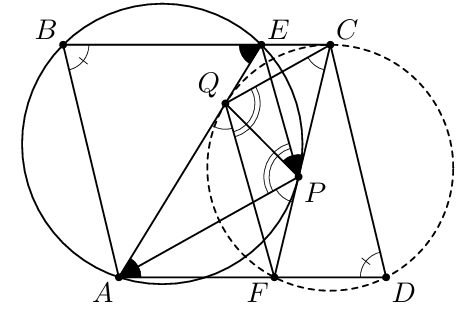
First solution. Let the point of tangency of the circle (\( ABE \)) with segment \( CF \) be \( P \). Let the line passing through \( C \) and parallel to \( AP \) intersect segment \( AE \) at point \( Q \) (see fig. 2). Then \( \angle QCP = \angle APF = \angle AEP \) (from the aforementioned tangency and parallelism). Thus, quadrilateral \( CEQP \) is cyclic. We have \( \angle QPC = 180^{\circ} - \angle QEC = \angle QAF \). Consequently, quadrilateral \( QPFA \) is cyclic. Then \( \angle AQF = \angle APF = \angle QCP \), from which \( QF \parallel EP \). Therefore, lines \( CQ \), \( EP \), \( PA \), and \( QF \) bound a parallelogram, hence \( \angle CQF = \angle APE \). Since \( \angle APE = 180^{\circ} - \angle ABC = 180^{\circ} - \angle CDF \), point \( Q \) lies on the circle (\( CDF \)). Since \( \angle AQF = \angle QCP \), the circle (\( CDF \)) is tangent to segment \( AE \) at point \( Q \), which was required.

Fig. 2

Fig. 3

Second solution. Let \(O_{1}\) be the center of the circle \((A B E)\); let \(R_{1}\) be its radius and \(d_{1}\) the distance from \(O_{1}\) to the line \(C F\). Let \(O_{2}\) be the center of the circle \((C D F)\); let \(R_{2}\) be its radius and \(d_{2}\) the distance from \(O_{2}\) to the line \(A E\). We will prove the more general fact \(d_{1}/R_{1}=d_{2}/R_{2}\) \((\star)\).

In particular, if \(d_{1}=R_{1}\), then \(d_{2}=R_{2}\), and the first equality is equivalent to the tangency of line \(C F\) with circle \((A B E)\), while the second is equivalent to the tangency of line \(A E\) with circle \((C D F)\).

If \(A E \parallel C F\), then points \(E\) and \(F\), as well as \(O_{1}\) and \(O_{2}\), are symmetric with respect to the center of the parallelogram. By this central symmetry we have \(d_{1}=d_{2}\) and \(R_{1}=R_{2}\), hence \((\star)\) follows.

Otherwise, without loss of generality, assume that ray \(A E\) intersects ray \(F C\); denote their intersection point by \(K\) (see Fig. 3).

Let \(\alpha\) be the angles at vertices \(B\) and \(D\) of parallelogram \(A B C D\). Consider the case \(\alpha<90^{\circ}\); the other cases are similar. Then \(\angle A O_{1} E=2\alpha=\angle C O_{2} F\), so the isosceles triangles \(A O_{1} E\) and \(C O_{2} F\) are similar. Hence \(\angle E A O_{1}=\angle C F O_{2}\) and \(\frac{R_{1}}{R_{2}}=\frac{O_{1}A}{O_{2}F}=\frac{A E}{C F}=\frac{K A}{K F}\) (the last equality follows from Thales’ theorem). Therefore triangles \(K A O_{1}\) and \(K F O_{2}\) are similar by an angle and the ratio of the including sides. Thus \(\frac{O_{1}K}{O_{2}K}=\frac{O_{1}A}{O_{2}F}=\frac{R_{1}}{R_{2}}\) and \(\angle O_{1} K A=\angle O_{2} K F\). Then \(\angle O_{1} K F=\angle O_{2} K A\), so \(\frac{d_{1}}{d_{2}}=\frac{O_{1}K}{O_{2}K}=\frac{R_{1}}{R_{2}}\), which is exactly what we needed.

Remark. Relation \((\star)\) is equivalent to saying that the angle between circle \((A B E)\) and line \(C F\) equals the angle between circle \((C D F)\) and line \(A E\).

Third solution. Let circle \((A B E)\) be tangent to segment \(C F\) at point \(P\) and meet line \(A D\) again at point \(X\). Let \(Y\) be the second intersection point of circle \((F C D)\) with line \(B C\) (see Fig. 4). Then segments \(X E\) and \(A B\) are symmetric with respect to the perpendicular bisector of \(B E\), and segments \(C D\) and \(Y F\) are symmetric with respect to the perpendicular bisector of \(D F\); hence \(\overrightarrow{X E}=\overrightarrow{F Y}\). Since circle \((A B E)\) is tangent to segment \(C F\), point \(X\) lies on ray \(F A\). Consequently, point \(Y\) lies on ray \(E C\), and moreover \(X F=E Y\).

Because circle \((A B E X)\) is tangent to segment \(C F\) at \(P\), we have \(C P^{2}=C E \cdot C B\) and \(F P^{2}=F A \cdot F X\). Hence \(C F=\sqrt{C E \cdot C B}+\sqrt{F X \cdot F A}\) \((\star)\).

We will later prove that this implies \(A E=\sqrt{A F \cdot A D}+\sqrt{E Y \cdot Y C}\) \((\star\star)\). First we finish the solution using it. Mark a point \(T\) on segment \(A E\) such that \(E T=\sqrt{E Y \cdot E C}\) and \(A T=\sqrt{A F \cdot A D}\). If \(T\) is different from the endpoints of \(A E\), these equalities mean that circles \((Y C T)\) and \((F D T)\) are tangent to line \(A E\) at \(T\). If these circles are not the same, then neither of them coincides with circle \((F Y C D)\), and in that case lines \(A E\), \(B C\), and \(A D\) would be the radical axes of these three circles. But lines \(B C\) and \(A E\) meet at point \(E\), which does not lie on line \(A D\), a contradiction. Therefore circles \((Y C T)\) and \((F D T)\) actually coincide; then this common circle is exactly \((C D F)\), and it is tangent to \(A E\) at \(T\). If points \(Y\) and \(C\) coincide, then, as usual, by circle \((Y C T)\) we mean the circle passing through \(T\) and tangent to \(B C\) at \(Y\). If \(T\) coincides with one endpoint of \(A E\), only \(T=E\) is possible; then \(E Y=0\), i.e. \(E=Y\), and also \(A E^{2}=A F \cdot A D\). Hence circle \((C F D)\) is tangent to \(A E\) at \(E\).

It remains to prove relation \((\star\star)\). Put \(E Y=a\), \(E C=x\), \(A F=y\). From the above, the vectors \(\overrightarrow{B A}, \overrightarrow{X E}, \overrightarrow{F Y}, \overrightarrow{C D}\) are equal in length; denote this length by \(b\). Their projections onto the axis directed along \(\overrightarrow{B C}\) are also equal; denote such a projection by \(h\). Let \(d=2h-a\). Then \(B E=y+d\) and \(D F=x+d\).

By Ptolemy’s theorem for quadrilaterals \(F Y C D\) and \(A B E X\) we obtain \(C F^{2}=b^{2}+(x+d)(x-a)\) and \(A E^{2}=b^{2}+(y+d)(y-a)\). Note that these equalities hold regardless of the relative positions of points \(A\) and \(X\), \(C\) and \(Y\). Thus relation \((\star)\) becomes

\(\displaystyle \sqrt{b^{2}+(x+d)(x-a)}=\sqrt{x(x+y+d)}+\sqrt{a y}.\)

Squaring and canceling common terms yields a relation symmetric in \(x\) and \(y\):

\(\displaystyle b^{2}=a(x+y)+ad+xy+2\sqrt{a x y(x+y+d)}.\)

Therefore,

\(\displaystyle \sqrt{b^{2}+(y+d)(y-a)}=\sqrt{y(x+y+d)}+\sqrt{a x},\)

which is exactly \((\star\star)\), as required.

Remark. The point \(T\) coincides with point \(Q\) from Solution 1.

solution media solution media solution media
ARMO 2022, Final Round, 11.6
ID: 199 ✍️ A. Kuznetsov 🏷 ARMO 📅 2022 🎓 11 ★★★★★★★★★☆ Very hard
examples & counterexamples geometry geometry (misc) number theory

Given a natural number \( n \). Sasha claims that for any \( n \) rays in space, no two of which have common points, he can mark \( k \) points on these rays that lie on one sphere. For what largest \( k \) is his claim true?

\( k = n \) for even \( n \), \( k = n + 1 \) for odd \( n \), that is \( 2 \cdot\left\lceil\frac{n}{2}\right\rceil \).

Example. For even \( n = 2m \), consider \( m \) parallel lines and on each select a pair of non-intersecting rays. Notice that in each pair of rays, intersections with the sphere are no more than two, since a line has no more than two common points with a sphere, therefore \( k \leqslant 2m \). An example for odd \( n = 2m - 1 \) is obtained by removing one ray from the example for \( n = 2m \).

Estimation. Consider some line \( \ell \) that is not perpendicular to any of our rays. Consider the projections of our rays on \( \ell \), among them at least \( \left\lceil\frac{n}{2}\right\rceil = \left[\frac{n + 1}{2}\right] \) are directed in one direction (let's say to the right), forget about the other rays. Let point \( X \) on the line belong to all selected projections, choose any point \( Y \in \ell \) to the right. Let \( \alpha_{X} \) and \( \alpha_{Y} \) be planes perpendicular to the line \( \ell \), passing through \( X \) and \( Y \) respectively. Each of our selected rays intersects both these planes. Choose a sufficiently large \( R \) such that the circle \( \omega \subset \alpha_{Y} \) with center \( Y \) and radius \( R \) contains inside all intersection points of the plane \( \alpha_{Y} \) with the selected rays. Consider the sphere \( \Omega \), which touches the plane \( \alpha_{X} \) at point \( X \) and contains the circle \( \omega \). Consider any of our rays. It passes through a point inside the sphere \( \Omega \), and its origin lies in another half-space relative to the plane \( \alpha_{X} \) than \( \Omega \), therefore it intersects \( \Omega \) at two points. Thus, we obtained \( k = 2\left\lceil\frac{n}{2}\right\rceil \) intersection points.

ARMO 2022, Final Round, 11.8
ID: 200 ✍️ A. Kuznetsov, I. Frolov 🏷 ARMO 📅 2022 🎓 11 ★★★★★★★★★☆ Very hard
geometry geometry (misc) graph theory inversion

From each vertex of triangle \( ABC \), two rays are drawn inside the triangle, one red and one blue, symmetric with respect to the bisector of the corresponding angle. Circles are circumscribed around the triangles formed by the intersection of rays of the same color. Prove that if the circumscribed circle of triangle \( ABC \) is tangent to one of these circles, then it is also tangent to the other.

Let the triangle formed by the blue rays be denoted as \( A_{1} B_{1} C_{1} \) (as in the figure), and let its circumscribed circle be tangent to the circle \( ABC \). Let the circle \( A_{1} BC \) intersect the circle \( AB_{1} C \) again at point \( P \) (which obviously lies inside triangle \( A_{1} B_{1} C_{1} \)). Then \( \angle APC = \angle AB_{1} C \) and \( \angle BPC = \angle BA_{1} C \). Since also \( \angle APB + \angle BPC + \angle APC = 360^{\circ} = \angle AB_{1} C + \angle AC_{1} B + \angle BA_{1} C \) (the second equality is the sum of the external angles of triangle \( A_{1} B_{1} C_{1} \)), it follows that \( \angle APB = \angle AC_{1} B \). Thus, point \( P \) also lies on the circle \( (AC_{1} B) \).

Fig. 5

Perform an inversion with center at point \( P \) (and with an arbitrary radius), and denote the images of points with the same letters with primes. Recall that for any points \( X \) and \( Y \), triangles \( XPY \) and \( Y'PX' \) are similar (by angle and the ratio of enclosing sides), so \( \angle X'Y'P = \angle PXY \).

We will prove that triangle \( A_{1}'B_{1}'C_{1}' \) is similar to triangle \( ABC \). Indeed, \( \angle B_{1}'A_{1}'C_{1}' = \angle B_{1}'A_{1}'P + \angle PA_{1}'C_{1}' = \angle PB_{1}A_{1} + \angle A_{1}C_{1}P = \angle PAC + \angle BAP = \angle BAC \), similarly for the other angles.

The circle \( (CPA_{1}B) \) under inversion transforms into the line \( C'B' \), passing through the vertex \( A_{1}' \) of triangle \( A_{1}'B_{1}'C_{1}' \). Find the angle between this line and side \( A_{1}'B_{1}' : \angle B'A_{1}'B_{1}' = \angle PA_{1}'B_{1}' - \angle PA_{1}'B' = \angle A_{1}B_{1}P - \angle A_{1}BP = \angle A_{1}B_{1}P - \angle A_{1}CP = \angle CPB_{1} = \angle CAB_{1} \). Together with two similar equalities, it follows that in the similar triangles \( ABC \) and \( A_{1}'B_{1}'C_{1}' \), the red rays in the first and the rays \( A_{1}'B', B_{1}'C', C_{1}'A' \) in the second are corresponding elements. The circles \( (A_{1}'B_{1}'C_{1}') \) and \( (A'B'C') \) are tangent (since they are obtained by inversion from tangent circles), and then the circle \( ABC \) is tangent to the circumscribed circle of the triangle bounded by the red rays, which was required to be proved.

Note. The solution implies a more general fact: the angles between the circle \( (ABC) \) and the circles circumscribed around the red and blue triangles are the same.

solution media