The bike path consists of two sections: first, there is an asphalt section, and then a sandy section. Petya and Vasya started separately (first Petya, then Vasya), and each rode the entire path. The speed of each boy on each of the two sections was constant. It turned out that they met in the middle of the asphalt section, as well as in the middle of the sandy section. Which of the boys spent less time on the entire path?
They spent the same amount of time.
First solution. Between the two moments of meeting, each boy traveled half of the asphalt section and half of the sandy section, and they spent the same amount of time on this. Therefore, each of them spent twice as much time on the entire path, which means they spent the same amount of time overall.
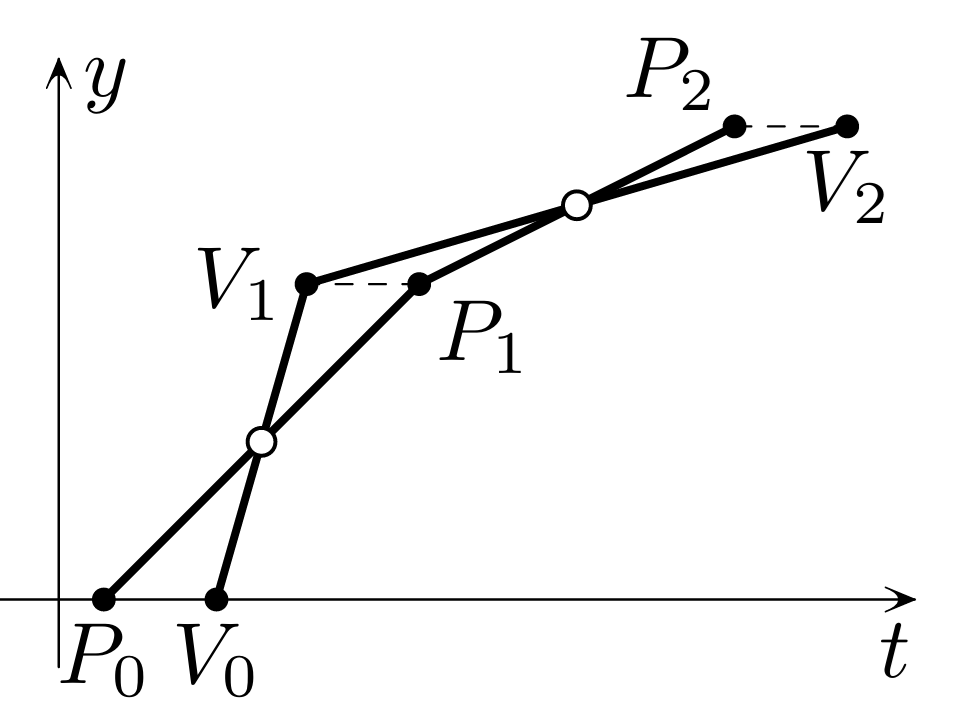
Second solution. Let's draw graphs of the boys' movements along the path: on the horizontal axis, we mark the time \( t \), and on the vertical axis, the position \( y \) of the boy, starting from the beginning of the path. Let \( P_{0}, P_{1}, P_{2} \) be the points corresponding to Petya's start, the moment he switched from the asphalt section to the sandy section, and his finish; let \( V_{0}, V_{1}, V_{2} \) be the analogous points for Vasya. Then the graphs of the boys' movements are the broken lines \( P_{0} P_{1} P_{2} \) and \( V_{0} V_{1} V_{2} \), with the segments \( P_{0} V_{0}, P_{1} V_{1} \), and \( P_{2} V_{2} \) being horizontal (see Fig. 1). According to the condition, the midpoints of the segments \( P_{0} P_{1} \) and \( V_{0} V_{1} \) coincide, from which \( P_{0} V_{0} P_{1} V_{1} \) is a parallelogram. Similarly, \( P_{1} V_{1} P_{2} V_{2} \) is a parallelogram. Therefore, the segments \( P_{0} V_{0}, V_{1} P_{1} \), and \( P_{2} V_{2} \) are parallel and equal. Hence, the time between Petya's and Vasya's finishes is the same as the time between their starts; thus, the answer follows.