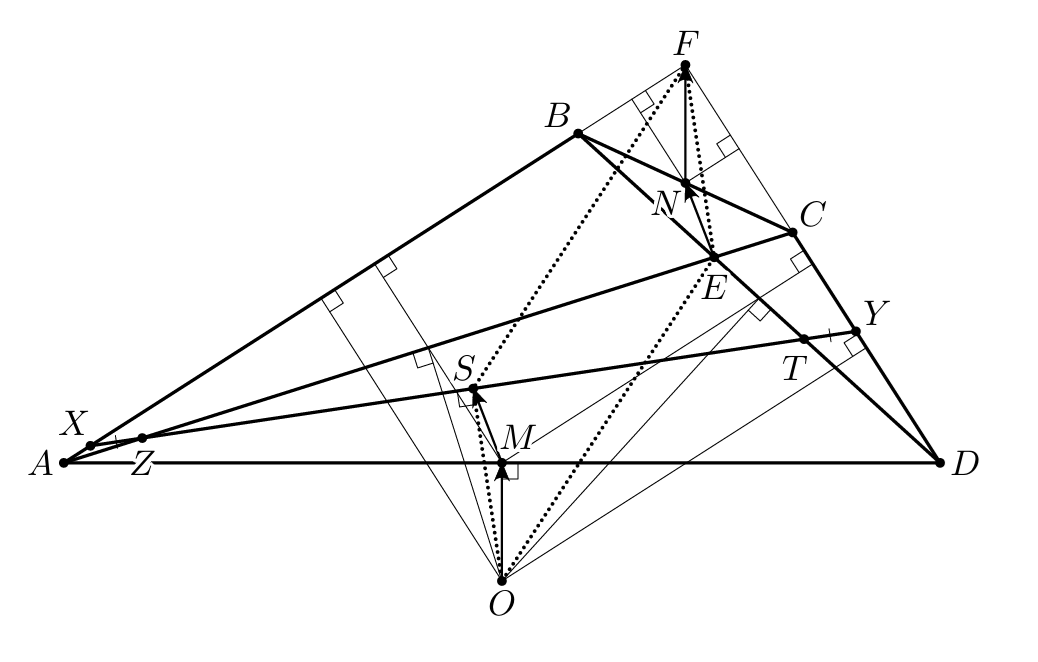
First solution. Without loss of generality, we can assume that the rays \(AB\) and \(DC; CB\) and \(DA\) intersect. Let the segments \(AC\) and \(BD\) intersect at point \(G\), and also let \(A'B'C'D'\) be the quadrilateral formed by the lines \(\ell_{a}, \ell_{b}, \ell_{c}, \ell_{d}\) (see Fig. 4). Also, denote by \(X\) the intersection of \(AB\) and \(CD'\), and by \(Y\) the intersection of \(CD\) and \(AB'\).
Fig. 4

Let \(\angle B'A B = \alpha\). From the inscribed quadrilateral \(A'B'C'D'\) and the conditions \(AX \parallel \ell_{d}, CY \parallel \ell_{b}\), we have: \(\alpha = \angle B'A X = 180^{\circ} - \angle A'B'C' = \angle C'D'X = \angle YCA'\). Thus, firstly, the points \(A, D', X, C'\) lie on one circle, denote it \(\gamma_{1}\); secondly, the points \(C, Y, A', B'\) lie on one circle, denote it \(\gamma_{2}\); thirdly, the points \(A, X, C, Y\) lie on one circle, denote it \(\gamma_{0}\). Note that point \(B\) is the radical center of the circles \(\gamma, \gamma_{0}, \gamma_{1}\) (since it lies on the lines \(AX\) and \(C'D'\)); point \(D\) is the radical center of the circles \(\gamma, \gamma_{0}, \gamma_{2}\) (since it lies on the lines \(CY\) and \(A'B'\)). Thus, \(BD\) is the radical axis of the circles \(\gamma_{0}\) and \(\gamma\); \(AC\) is the radical axis of the circles \(\gamma_{0}\) and \(\omega\); \(EF\) is the radical axis of the circles \(\omega\) and \(\gamma\), therefore these three lines intersect at one point, which was to be proved.
Second solution. We introduce the notations as in the first solution. For a point \(P\) on the plane, denote by \(f(P)\) the difference of the powers of point \(P\) with respect to the circles \(\omega\) and \(\gamma\). Since \(EF\) is the radical axis of the circles \(\omega\) and \(\gamma\), it suffices to prove that \(f(G) = 0\). Moreover, it is easy to see that \(f(A) = AC' \cdot AB'\) and \(f(C) = -CD' \cdot CA'\).
Fig. 5
Note that the function \(f\) is linear, that is, for a point \(P\) on the segment \(QR\), the equality \(f(P) = \frac{PR \cdot f(Q) + PQ \cdot f(R)}{QR}(\star)\) holds. We will prove this statement later. For now, applying it to the points \(A, G, C\), we obtain that \(f(G) = \frac{AG \cdot f(C) + CG \cdot f(A)}{AC}\).
Thus, it suffices to prove that \(\frac{f(A)}{-f(C)} = \frac{AG}{CG}(\star \star)\). Note that \(\frac{AG}{GC} = \frac{d(A, BD)}{d(C, BD)} = \frac{S_{ABD}}{S_{BCD}} = \frac{AB \cdot AD}{CB \cdot CD}\) (the last equality follows from the fact that \(\angle BAD + \angle BCD = 180^{\circ}\); by \(d(P, \ell)\) we denote the distance from point \(D\) to the line \(\ell\)). Therefore, the equality (\(\star \star\)) is rewritten as: \(\frac{AC' \cdot AB'}{CD' \cdot CA'} = \frac{AB \cdot AD}{CB \cdot CD}\).
From the inscribed quadrilateral \(ABCD\) and the given parallelisms of the lines in the condition, we have the angle equalities: \(\angle CA'D = 180^{\circ} - \angle ADB' = \angle BAD = 180^{\circ} - \angle BCD = \angle CBC' = \angle AC'B; \angle ABC' = \angle CDA'\) and \(\angle BCD' = \angle B'AD\). Thus, \(\triangle ABC'\) and \(\triangle CDA'\), as well as \(\triangle DAB'\) and \(\triangle BCD'\), are similar by two angles. From the similarity, we obtain the ratio equalities \(\frac{AC'}{CA'} = \frac{AB}{CD}\) and \(\frac{AB'}{CD'} = \frac{AD}{BC}\), we just need to multiply these equalities.
Returning to the proof of the linearity of the function \(f\). We introduce Cartesian coordinates such that the centers of the circles \(\omega\) and \(\gamma\) lie on the x-axis, let their coordinates be \((x_{1}, 0)\) and \((x_{2}, 0)\), and the radii of the circles be \(R_{1}\) and \(R_{2}\). Then for an arbitrary point \(P\) with coordinates \((x, y)\), by the definition of the power of a point, we obtain that \(f(P) = (x - x_{1})^{2} + y^{2} - R_{1}^{2} - (x - x_{2})^{2} - y^{2} + R_{2}^{2} = ax + b\), where \(a\) and \(b\) are two constants. If point \(P\) lies on the segment \(QR\) and \(x_{q}, x_{r}\) are the coordinates of points \(Q\) and \(R\) on the x-axis, then \(x = \frac{PR \cdot x_{q} + PQ \cdot x_{r}}{QR}\), from which (\(\star\)) immediately follows.
Remark 1. A linear function in arbitrarily introduced Cartesian coordinates has the form \(f(x, y) = ax + by + c\). If it is not constant, then the solution of the equation \(f(x, y) = 0\) will be a line. For example, in this way (reasoning as in the given solution), it is proved that the radical axis of two circles is a line perpendicular to the line of centers.
Remark 2. We present a plan for solving the problem using complex numbers. Let the circle \(\omega\) be the standard unit circle, and the coordinates of the points \(A, B, C, D\) be denoted as \(a, b, c, d\), respectively. Consider the lines (more precisely, the equations of the lines) \(\ell_{ac}(z) = ac \bar{z} + z - a - c, \ell_{bd}(z) = bd \bar{z} + z - b - d\) - these are the corresponding diagonals \(AC, BD\). The line \(\ell_{a}\) through point \(A\) parallel to \(BC\) has the equation \(\ell_{a}(z) = bc \bar{z} + z - bc/a - a\), similarly for the other three lines from the condition. The circle \(\gamma\), passing through the points of their intersection, has the equation \(F(z) := \ell_{a}(z)\ell_{c}(z) - \ell_{b}(z)\ell_{d}(z)\): on one hand, the intersection points satisfy the condition \(F = 0\), on the other hand, the coefficients at \(z^{2}\) and \(\bar{z}^{2}\) cancel out, so it is indeed a circle. The radical axis of the circles \(\gamma\) and \(\omega\) has the equation \(\ell_{ef}(z) := F(z) - T(z \bar{z} - 1)\), where \(T\) is a suitable coefficient to make it a line (it will not be important for us later). We will prove that for some coefficients \(\tau, \theta\), the identity \(\ell_{ef}(z) + \tau \ell_{ac}(z) + \theta \ell_{bd}(z) = 0(\mathrm{A})\) holds, from which the required will follow. The identity (A) is sufficient to check when \(z\) is one of the vertices of the quadrilateral \(ABCD\), because they do not lie on one line. Substituting, for example, \(z = a\), we obtain the identity \(0 = F(a) + \theta \ell_{bd}(a) = -\ell_{b}(a)\ell_{d}(a) + \theta \ell_{bd}(a)\). This gives the value of \(\theta\), and it must be consistent with the value obtained for \(z = c\), that is, the identity \(\ell_{b}(a)\ell_{d}(a)/\ell_{bd}(a) = \ell_{b}(c)\ell_{d}(c)/\ell_{bd}(c)\) must hold, and the second similar one. All these values are calculated directly (and decomposed into factors, for example, \(\ell_{bd}(a) = bd/a + a - b - d = (a - b)(a - d)/d\)), after which it is not difficult to prove the required identity.