Regional Round 2024 · ARMO

Total: 26
Reset
Всеросс. 2024, Regional Round, 9.1
ID: 57 ✍️ O. Podlipskiy 🏷 Всеросс. 📅 2024 🎓 9 ★★★★★☆☆☆☆☆ Medium
combinatorics inequalities planimetry proof by contradiction geometry (misc)

Oleg has a set of 2024 different grid rectangles of sizes 1 × 1, 1 × 2, 1 × 3, …, 1 × 2024 (one rectangle of each size). Can he choose some of them to form any grid square with an area greater than 1?

He cannot.

Assume the contrary, and let \(n>1\) be the largest length among the chosen rectangles. Then a grid square \(k\times k\) is formed, where \(k\ge n>1\). Thus, its area is at least \(n^2\).

On the other hand, its area is no greater than the total area of the rectangles \(\,1\times1,\,1\times2,\,1\times3,\,\dots,\,1\times n\,\), i.e., no more than \(\,1+2+3+\dots+n\ \lt\ n^2\,\). This is a contradiction.

Note. Arranging the rectangles \(\,1\times1,\,1\times2,\,1\times3,\,\dots,\,1\times n\,\) in a “staircase” inside an \(n\times n\) square shows their total area is less than that of the whole square.

Всеросс. 2024, Regional Round, 9.2
ID: 58 ✍️ N. Agakhanov 🏷 Всеросс. 📅 2024 🎓 9 ★★★★★☆☆☆☆☆ Medium
planimetry graphs & loci quadratic equations geometry (misc)

On the coordinate plane, a parabola is drawn: \( y = x^2 \). For a given number \( k > 0 \), consider trapezoids inscribed in this parabola (i.e., all vertices of the trapezoid lie on the parabola), with bases parallel to the x-axis, and the product of the lengths of the bases equal to \( k \). Prove that the diagonals of all such trapezoids pass through a single point.

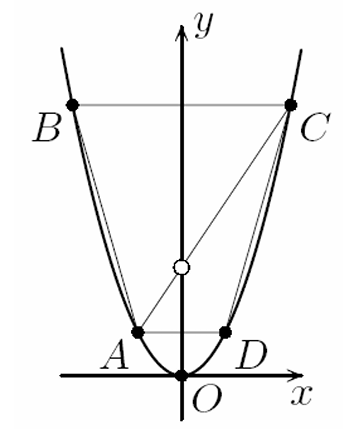
Let \(ABCD\) be one of the considered trapezoids, with \(AD \parallel BC \parallel Ox\) (see figure).

Olympiad diagram

Let the points \(A\) and \(C\) have coordinates \((a,a^2)\) and \((c,c^2)\). It is easy to obtain the equation of the line \(AC\): \((c^2-a^2)x - (c-a)y + (c a^2 - a c^2) = 0\), which after dividing by \(c-a \neq 0\) becomes \(y=(a+c)x - ac\).

But \(-ac\) equals the product of the halves of the bases of the trapezoid (this is the product of the distances from \(A\) and \(C\) to the \(y\)-axis). Hence \(-ac = k/4\). Therefore, the line \(AC\) passes through the fixed point \((k, k/4)\).

Remark. The statement is true for any parabola (not just for \(y=x^2\)).

extra media
ARMO 2024, Regional Round, 11.3
ID: 77 ✍️ P. Kozhevnikov 🏷 ARMO 📅 2024 🎓 11 ★★★★★☆☆☆☆☆ Medium
combinatorics game theory coloring parity circle

On a circle there are 100 white points. Anya and Boris take turns coloring one uncolored point red or blue; Anya moves first. Anya wants the total number of pairs of adjacent points of different colors to be as large as possible, while Boris wants it to be as small as possible. What is the largest number of such pairs that Anya can guarantee regardless of Boris's play?

50.

Solution. We need to show that Anya can always ensure that the number of adjacent opposite-colored pairs is at least 50, while Boris can prevent there being more than 50.

Strategy of Anya. On the first move Anya colors any point in any color. After that, on each of her moves she chooses a pair consisting of an uncolored point and a colored point next to it (there is always such a pair) and colors the uncolored point in the color different from that of the colored one. This creates a new pair of adjacent opposite-colored points.

Strategy of Boris. On each of his moves Boris chooses a pair consisting of an uncolored point and a colored point next to it and colors the uncolored point in the same color as the colored one. This creates a new pair of adjacent same-colored points.

Why the strategies are correct. There are 100 pairs of neighboring points around the circle, and each player makes 50 moves. After making his moves, Boris ensures that at least 50 of these 100 pairs are monochromatic, and Anya ensures that at least 49 of them are bichromatic. However, note that the number of bichromatic pairs is always even. Indeed, after the game ends, go around the whole circle starting from some marked point (say, red). Runs of consecutive red and blue points alternate (K ext{–}C ext{–}K ext{–}C ext{–}\cdots ext{–}K), so we encounter as many (K ext{–}C) neighbor pairs as (C ext{–}K) pairs. Therefore, if the number of bichromatic neighbor pairs is at least 49, then it is at least 50.

First method. Partition all marked points into 50 neighbor pairs: \(P_1,P_2,\ldots,P_{50}\).

Strategy of Boris. If on her move Anya colors a point in a pair \(P_i\), then in response Boris colors the second point in the same pair \(P_i\) in the same color. Clearly, with this play, by the end of the game each pair \(P_i\) will be monochromatic. Hence among the 100 neighbor pairs at least 50 are monochromatic, so the number of bichromatic pairs is at most \(100-50=50\).

Strategy of Anya. Anya will ensure that in each pair \(P_i\) with odd index \(i\) she colors one of the points red, and in each pair \(P_i\) with even index \(i\) she colors one of the points blue. If she succeeds, then the 50 points colored by her will divide the circle into 50 arcs with endpoints of different colors. On each of these arcs there is, obviously, at least one pair of adjacent marked points of different colors (in particular, if there are no points marked by Boris on an arc, the arc’s endpoints form such a pair).

We show how Anya can realize this plan. On her first move she colors one of the points in some pair \(P_i\) in the required color. Next, if Boris replies by moving in the same pair, then Anya colors one of the points in any still uncolored pair; otherwise, she colors the second point in the pair in which Boris just colored a point. As a result, after each of Anya’s moves there will be exactly one pair \(P_j\) in which one point is colored by Anya and the other is not, and in each of the remaining pairs \(P_i\) there will either be two colored points with exactly one of them colored by Anya, or no colored points at all. Thus, by the end of the game Anya will have colored exactly one point in each pair \(P_i\), as required.

ARMO 2024, Regional Round, 11.6
ID: 80 ✍️ O. Podlipsky 🏷 ARMO 📅 2024 🎓 11 ★★★★★☆☆☆☆☆ Medium
combinatorics modular arithmetic number theory inequalities greedy

A teacher has 100 weights of masses 1 g, 2 g, …, 100 g. He wants to give Petya and Vasya 30 weights each so that the following holds: no 11 of Petya’s weights can be balanced by any 12 of Vasya’s weights, and no 11 of Vasya’s weights can be balanced by any 12 of Petya’s weights. Can the teacher do this?

Yes, he can.

Solution 1. Take 30 weights of the form \(3k+1\) g and give them to Petya, and 30 weights of the form \(3k+2\) g to Vasya. Then the total mass of any 12 weights taken from one person is divisible by 3, whereas the total mass of any 11 weights taken from one person is not divisible by 3.

Solution 2. Give Petya the weights 1, 2, 3, …, 30, and give Vasya the weights 71, 72, 73, …, 100 g. Then the sum of any 11 or 12 of Petya’s weights is less than \(30\cdot 12=360\) g, while the sum of any 11 or 12 of Vasya’s weights is greater than \(70\cdot 11=770\) g.

ARMO 2024, Regional Round, 11.7
ID: 81 ✍️ A. Teryoshin 🏷 ARMO 📅 2024 🎓 11 ★★★★★☆☆☆☆☆ Medium
analytic geometry parabola tangent lines quadratic algebra

The graph \(G_1\) of the quadratic \(y=px^2+qx+r\) (with real coefficients) meets the graph \(G_2\) of the quadratic \(y=x^2\) at points \(A\) and \(B\). The tangents at \(A\) and \(B\) to \(G_2\) intersect at a point \(C\). It turns out that \(C\) lies on \(G_1\). Find all possible values of \(p\).

2.

First solution. The tangent at \(A(x_a;\,x_a^2)\) to \(G_2\) has equation \(y=f'(x_a)(x-x_a)+x_a^2\)\(=2x_a(x-x_a)+x_a^2\)\(=2x_a x-x_a^2\). Similarly, the tangent at \(B(x_b;\,x_b^2)\) is \(y=2x_b x-x_b^2\), hence their intersection is \(\left(\dfrac{x_a+x_b}{2},\,x_a x_b\right)\). Since \(A,B,C\) lie on the quadratic \(p x^2+q x+r\), we have:

\(p x_a^2+q x_a+r=x_a^2,\)
\(p x_b^2+q x_b+r=x_b^2,\)
\(p\!\left(\dfrac{x_a+x_b}{2}\right)^{\!2}+q\,\dfrac{x_a+x_b}{2}+r=x_a x_b.\)

Adding the first two equalities and subtracting twice the third gives \(p\!\cdot\!\left(x_a^2+x_b^2-\dfrac{x_a^2}{2}-x_a x_b-\dfrac{x_b^2}{2}\right)\;+\;q(x_a+x_b-x_a-x_b)\;+\;2r-2r\)\(=\;x_a^2+x_b^2-2x_a x_b\), hence \(p\,\dfrac{(x_a-x_b)^2}{2}=(x_a-x_b)^2\). Since \(x_a\ne x_b\), it follows that \(p=2\).

Second solution. Subtract from both quadratics the linear function through \(A\) and \(B\). Denote the resulting quadratics by \(P(x)\) and \(Q(x)\) (the leading coefficient of \(P\) is \(p\), and of \(Q\) is \(1\)). Let the abscissas of \(A\) and \(B\) be \(x_a\) and \(x_b\). Then \(P(x_a)=P(x_b)=Q(x_a)=Q(x_b)=0\), and the tangents at \((x_a,0)\) and \((x_b,0)\) to \(Q(x)\) meet on the graph of \(P(x)\). Indeed, subtracting a linear function preserves tangency at a given abscissa and the intersection of two lines with the parabola at one point.

Let \(x_m=(x_a+x_b)/2\). Since \(Q(x_a)=Q(x_b)=0\), the graph of \(Q(x)\) is symmetric about \(x=x_m\), so the tangents at \((x_a,0)\) and \((x_b,0)\) intersect on this axis. Let the intersection point be \((x_m,y_c)\), and the vertex of the parabola \(Q(x)\) be \((x_m,y_d)\).

Because the leading coefficient of \(Q(x)\) is \(1\), we have \(0-y_d=(x_b-x_m)^2\), i.e. \(y_d=-(x_a-x_b)^2/4\), since \(Q(x)\) is the parabola \(y=x^2\) translated so that its vertex is at \((x_m,y_d)\). For the same reason, the slopes of the tangents at \((x_a,0)\) and \((x_b,0)\) are \(\pm(x_a-x_b)\); hence the ordinates of the points with abscissa \(x=x_m\) on these parabolas are \(-y_c\) and \(-y_d=-y_c/2\), respectively. Therefore the leading coefficient of \(P(x)\) is twice that of \(Q(x)\), so \(p=2\).

ARMO 2024, Regional Round, 11.8
ID: 83 ✍️ A. Kuznetsov 🏷 ARMO 📅 2024 🎓 11 ★★★★★☆☆☆☆☆ Medium
stereometry sphere tangent plane circumcenter symmetry

In space there are segments \(AA_1\), \(BB_1\) and \(CC_1\) with a common midpoint \(M\). The sphere \(\omega\) circumscribed about the tetrahedron \(MA_1B_1C_1\) is tangent to the plane \(ABC\) at a point \(D\). Let \(O\) be the circumcenter of triangle \(ABC\). Prove that \(MO=MD\).

Solution. Let \(O_1\) be the circumcenter of triangle \(A_1B_1C_1\), and let \(P\) be the center of the sphere \(\omega\). Under central symmetry with respect to \(M\), triangle \(ABC\) maps to \(A_1B_1C_1\). Hence \(O\) and \(O_1\) are symmetric about \(M\), so \(M\) is the midpoint of \(OO_1\). We also obtain that the planes \(ABC\) and \(A_1B_1C_1\) are parallel. Therefore, on the line through \(P\) perpendicular to these planes lie the points \(D\) and \(O_1\); hence \(\angle O_1DO=90^\circ\). Thus \(DM\) is a median in the right triangle \(O_1DO\), and therefore \(MO=MD\), as required.

solution media
Всеросс. 2024, Regional Round, 9.3
ID: 59 ✍️ M. Didin 🏷 Всеросс. 📅 2024 🎓 9 ★★★★★★☆☆☆☆ Medium
logic puzzle averages proof by contradiction

On an island, there are knights who always tell the truth and liars who always lie. For a knockout table tennis game, all the island's inhabitants were divided into two teams, A and B, with more inhabitants in A than in B. The game started with two players from different teams; after each match, the losing player permanently left the game and was replaced by another (who had not yet played) member of their team. The team whose all members were out of the game lost. After the tournament, each member of team A was asked: "Is it true that in some game you lost to a liar?", and each member of team B was asked: "Is it true that you won against at least two knights?" All answers were affirmative. Which team won - A or B?

Team A.

Let there be at least one knight r in B. Then r won against at least two knights from A, let s be one of them. Since s is a knight, he truthfully answered the question posed to him, meaning he lost to a liar. But according to the rules, each player loses no more than once, and s lost to both the knight r and a liar. Contradiction. Therefore, B consists only of liars.

Assume that A consists only of knights. Then each of them lost to some liar from B, however, each liar in B won against no more than one knight from A, as he lied when answering the question. Consequently, different knights from A correspond to different liars from B, so there are no fewer people in B than in A; contradiction.

Thus, there is at least one liar in team A; let f be one of them. Then f lied, meaning he did not lose to any liar from B - hence, to no player from B. This means that f either won all his matches or it was not his turn to play. In either case, team A won.

Всеросс. 2024, Regional Round, 9.4
ID: 60 ✍️ S. Berlov 🏷 Всеросс. 📅 2024 🎓 9 ★★★★★★☆☆☆☆ Medium
number theory sequences inequalities calculus (series) geometry (misc)

All natural numbers from 1 to 1000 are written in a row in some order. Prove that it is possible to select several consecutive numbers from this sequence such that their sum is greater than 100000 but does not exceed 100500.

The sum of all numbers in the list except \(500\) is \((1+2+3+\dots+1000)-500>2\cdot100000\), so the sum of the numbers on one side of \(500\) exceeds \(100000\); fix the right side. Let the numbers to the right of \(500\) be (from left to right) \(a_1,a_2,\dots,a_k\). Define \(S_n=a_1+a_2+\dots+a_n\) and choose the smallest \(n\) for which \(S_n>100000\), so \(S_n>100000\ge S_{n-1}\). If \(S_n\le 100500\), we are done.

Now suppose \(S_n>100500\). We claim the sum \(500+a_1+\dots+a_{n-1}=500+S_{n-1}\) works. Indeed, since \(a_n\le 1000\), \(500+S_{n-1}=500+S_n-a_n>500+100500-1000=100000\). On the other hand, \(500+S_{n-1}\le 500+100000=100500\), as required.

Всеросс. 2024, Regional Round, 9.5
ID: 61 ✍️ A. Kuznetsov 🏷 Всеросс. 📅 2024 🎓 9 ★★★★★★☆☆☆☆ Medium
planimetry power of a point circles geometry (misc) trigonometry number theory

Given an isosceles triangle ABC (AB = BC). On the extensions of the sides AB and BC beyond point B, points D and E are marked respectively, and on the base AC, point F is marked such that AC = DE and ∠CFE = ∠DEF. Prove that ∠ABC = 2∠DFE.

Solution 1. Let \(O\) be the midpoint of the arc \(DBE\) of the circumcircle of triangle \(DBE\). The line \(BO\) is the external bisector in triangle \(DBE\), and therefore, in triangle \(ABC\). But \(ABC\) is isosceles, so \(BO \parallel AC\). Note further that \(\angle EOD=\angle EBD=\angle ABC\).

Olympiad diagram

Thus, in the isosceles triangles \(EOD\) and \(ABC\), the vertex angles are equal, as are the bases, so the triangles themselves are equal. Hence, first, \(\;BA=BC=OE=OD\). Second, the distance from point \(O\) to line \(DE\) equals the distance from point \(B\) to \(AC\), and the latter equals the distance from \(O\) to \(AC\) (since \(BO \parallel AC\)). Therefore, point \(O\) lies on the bisector of the angle between the lines \(DE\) and \(AC\).

From the condition \(\angle DEF=\angle CFE\), it follows that this bisector is the perpendicular bisector of segment \(EF\). Thus, \(OF=OE=OD\). In other words, \(O\) is the center of the circumcircle of triangle \(DFE\). Consequently, \(2\angle DFE=\angle DOE=\angle ABC\), as required.

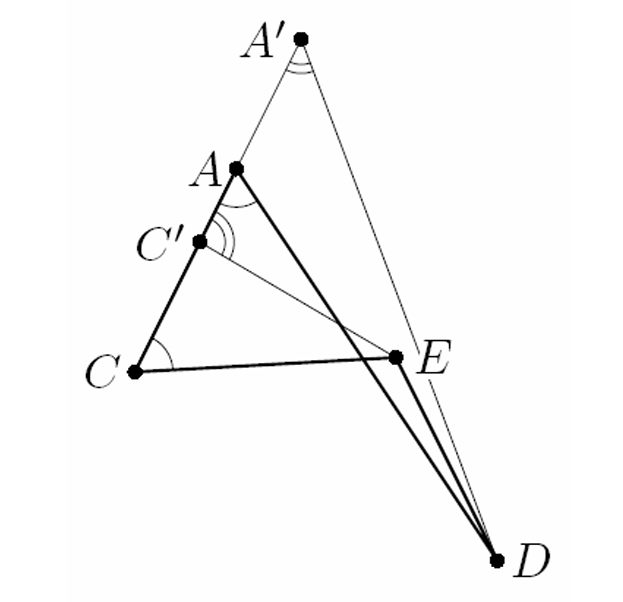
Solution 2. Remark: let points \(A'\) and \(C'\) be chosen on the line \(AC\) such that \(A'C'=AC\) and \(\angle DA'C'=\angle EC'A'\); then \(A'=A\) and \(C'=C\). Otherwise, say, the points \(A'\) and \(C'\) lie on the ray \(CA\), then \(\angle DA'C' < \angle DAC=\angle ECA < \angle EC'A'\), which is impossible.

Olympiad diagram

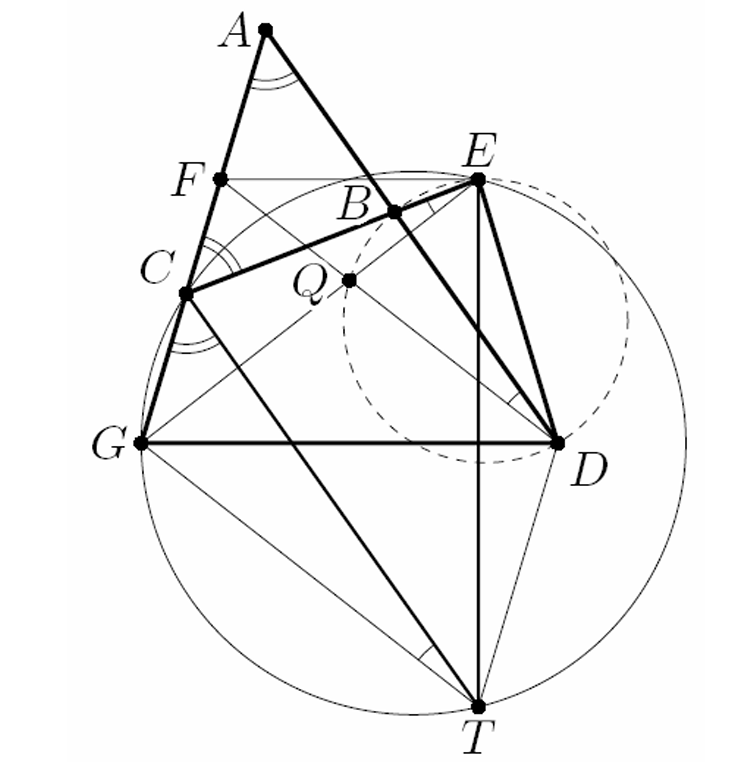
Construct such points. Let the lines \(DE\) and \(AC\) intersect at \(P\); for definiteness, let \(P\) lie on the ray \(DE\). Choose a point \(G\) on \(AC\) such that \(EF \parallel DG\). Then \(DEFG\) is a trapezoid with equal base angles; hence, \(FG=DE=AC\) and \(DF=EG\). Let the diagonals \(DF\) and \(EG\) intersect at \(Q\). Finally, let the circumcircles of triangles \(PDQ\) and \(PEQ\) meet \(AC\) again at \(A'\) and \(C'\), respectively.

Olympiad diagram

Since \(PQ\) is the bisector of \(\angle APD\), we have \(QA'=QD\) and \(QC'=QE\), as well as \(\angle DQA' = 180^\circ - \angle DPG = \angle EQC'\). Thus, \(\angle DQE=\angle A'QC'\); the triangle \(A'QC'\) is obtained from \(DQE\) by a rotation about \(Q\). Further, by inscribed-angle relations and symmetry, \(\angle EC'P=\angle EQP=\angle FQP=180^\circ-\angle DQP=\angle DA'C'\), hence \(A'C'=AC\). By the remark, \(A=A'\) and \(C=C'\). Now \(\angle ADQ=\angle APQ=\angle CEQ\), so \(D,E,B,Q\) lie on the same circle. Therefore, \(\angle ABC=\angle DBE=\angle DQE=\angle QEF+\angle QFE=2\angle DFE\).

Solution 3. Complete the isosceles trapezoid \(DEFG\); let the diagonals meet at \(Q\). As seen from Solution 2, it suffices to prove that \(D,E,B,Q\) lie on one circle. Choose a point \(T\) such that \(ACTD\) is a parallelogram.

Olympiad diagram

Then \(FGTD\) is also a parallelogram, since \(DT=AC=FG\); hence \(GT=FD=GE\) and \(\angle TCA=180^\circ-\angle DAC=180^\circ-\angle ECA\). The first equality implies that \(G\) lies on the perpendicular bisector of \(ET\), and the second that \(CG\) is the external bisector of \(\angle ECT\). This external bisector meets the circumcircle of triangle \(ECT\) again at a point lying on the perpendicular bisector of \(ET\); hence \(G\) is this point, and \(C,G,T,E\) lie on one circle. Finally, from this circle and the two parallelograms we obtain \(\angle BDQ=\angle ADF=\angle CTG=\angle CEG=\angle BEQ\), that is, \(D,E,B,Q\) lie on one circle; as required.

Remark. If \(DE \parallel AC\), then \(F\) coincides with \(A\), which is impossible; thus we may assume \(DE\) and \(AC\) intersect. Moreover, under the problem’s conditions, \(P\) always lies on the ray \(DE\).

extra media extra media extra media extra media
Всеросс. 2024, Regional Round, 9.6
ID: 62 ✍️ I. Bogdanov 🏷 Всеросс. 📅 2024 🎓 9 ★★★★★★☆☆☆☆ Medium
algebra quadratic functions puzzle logic geometry (misc)

On a board, there are 7 different numbers written, the sum of which is 10. Petya multiplied each of them by the sum of the other six and wrote down the 7 resulting products in a notebook. It turned out that there are only four different numbers in the notebook. Find one of the numbers written on the board.

-20.

For each number x written on the board, the product of x and the sum of the others is equal to \( f(x) = x(10 - x) = 10x - x^2 \). The quadratic function \( f(x) \) takes all values, except the maximum, twice - at points \( a \) and \( 10 - a \). Thus, if \( f(a) = f(b) \) for \( a \neq b \), then \( a + b = 10 \).

Therefore, each number appears in the notebook no more than twice. Since there are only four different numbers in the notebook, three of them appear twice, and one more appears once. Consequently, six of the seven numbers on the board are paired with a sum of 10. The sum of these six numbers is 30, so the seventh number is \( 10 - 30 = -20 \).

Remark 1. Any seven numbers of the form \( -20, a, 10 - a, b, 10 - b, c, 10 - c \) (if all are different) could have been written on the board. No number other than \( -20 \) can be determined.

Remark 2. We can reason directly: if \( f(a) = f(b) \), then \( 0 = (10a - a^2) - (10b - b^2) = (a - b)(10 - a - b) \), so either \( a = b \) or \( a + b = 10 \).

Всеросс. 2024, Regional Round, 9.7
ID: 63 ✍️ I. Bogdanov 🏷 Всеросс. 📅 2024 🎓 9 ★★★★★★☆☆☆☆ Medium
sequences analysis methods puzzle probability geometry (misc) planimetry

A point is marked on a circle with a circumference of 1 meter. From this point, two cockroaches start running simultaneously in the same direction with different constant speeds. Each time the faster cockroach catches up with the slower one, the slower cockroach instantly turns around without changing its speed. Each time they meet face to face, the faster cockroach instantly turns around without changing its speed. At what distance from the marked point could their hundredth meeting occur?

At zero distance (at the starting point).

Solution 1. Let the faster and slower cockroaches be B and M. If a cockroach runs in the same direction as at the start, we say it runs "forward"; otherwise, "backward". Until the first meeting, both run forward; between the first and second meetings, B runs forward, M backward; between the second and third meetings, both run backward; between the third and fourth meetings, B runs backward, M forward. At the fourth meeting, B turns around, and both run forward again. Between meetings when directions are opposite, the same time passes, so M covers the same distance (in opposite directions between the 1st - 2nd and 3rd - 4th meetings). Similarly, when directions coincide (before the first and between the 2nd - 3rd meetings). Therefore, at the fourth meeting, M (and B) will be at the starting point. This repeats every 4 meetings, so the hundredth meeting is at the starting point.

Solution 2. Let the speeds be (b > m). When directions coincide, the separation speed is (b - m): until the first meeting, they run for 1 / (b - m) seconds, and M covers m / (b - m) meters. Then they run towards each other with speed (b + m): until the second meeting - 1 / (b + m) seconds, M's displacement relative to the start becomes m / (b - m) - m / (b + m) = 2m^2 / (b^2 - m^2) meters. Then both run counterclockwise for 1 / (b - m) seconds, M's final displacement is - m + m / (b - m) + m / (b + m) = - m / (b + m). Finally, when moving towards each other for another 1 / (b + m) seconds, the fourth meeting occurs at a distance of - m / (b + m) + m / (b + m) = 0 from the start. The cycle is periodic with a period of 4 meetings, so the hundredth is at zero.

Comment. In the second solution, one can formally speak of the "distance from the starting point"; even if the cockroaches make several rounds, with correct accounting of periodicity, the conclusion remains valid.

Всеросс. 2024, Regional Round, 9.8
ID: 64 ✍️ A. Matveev 🏷 Всеросс. 📅 2024 🎓 9 ★★★★★★☆☆☆☆ Medium
planimetry triangles bisectors geometry (misc) averages equivalence relations

On the side BC of an acute-angled triangle ABC, points P and Q are chosen such that BP = PQ = QC. Points X and Y are chosen on segments AC and AB respectively such that PX ⟂ AC and QY ⟂ AB. Prove that the intersection point of the medians of triangle ABC is equidistant from the lines XQ and YP.

Let M be the midpoint of BC (then M is also the midpoint of PQ), and G be the intersection point of the medians of ABC. By the property of medians, MG : GA = 1 : 2. Since MP : PB = 1 : 2, we have PG ∥ BA. Then ∠YPG = ∠PYB and ∠QPG = ∠PBY. But YP is the median of the right triangle BYQ, so ∠PYB = ∠PBY. Therefore, ∠YPG = ∠QPG, meaning PG is the bisector of angle QPY. Hence, G is equidistant from the lines PQ and PY. Similarly, QG is the bisector of angle PQX, from which G is equidistant from PQ and QX. Consequently, G is equidistant from the three lines YP, PQ, and XQ, which is what was required to prove.

Remark. Under the conditions (acute-angled ABC), it follows that G is the center of the excircle of triangle PQR, where R is the intersection point of XQ and YP.

Comment. It is shown that PG ∥ AB - 2 points. Separate relations without application do not add points. From the fact about the bisectors of angles QPY and PQX, a conclusion is drawn about the center of the excircle without justification - points are not deducted.

Всеросс. 2024, Regional Round, 9.9
ID: 65 ✍️ I. Bogdanov 🏷 Всеросс. 📅 2024 🎓 9 ★★★★★★☆☆☆☆ Medium
combinatorics geometry (misc) counting set theory averages calculus (series)

An equilateral triangle T with side 111 is divided by lines parallel to its sides into equilateral triangles with side 1. All vertices of these triangles, except the center of triangle T, are marked. We call a set of several marked points linear if all these points lie on a line parallel to a side of T. How many ways are there to divide all marked points into 111 linear sets? (Ways differing only in the order of the sets are considered the same.)

\( 2^{3·372} = 2^{4107} \)

Consider an equilateral triangle with side \(k\); divide it into unit equilateral triangles and mark all vertices. We call the resulting construction a \(k\)-triangle. By “lines” we mean lines parallel to the sides of the \(k\)-triangle that pass through marked points.

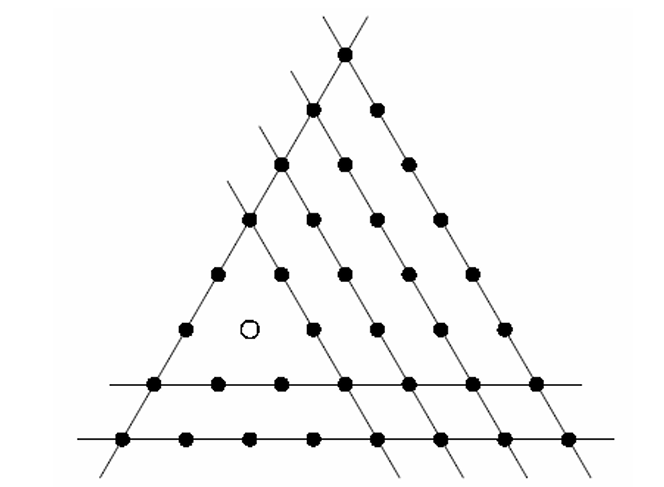
Lemma. For any marked point \(A\) in a \(k\)-triangle, there is a unique way to draw \(k\) lines so that all marked points, except possibly \(A\), are covered by these lines: for each side, draw all lines parallel to it between this side and the point \(A\) (including the side itself, excluding the line through \(A\)).

Olympiad diagram

Proof of the lemma. Induction on \(k\). The base case \(k=1\) is obvious. For the inductive step, consider the side on which \(A\) does not lie. If the line containing this side is not drawn, then all \(k+1\) points on it would have to be covered by different lines — impossible, since there are only \(k\) lines. Thus this line is drawn. Removing it and the points on it, we obtain a \((k-1)\)-triangle with \(k-1\) lines under the same conditions. Apply the induction hypothesis.

Now move to the problem. For any partition into linear sets, draw the lines containing them. These lines cover all marked points of the \(111\)-triangle, except possibly the center \(A\); therefore, the set of lines is arranged as in the lemma and is unique.

Olympiad diagram

Note that the \(111\)-triangle is divided into 6 regions: three “rhombi” at the corners (points covered by two lines) and three “trapezoids” along the sides (each point covered by one line). Each point of a trapezoid belongs to the set on its line; and each point of a rhombus may belong to either of the two sets (on the two intersecting lines). The choices are independent. Each of the three rhombi contains \(37^2\) points, so the number of required partitions is exactly \(2^{3\cdot 37^2}\).

Remark. One can also show that it is impossible to cover all points except one with fewer than \(k\) lines.

Comment. Showing only that fewer than \(111\) lines are insufficient — 1 point. Proving only the lemma with incorrect counting — 4 points. An otherwise correct count with an error of \(\pm 1\) in the rhombi — minus 1 point.

extra media extra media
Всеросс. 2024, Regional Round, 9.10
ID: 66 ✍️ A. Chironov 🏷 Всеросс. 📅 2024 🎓 9 ★★★★★★☆☆☆☆ Medium
number theory digits constructive equations classical combinatorics examples & counterexamples

Does there exist a natural number \( n > 10^{100} \) such that the decimal representations of the numbers \( n^2 \) and \( (n + 1)^2 \) differ by a permutation of digits? (In other words, the decimal representations of \( n^2 \) and \( (n + 1)^2 \) must have the same number of each digit 0, the same number of each digit 1, ..., the same number of each digit 9.)

Yes, it exists.

Solution 1. The numbers \(13^2=169\) and \(14^2=196\) are obtained from each other by a permutation of digits. Let \(a=1\cdot(13\cdot1000+14)=6507\). Set \(n=10^{100}\cdot a+13\). Then \(n^2=10^{200}\cdot a^2+10^{100}\cdot(1000\cdot13^2+14\cdot13)+13^2\), \((n+1)^2=10^{200}\cdot a^2+10^{100}\cdot(1000\cdot13\cdot14+14^2)+14^2\). In other words, the decimal representation of \(n^2\) consists of blocks \(a^2\), \(18^2=14\cdot13\), and \(169=13^2\) (twice), separated by zeros; for \((n+1)^2\) these blocks are \(a^2\), \(18^2=13\cdot14\), and \(196=14^2\) (twice). Since the number of separating zeros is the same, we find that \(n\) satisfies the requirements.

Note. Similarly, one can take any \(k\) and \(k+1\) whose squares are anagrams by digits, and choose \(t\) such that \(2tk\) and \(2t(k+1)\) also differ by a permutation of digits.

Solution 2. Suppose a number \(b\) is found (possibly with a leading zero), such that the multiset of digits in \(2b\) is obtained from that of \(b\) by removing the digit \(4\) and adding the digit \(1\) (that is, if \(1\) is appended to \(b\) and \(4\) to \(2b\), the resulting numbers differ by a permutation of digits). Then one can take \(n=5\cdot10^d\cdot b+1\) (where \(d>100\) and \(d-1\) exceeds the number of digits in \(2b\)). Indeed, \(n^2=1+10^{d+1}\cdot b+10^{2d}\cdot25b^2\), \((n+1)^2=4+10^{d+1}\cdot2b+10^{2d}\cdot25b^2\): these are blocks \((1,b,25b^2)\) and \((4,2b,25b^2)\), separated by zeros, and the blocks are anagrams. Example: \(b=0526315789473684\), then \(2b=1052631578947368\).

ARMO 2024, Regional Round, 10.3
ID: 67 ✍️ P. Kozhevnikov 🏷 ARMO 📅 2024 🎓 10 ★★★★★★☆☆☆☆ Medium
calculus (series) coloring geometry (misc)
There are 100 white points arranged in a circle. Anya and Borya take turns coloring one uncolored point either red or blue, with Anya starting first. Anya wants to maximize the number of pairs of adjacent points with different colors, while Borya wants to minimize this number. What is the maximum number of pairs of adjacent points with different colors that Anya can guarantee, regardless of Borya's strategy?
50
We need to show that Anya can always ensure that there are at least 50 pairs of adjacent points with different colors, and Borya can prevent her from achieving more than 50 such pairs. First method. Anya's strategy. On her first move, Anya colors any point in any color, and on each subsequent move, she chooses a pair consisting of an uncolored point and an adjacent colored point, and colors the uncolored point in a color different from the colored one. This creates a new pair of adjacent points with different colors. Borya's strategy. On each move, Borya chooses a pair consisting of an uncolored point and an adjacent colored point, and colors the uncolored point in the same color as the colored one. This creates a new pair of adjacent points with the same color. Justification. There are a total of 100 pairs of adjacent points in the circle, and each player makes 50 moves. Borya will ensure that at least 50 pairs are monochromatic, and Anya will ensure that at least 49 pairs are bichromatic. The number of bichromatic pairs is always even, so if there are at least 49, then there are at least 50. Second method. Divide all marked points into 50 pairs of neighbors P1, ..., P50. Borya's strategy: if Anya colors a point in pair Pi, then Borya colors the second point of this pair in the same color. Then each pair Pi will be monochromatic, and there will be no more than 50 bichromatic pairs. Anya's strategy: ensure that in each pair Pi with odd i, she colors one of the points red, and in each pair Pi with even i, she colors one of the points blue. Then the 50 points she colors will divide the circle into 50 arcs with endpoints of different colors, and on each arc, there will be at least one pair of adjacent marked points with different colors. The implementation is described as standard.
ARMO 2024, Regional Round, 10.4
ID: 68 ✍️ S. Berlov 🏷 ARMO 📅 2024 🎓 10 ★★★★★★☆☆☆☆ Medium
calculus (series) geometry (misc) planimetry

All natural numbers from 1 to 1000 are written in a row in some order. Prove that it is possible to select several consecutive numbers such that their sum is greater than 100000 but does not exceed 100500.

The sum of all numbers in the row, except for the number 500, is \((1 + 2 + \ldots + 1000) - 500 > 2 \cdot 100000\), so the sum of the numbers on one side of 500 is greater than 100000 (let's assume it's on the right side for definiteness). Let the numbers on the right of 500 be \(a_1, \ldots, a_k\) (from left to right). Denote \(S_n = a_1 + \ldots + a_n\); choose the smallest \(n\) for which \(S_n > 100000\), so that \(S_{n - 1} \leq 100000 < S_n\). If \(S_n \leq 100500\), then the required segment is found. If \(S_n > 100500\), then the sum \(500 + a_1 + \ldots + a_{n - 1} = 500 + S_{n - 1}\) is suitable. Since \(a_n \leq 1000\), we have \(500 + S_{n - 1} > 500 + 100500 - 1000 = 100000\) and \(500 + S_{n - 1} \leq 100500\).

ARMO 2024, Regional Round, 10.5
ID: 69 ✍️ S. Berlov 🏷 ARMO 📅 2024 🎓 10 ★★★★★★☆☆☆☆ Medium
inequalities geometry (misc) planimetry

The diagonals of a convex quadrilateral ABCD are perpendicular and intersect at point O. The centers of the incircles of triangles ABC, BCD, CDA, DAB are the vertices of a convex quadrilateral whose perimeter is P. Prove that the sum of the radii of the incircles of triangles AOB, BOC, COD, DOA does not exceed P / 2.

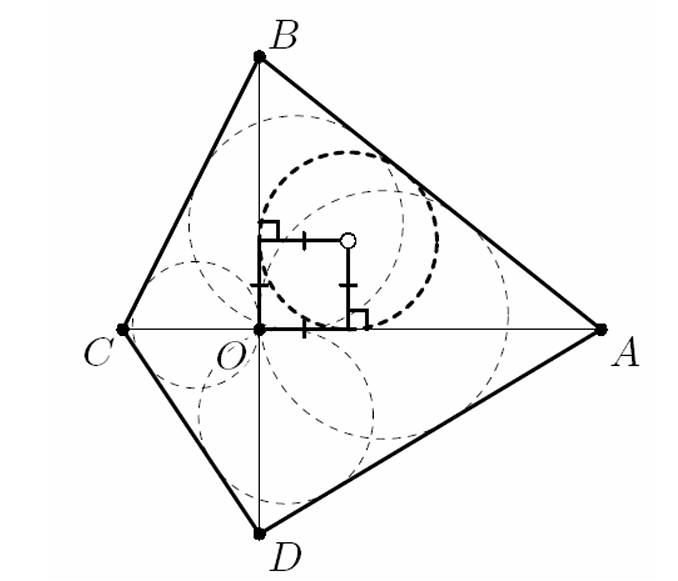
In the right triangle AOB, the radius of the incircle is equal to \((OA + OB - AB) / 2\). Summing with similar equalities for triangles BOC, COD, DOA, we find that the sum S of the radii of the incircles of triangles AOB, BOC, COD, DOA is \((AC + BD - P_{ABCD}) / 2\).

Olympiad diagram

Let the incircles of triangles ABC and DAB have centers I, J and touch side AB at points K and L. Since KL is the projection of IJ onto line AB, we have \(IJ \geq KL = AK - AL = \frac{1}{2}(AC + AB - BC) - \frac{1}{2}(AD + AB - BD) = \frac{1}{2}(AC + BD - BC - AD)\). Adding this inequality with similar ones for other pairs of centers (between ABC, BCD, CDA, DAB), we obtain an estimate for the perimeter P: \(P \geq \frac{1}{2}(4AC + 4BD - 2P_{ABCD})\). Comparing with the expression for S, we get \(2S \leq P\), i.e., \(S \leq P / 2\).

Olympiad diagram

extra media extra media
ARMO 2024, Regional Round, 10.6
ID: 70 ✍️ P. Kozhevnikov, folklor 🏷 ARMO 📅 2024 🎓 10 ★★★★★★☆☆☆☆ Medium
averages real numbers logic

Sergey claims that he found distinct real numbers \(x, y, z\) such that

\[ \frac{1}{x^2 + x + 1} + \frac{1}{y^2 + y + 1} + \frac{1}{z^2 + z + 1} = 4. \]

Can Sergey's words be true?

They cannot be true.

Notice that

\[ 4(x^2 + x + 1) = (4x^2 + 4x + 1) + 3 = (2x + 1)^2 + 3 \geq 3, \]

with equality only when \(x = -\frac{1}{2}\). Therefore, \(\frac{1}{x^2 + x + 1} > 0\) and does not exceed \(\frac{4}{3}\). The same holds for the other two terms. Consequently, the sum does not exceed \(3 \cdot \frac{4}{3} = 4\), with equality only when \(x = y = z = -\frac{1}{2}\), meaning equality is impossible for distinct \(x, y, z\).

ARMO 2024, Regional Round, 10.7
ID: 71 ✍️ P. Kozhevnikov 🏷 ARMO 📅 2024 🎓 10 ★★★★★★☆☆☆☆ Medium
digits calculus (series) logic examples & counterexamples

Petya claims that he wrote 10 consecutive natural numbers, and it turned out that among all the digits used in these numbers, each digit (from 0 to 9) occurs the same number of times. Could Petya's words be true?

Yes, they could.

Example: numbers of the form A0, A1, A2, A3, A4, A5, A6, A7, A8, A9, where A = 1023456789.

ARMO 2024, Regional Round, 10.8
ID: 72 ✍️ A. Kuznetsov 🏷 ARMO 📅 2024 🎓 10 ★★★★★★☆☆☆☆ Medium
averages geometry (misc) planimetry

Given a quadrilateral ABCD where ∠A = ∠C = 90°. It is known that its vertices A and D, along with the midpoints of sides AB and BC, lie on the same circle. Prove that the vertices B and C, along with the midpoints of sides AD and DC, also lie on the same circle.

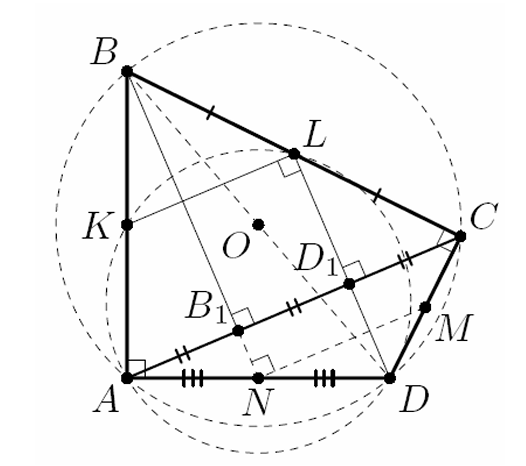
First solution. Let K, L, M, N be the midpoints of sides AB, BC, CD, DA. According to the condition, the quadrilateral AKLD is inscribed. Therefore, ∠KLD = 180° - ∠KAD = 90°. Since KL is the midline of triangle ABC and KL ∥ AC, it follows that LD ⟂ AC. Let the segments DL and AC intersect at point D1. Drop a perpendicular BB1 from point B to AC. Then BB1 ∥ LD1, which means D1 is the midpoint of segment CB1 (Thales' theorem). Furthermore, ABCD is inscribed in a circle with diameter BD; its center O implies that the projections of B and D on AC are equidistant from the midpoint of AC. Hence, CD1 = AB1. In total, AB1 = CD1 = B1D1. Therefore, B1N is the midline in triangle AD1B, so B1N ∥ DD1 and ∠D1B1N = 90°. Since NM is the midline of triangle ACD, NM ∥ AC and ∠B1NM = 90°. Consequently, points B, C, N, and M lie on a circle with diameter BM.

Olympiad diagram

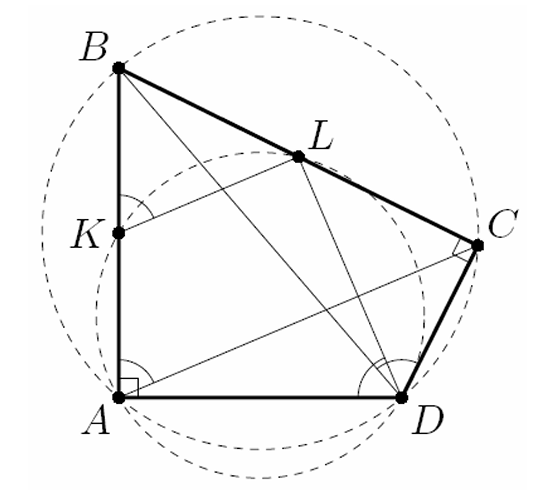
Second solution. Since KL ∥ AC and ABCD is inscribed, we have ∠BDC = ∠BAC = ∠BKL = 180° - ∠AKL. The inscribed condition of AKLD is equivalent to ∠ADL = ∠BDC, which is equivalent to ∠ADB = ∠CDL. The latter is equivalent to the similarity of ΔLCD and ΔBAD, i.e., LC / CD = AB / AD. Multiplying, we obtain AB · CD = ½ · AD · BC. Similarly, the inscribed condition of quadrilateral BNMC is derived.

Olympiad diagram

extra media extra media
ARMO 2024, Regional Round, 10.9
ID: 73 ✍️ A. Chironov, I. Bogdanov 🏷 ARMO 📅 2024 🎓 10 ★★★★★★☆☆☆☆ Medium
number theory probability proof by contradiction

Find all triples (not necessarily distinct) of natural numbers \(a, b, c\) such that each of the numbers \(a + bc, b + ca, c + ab\) is a prime divisor of the number \((a^2 + 1)(b^2 + 1)(c^2 + 1)\).

(1,1,1)

The triple \(a = b = c = 1\) is suitable. We will prove that there are no others.

1) Let \(s = (a^2 + 1)(b^2 + 1)(c^2 + 1)\) be divisible by \(pqr\), where \(p = a + bc\), \(q = b + ca\), \(r = c + ab\) (in the case when \(p, q, r\) are distinct, this follows from the condition). None of the factors \(a^2 + 1, b^2 + 1, c^2 + 1\) can be divisible by the product of two of the numbers \(p, q, r\), as it is less than this product: \(pq = (a + bc)(b + ca) > c^2 \cdot ab + ab \geq c^2 + 1\), \(pq > b^2 + 1\) and \(pq > a^2 + 1\). Therefore, each of \(a^2 + 1, b^2 + 1, c^2 + 1\) is divisible by exactly one of \(p, q, r\). Let \(a\) be the smallest of \(a, b, c\). Then \(a^2 \leq bc\) and \(1 \leq a\), so \(a^2 + 1\) can be divisible by \(p = bc + a\) only when \(a^2 = bc\) and \(a = 1\), i.e., \(a = b = c = 1\). Similarly, if \(a^2 + 1\) is divisible by \(q\) or \(r\), we again get \(a = b = c = 1\).

2) Suppose two of \(p, q, r\) coincide, say, \(p = q\). Then \(0 = q - p = b + ca - a - bc = (a - b)(c - 1)\), from which either \(a = b\) or \(c = 1\). The first case is possible only when \(a = b = 1\), otherwise \(p = a + bc = a + ac = a(a + c)\) is composite. Thus, among \(a, b, c\) there is a one, say, \(c = 1\). Then \(p = a + b\), \(q = a + b\) and \(r = ab + 1\) are prime divisors of \(s = 2(a^2 + 1)(b^2 + 1)\). If at least one of \(a, b > 1\), then \(p > 2\), and \(p = a + b\) must divide at least one of \(a^2 + 1\) and \(b^2 + 1\). Since \((a^2 + 1) - (b^2 + 1) = (a - b)(a + b)\) is divisible by \(p = a + b\), both \(a^2 + 1\) and \(b^2 + 1\) are divisible by \(p\). If \(r\) is different from \(p = q\), then \(s\) is divisible by \(pqr\) and we return to point 1). The remaining case is \(p = q = r\). Then at least two of \(a, b, c\) are equal to 1. Let \(a = b = 1\), \(p = q = r = c + 1\), \(s = 4(c^2 + 1)\). The case \(c = 1\) has already been considered. If \(c > 1\), then \(c + 1\) is an odd prime, and \(c^2 + 1\) must be divisible by \(c + 1\), but \((c^2 + 1) - (c + 1) = c(c - 1)\) is not divisible by \(c + 1\). Contradiction.

ARMO 2024, Regional Round, 10.10
ID: 74 ✍️ Ya. Shubin, G. Shubin 🏷 ARMO 📅 2024 🎓 10 ★★★★★★☆☆☆☆ Medium
logic graph theory set theory polynomials examples & counterexamples

Each of the 2024 people is either a knight or a liar. Some of them are friends with each other, and friendship is mutual. Each of them was asked about the number of friends they have, and all the answers turned out to be different integers from 0 to 2023. It is known that all knights answered the question truthfully, and all liars altered the true answer by exactly 1. What is the minimum number of liars that could be among these people?

1012

Let \(n=1012\). Represent the people as vertices of a graph; the label of a vertex is the person’s answer. Connect two vertices by an edge if the corresponding people are friends. Let \(A=\{0,\dots,n-1\}\) and \(B=\{n,\dots,2n-1\}\) be the sets of answers. Let \(d_i\) be the degree of vertex \(i\) (the number of friends). By the condition, for a knight \(d_i=i\), and for a liar \(|d_i-i|=1\). Suppose there are exactly \(x\) liars in \(A\) and exactly \(y\) in \(B\). Let \(E\) be the number of edges between \(A\) and \(B\). Then \[ E \le \sum_{i\in A} d_i \le \sum_{i=0}^{n-1} i + x \;=\; \frac{(n-1)n}{2}+x. \] On the other hand, for each \(i\in B\) at most \(n-1\) edges go inside \(B\), so at least \(d_i-(n-1)\) edges go to \(A\). Hence \[ E \ge \sum_{i\in B} (d_i-(n-1)) \;\ge\; \sum_{i=n}^{2n-1} i - y - n(n-1) = \frac{n(3n-1)}{2} - y - n(n-1) = \frac{n(n+1)}{2} - y. \] Thus \(\frac{(n-1)n}{2}+x \ge \frac{n(n+1)}{2}-y\), whence \(x+y\ge n\). Consequently, there are at least \(n\) liars.

An extremal construction for \(n=1012\) attains this bound: vertices \(0,\dots,n-1\) form an independent set; vertices \(n,\dots,2n-1\) form a clique; and \(i\in[0,n-1]\) is connected to \(j\in[n,2n-1]\) iff \(i+j\ge 2n-1\). Then each \(i\) in the first group has exactly \(i+1\) friends, and each \(j\) in the second has exactly \(j\) friends. Thus everyone in the first group is a liar and everyone in the second is a knight, and the conditions are satisfied.

ARMO 2024, Regional Round, 11.2
ID: 76 ✍️ N. Agahanov 🏷 ARMO 📅 2024 🎓 11 ★★★★★★☆☆☆☆ Medium
algebra products integer values sequences induction

Let \(x_1\lt x_2\lt \cdots \lt x_{2024}\) be an increasing sequence of natural numbers. For \(i=1,2,\dots,2024\) define \(p_i=(x_1-\tfrac{1}{x_1})(x_2-\tfrac{1}{x_2})\cdots(x_i-\tfrac{1}{x_i})\). What is the largest possible number of natural numbers among \(p_1,p_2,\dots,p_{2024}\)?

2023.

Solution 1. The value \(p_1=x_1-\frac{1}{x_1}\) is never a natural number: if \(x_1=1\), then \(p_1=0\); if \(x_1>1\), then \(x_1-\tfrac{1}{x_1}\notin\mathbb{Z}\). Hence at most \(2023\) numbers among \(p_1,\dots,p_{2024}\) can be natural.

To attain \(2023\), take \(x_1=2\), \(x_2=3\). Then \(p_2=\left(2-\tfrac{1}{2}\right)\left(3-\tfrac{1}{3}\right)=\tfrac{3}{2}\cdot\tfrac{8}{3}=4\). For \(n\ge2\) set \(x_{n+1}=p_n>x_n\). Then \(p_{n+1}=p_n\bigl(x_{n+1}-\tfrac{1}{x_{n+1}}\bigr)=p_n\bigl(p_n-\tfrac{1}{p_n}\bigr)=p_n^{2}-1\in\mathbb{N}\), so \(p_2,p_3,\dots,p_{2024}\) are natural—exactly \(2023\) numbers.

Solution 2 (telescoping). Suppose \(x_k-\tfrac{1}{x_k}=k+1-\tfrac{1}{k+1}=\tfrac{k(k+2)}{k+1}\). Then for \(i\ge2\), \(p_i=\prod_{k=1}^{i}\left(x_k-\tfrac{1}{x_k}\right)=\tfrac{1\cdot3}{2}\cdot\tfrac{2\cdot4}{3}\cdots\tfrac{i(i+2)}{i+1}=\tfrac{i(i+2)}{2}\in\mathbb{N}\). Taking \(x_1=2,x_2=3,\dots,x_{2024}=2025\) yields \(p_2,\dots,p_{2024}\in\mathbb{N}\), so the maximum is \(2023\).

ARMO 2024, Regional Round, 11.4
ID: 78 ✍️ M. Evdokimov 🏷 ARMO 📅 2024 🎓 11 ★★★★★★☆☆☆☆ Medium
planimetry areas power of a point circles geometry (misc)

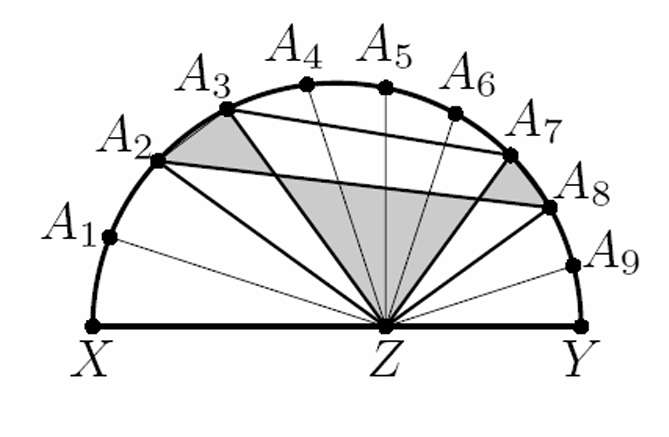
On the segment \(XY\) a semicircle is drawn with diameter \(XY\), and a point \(Z\) is chosen on this segment. Nine rays from \(Z\) divide the straight angle \(XZY\) into ten equal parts and meet the semicircle at points \(A_1,A_2,\ldots,A_9\) respectively (in the order from \(X\) to \(Y\)). Prove that the sum of the areas of triangles \(A_2ZA_3\) and \(A_7ZA_8\) equals the area of the quadrilateral \(A_2A_3A_7A_8\).

Solution. We will show that \(S(A_2ZA_8)=S(A_3ZA_7)\). The required equality follows by subtracting from both sides the area of the gray triangle with vertex at \(Z\) and then adding the areas of the two gray triangles adjacent to the chords \(A_2A_3\) and \(A_7A_8\) (see the figure).

Note that \(\angle A_2ZA_8+\angle A_3ZA_7=\tfrac{6}{10}\cdot180^{\circ}+\tfrac{4}{10}\cdot180^{\circ}=180^{\circ}\), hence the sines of these angles are equal. Therefore it suffices to prove that \(ZA_2\cdot ZA_8=ZA_3\cdot ZA_7\). We will show that both products equal \(XZ\cdot XY\). For this it is enough to establish the following lemma.

Diagram

Lemma. Let \(P\) and \(Q\) be two points on the semicircle with diameter \(XY\), let \(Z\) lie on the segment \(XY\), and suppose \(\angle XZP=\angle YZQ\). Then \(ZP\cdot ZQ=ZX\cdot ZY\).

Proof of the lemma. Reflect \(Q\) across \(XY\) to a point \(R\). Then the quadrilateral \(XPYR\) is cyclic with diameter \(XY\). By symmetry \(ZQ=ZR\) and \(\angle XZP=\angle QZY=\angle RZY\), so the points \(P,Z,R\) are collinear. Hence \(Z\) is the intersection point of the diagonals of the inscribed quadrilateral \(XPYR\); therefore \(XZ\cdot XY=PZ\cdot ZR=PZ\cdot ZQ\). This proves the lemma and completes the solution.

ARMO 2024, Regional Round, 11.5
ID: 79 ✍️ M. Antipov 🏷 ARMO 📅 2024 🎓 11 ★★★★★★☆☆☆☆ Medium
algebra equations quartic Vieta root ordering

The equation \(t^4+at^3+bt^2=(a+b)(2t-1)\) has positive solutions \(t_1\lt t_2\lt t_3\lt t_4\). Prove that \(t_1t_4>t_2t_3\).

Solution. Set \(k=-a\) and \(\ell=a+b\). Then the equation becomes \(t^4-kt^3+(k+\ell)t^2-2\ell t+\ell=0\). Note that \(k=t_1+t_2+t_3+t_4\gt 0\) and \(\ell=t_1t_2t_3t_4\gt 0\).

Rewrite it as \(t^4+\ell(t-1)^2=kt^2(t-1)\), which immediately shows that all roots are strictly greater than \(1\). Adding \(2\sqrt{\ell}\,t^2(t-1)\) to both sides gives \((t^2+u(t-1))^2=v^2t^2(t-1)\), where \(u=\sqrt{\ell}\) and \(v=\sqrt{k+2\sqrt{\ell}}\). Let \(s=\sqrt{t-1}\). We obtain the homogeneous equation \(t^2-vst+us^2=0\), whence \(t/s=c_{1,2}\) with \(c_1=(v-\sqrt{v^2-4u})/2\) and \(c_2=(v+\sqrt{v^2-4u})/2\).

Each relation \(t/s=c_i\) can be rewritten as \(t^2-c_it+c_i=0\). These quadratic equations are distinct, and each has two distinct positive roots, since the original equation has four distinct positive roots. Hence \(4\lt c_1\lt c_2\).

Since \(f(x)=x-\sqrt{x^2-4x}\) is strictly decreasing for \(x\gt 4\) (e.g., by differentiation), we have \(c_2-\sqrt{c_2^2-4c_2}\lt c_1-\sqrt{c_1^2-4c_1}\).

It is now easy to compute and order the roots:

\(t_1=\dfrac{c_2-\sqrt{c_2^2-4c_2}}{2}\;\lt\; t_2\)\(=\dfrac{c_1-\sqrt{c_1^2-4c_1}}{2}\;\lt\; t_3\)\(=\dfrac{c_1+\sqrt{c_1^2-4c_1}}{2}\;\lt\; t_4\)\(=\dfrac{c_2+\sqrt{c_2^2-4c_2}}{2}\),

hence \(t_1t_4=c_2\gt c_1=t_2t_3\), as required.

Remark. The estimate is sharp: the difference \(t_1t_4-t_2t_3\) can be made arbitrarily close to \(0\).

ARMO 2024, Regional Round, 11.10
ID: 84 ✍️ M. Didin 🏷 ARMO 📅 2024 🎓 11 ★★★★★★★☆☆☆ Hard
combinatorics number theory fractions strategy game

Let \(n\gt 100\) be a natural number. Initially the number \(1\) is written on the board. Every minute Petya represents the number currently on the board as a sum of two unequal positive reduced fractions, and Vasya keeps on the board only one of these two fractions. Prove that Petya can ensure that, after \(n\) minutes, the denominator of the remaining fraction does not exceed \(2^n+50\), regardless of Vasya’s moves.

Solution. We describe a strategy for Petya. Write \(1\) as a sum of \(2^n\) unit fractions. Split them into unequal pairs and add the numbers in each pair. Then split the \(2^{\,n-1}\) results again into unequal pairs and add in each pair, and so on, until one number remains. Since the total sum is \(1\), after \(n\) steps the remaining number is \(1\).

Assume the above process is feasible. Then Petya writes \(1\) as the sum of two numbers that were added at step \(n-1\). Vasya chooses one addend that itself is a sum of two numbers obtained at step \(n-1\), and so on. In the end one of the original \(2^n\) fractions remains.

To realize this process we need the following auxiliary statement.

Lemma. There are two 4-tuples \(a_1>a_2>a_3>a_4\) and \(b_1>b_2>b_3>b_4\). Then one can pair them into \((a_i,b_j)\) so that in each pair the numbers are distinct and the pairwise sums are all different.

Proof of the lemma. Consider cases.

\(1^{\circ}.\) \(a_1=b_1\), \(a_2=b_2\). If \(a_4\ne b_4\), w.l.o.g. \(a_3\ge b_3\), we can arrange \(a_1+b_2>b_1+a_3>a_2+b_3>a_4+b_4\). If \(a_4=b_4\) and, w.l.o.g., \(a_3\ge b_3\), arrange \(a_1+b_2>b_1+a_3>a_2+b_4>b_3+a_4\).

\(2^{\circ}.\) \(a_3=b_3\), \(a_4=b_4\) reduces to the previous case after replacing the 4-tuples by \(-a_i\) and \(-b_i\).

\(3^{\circ}.\) The pairs \((a_1,b_1)\) and \((a_2,b_2)\) are different, and so are \((a_3,b_3)\) and \((a_4,b_4)\). Then we can pair the first two pairs with each other (and do the same with the third and fourth), obtaining two sums smaller than in the first pair. If \(a_1=b_1\) or \(a_2=b_2\), take \(a_1+b_2\), \(a_2+b_1\); otherwise take \(a_1+b_1\) and \(a_2+b_2\). The lemma is proved.

Now the process from the beginning is feasible (i.e., at every step we add distinct numbers) provided we can partition the initial \(2^n\) fractions into 4-tuples so that inside each 4-tuple all fractions are pairwise distinct. Indeed, then at each step we split the 4-tuples into pairs and, by the lemma, add numbers coming from different 4-tuples. After each step the obtained sums again split into 4-tuples of pairwise distinct numbers. Continuing this for the first \(n-2\) steps, we get a 4-tuple of distinct numbers \(x_1\lt x_2\lt x_3\lt x_4\); at step \(n-1\) we add \(x_1+x_2\) and \(x_3+x_4\), and at step \(n\) these two numbers are added.

Thus it suffices to represent \(\tfrac14\) as a sum of \(2^{n-2}\) fractions of the form \(1/m\) in four different ways, each time using distinct denominators not exceeding \(2^n+50\).

First way - the sum of \(2^{\,n-2}\) equal fractions \(\dfrac{1}{2^n}\).

Construct three other representations. Among the numbers \(n,n-1,n-2,n-3,n-4,n-5\) there is at most one power of two and at most two primes (since primes greater than \(3\) leave remainders \(1\) or \(5\) mod \(6\)); remove such numbers from consideration. Any remaining number can be written as \(n-k=pt\) with \(p,t>1\) and \(t\) odd. Then \(2^n+2^k=2^k(2^p+1)q\). Take \(2^{\,n-2}-2^{\,k+p-2}\) fractions \(\dfrac{1}{2^n+2^k}\) and \(2^{\,k+p-2}\) fractions \(\dfrac{1}{2^{\,k+p}q}\). Since \(k\le5\), we have \(2^{\,k+p}q<2^n+2^k\le2^n+50\). The sum equals

\(\dfrac{2^{\,n-2}-2^{\,k+p-2}}{2^n+2^k}+\dfrac{2^{\,k+p-2}}{2^{\,k+p}q} =\tfrac14\Big(\dfrac{2^n-2^{\,k+p}}{2^n+2^k}+\dfrac{2^k(2^p+1)}{2^n+2^k}\Big)=\tfrac14.\)

Do this for three different values of \(k\). The obtained representations have no common fractions: with the first set the three new ones do not intersect, and a fraction of the form \(\dfrac{1}{2^n+2^k}\) can occur in at most one set. It remains to check that the fractions \(\dfrac{1}{2^{\,k+p}q}\) are all distinct. Suppose contrary that \(2^{\,k+p}q=2^{\,k_1+p_1}q_1\). Because \(q,q_1\) are odd, we get \(q=q_1\), a common divisor of \(2^n+2^k\) and \(2^n+2^{k_1}\). Hence \(2^k-2^{k_1}\) is divisible by \(q\), so \(q<32\). But \(p=(n-k)/t32\), a contradiction.